One of the most significant changes introduced by the EB-5 Reform and Integrity Act of 2022 was a provision that had never existed before in the program’s three-decade history: concurrent filing. For H-1B holders specifically, this change transformed EB-5 from a long-term planning tool into something closer to an immediate safety net.
The EB-5 program allows foreign nationals to invest $800,000 in a qualifying U.S. project through a licensed regional center and, upon meeting job creation requirements, obtain a green card. Before the RIA, the process was strictly sequential: file the investment petition, wait for it to be approved, and only then apply for a green card. That wait could take years, during which an H-1B holder remained entirely dependent on their employer for their right to stay and work in the United States.
Concurrent filing changed that sequence. This post explains what it is, what it actually provides, and why it is particularly valuable for H-1B professionals navigating an uncertain immigration environment.
What Concurrent Filing Is
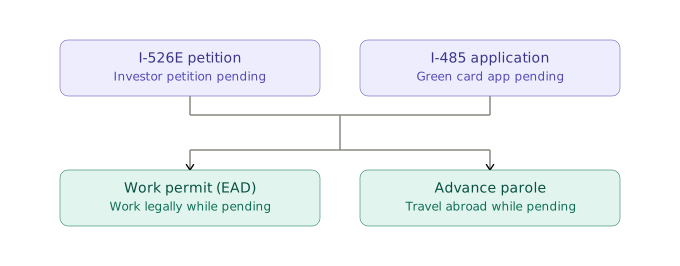
Concurrent filing means that an eligible investor can submit their I-526E (the EB-5 investment petition) and their I-485 (adjustment of status, the form that asks USCIS to convert someone from non-immigrant to immigrant status) at the same time, rather than waiting for the I-526E to be approved first.
Two conditions must be met. First, the investor must be in lawful non-immigrant status in the United States, such as H-1B or F student status. Second, a visa number must be immediately available in the investor’s EB-5 category. Right now, all EB-5 set-aside categories (rural, high-unemployment area, and infrastructure) are current, meaning visas are available for eligible investors regardless of country of birth. That availability is not guaranteed to last indefinitely, which is one reason the timing of this decision matters.
An important clarification: filing the I-485 concurrently does not mean it will be approved concurrently. The I-485 cannot be approved until the I-526E is approved. These are independent processes with independent timelines. What concurrent filing does is start the clock on the I-485 earlier, and more importantly, it unlocks two benefits that are available immediately while both petitions are pending.
The EAD: Independent Work Authorization
Alongside the I-485, an investor can file Form I-765 for an Employment Authorization Document (EAD). This card grants the right to work in the United States independent of H-1B status, independent of any employer, and independent of any employer’s decision to maintain, transfer, or withdraw sponsorship.
For an H-1B holder, this is a meaningful shift. H-1B work authorization is tied to a specific employer filing a petition on your behalf. If that employer conducts layoffs, is acquired, or simply decides not to renew your petition, your work authorization is at risk. The EAD removes that dependency. It does not replace the H-1B, but it provides an independent fallback that exists in parallel.
In practice, immigration attorneys advise most H-1B holders to maintain their H-1B status alongside the EAD where possible, rather than relying on the EAD exclusively. The reason is straightforward: if something goes wrong with the I-485 or I-526E, the H-1B remains as a backup. The EAD is not a replacement for the H-1B; it is an additional layer of protection.
Advance Parole: Travel Without the Consulate
Alongside the I-765, applicants can file Form I-131 for advance parole, which grants the right to travel in and out of the United States without going through consular processing. These two documents are sometimes issued together on a single combo card, though USCIS more often approves the EAD first.
For H-1B holders, this has a specific practical value. An H-1B visa stamp in your passport is what allows re-entry into the United States after international travel. If that visa has expired and you need to travel, the standard process requires booking a consulate appointment in your home country, attending an interview (now required in-person), and waiting two to three weeks at minimum to receive the stamped visa before you can return. Advance parole eliminates that process. It serves as a travel document in place of the H-1B visa stamp, allowing you to return without a consulate visit.
Critically, using advance parole in place of an H-1B visa does not extinguish the underlying H-1B status. H-1B holders can continue to maintain and extend their H-1B while using advance parole as their travel document. This preserves the hedge: if the adjustment of status application encounters a problem, the H-1B status remains intact as a fallback.
What This Means If You Are Laid Off
The practical significance of concurrent filing becomes clearest in a scenario that is increasingly common: an H-1B holder loses their job. Without a pending I-485, the options are limited. Find a new employer who will file an H-1B petition immediately, or leave the country. The timeline for finding new sponsorship is compressed and uncertain.
With a pending I-485 and an active EAD, the situation is different. The EAD provides an independent right to work in the United States that does not depend on finding a new H-1B sponsor. The individual can take time to find the right position, pursue independent work, or even start their own business without the immigration clock forcing a rushed decision. As one immigration attorney in the EB-5 space described it: “you can’t overstate” the psychological value of having that fallback in place.
EB-5 Does Not Foreclose Other Pathways
A common concern among H-1B holders considering EB-5 is whether pursuing it closes off employer-sponsored green card options. It does not. An investor can hold as many bases of eligibility for permanent residency as they qualify for. Pursuing EB-5 while an employer simultaneously files a PERM or I-140 is entirely permissible. Only one green card is ever issued, but there is no rule against building multiple pathways toward it.
This makes the decision to pursue EB-5 an additive one rather than a replacement. For H-1B holders whose employers are willing to sponsor them, EB-5 adds independence and a safety net without requiring them to abandon employer-based options. For those whose employers are not sponsoring, EB-5 provides a path that does not depend on that decision changing.
The next post in this series looks at the physician-specific immigration challenges that make the EB-5 timeline particularly important to start early, including J-1 training, waiver competition, and the risk of exhausting H-1B time before residency training is complete.
Ready to Explore EB-5?
CanAm Enterprises has raised $4.1B+ in EB-5 capital, facilitated 9,400+ permanent green cards, and maintained a 100% USCIS project approval rate across 75+ projects spanning more than 30 years. Contact our team to learn more about current projects and whether EB-5 fits your immigration strategy.
Contact us at info@canamenterprises.com or +1 (212) 668-0690.
About the Speakers
Peter Calabrese, CEO, CanAm Investor Services
Peter Calabrese is CEO of CanAm Investor Services, the FINRA-registered broker-dealer affiliate of CanAm Enterprises. He works closely with prospective investors navigating the EB-5 process and advises on project selection and investment structuring.
Nicolai Hinrichsen, Managing Partner, Miller Mayer EB-5 Practice
Nicolai Hinrichsen is Managing Partner of Miller Mayer’s EB-5 practice, one of the largest EB-5 law firms by volume. Miller Mayer has been active in the EB-5 program since its inception in 1993.
Kristal Ozmun, Managing Partner, Miller Mayer General Immigration Practice
Kristal Ozmun is Managing Partner of Miller Mayer’s General Immigration Practice Group. She advises clients across H-1B, J-1, adjustment of status, and EB-5 matters, with a particular focus on physicians and other professionals navigating complex immigration pathways.