EB-5 Data Party with Lee Li & Friends | Part 4 of 5
Since the Reform and Integrity Act (RIA) took effect in March 2022, pre-RIA and post-RIA investors have shared the same annual EB-5 visa allocation, with the older backlog consuming the majority of available numbers. That is beginning to change. Visa Bulletin data presented at the 2026 IIUSA EB-5 Industry Forum shows that unreserved category final action dates for both China and India have advanced significantly in fiscal year 2026. For India, the movement is so pronounced that Charlie Oppenheim, who spent 23 years as Chief of Immigrant Visa Control at the U.S. Department of State, estimated the pre-RIA backlog may already be nearly gone.
When the pre-RIA queue clears, the full annual EB-5 allocation becomes available to post-RIA investors. The implications are significant, but so is one unresolved complication: a structural mismatch between how consular processing and adjustment of status (AOS) investors can navigate the transition, which threatens to leave a large portion of Indian investors unable to take advantage of the opening.
How Far the Dates Have Moved
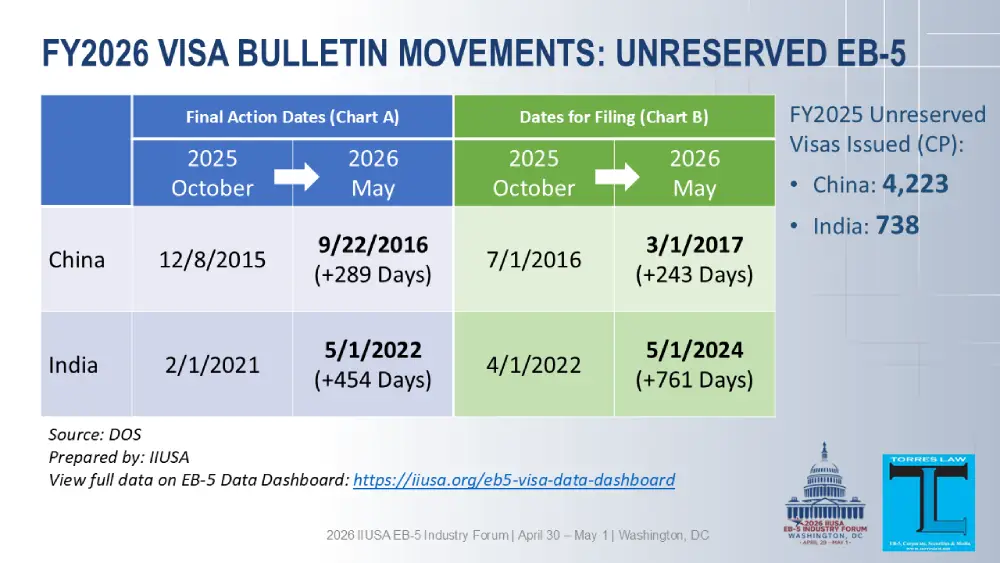
Lee Li, IIUSA’s Director of Policy Research & Data Analytics, walked through the movement of unreserved category final action dates in fiscal year 2026. For China, the Chart A final action date advanced from 12/8/2015 at the start of the fiscal year to 9/22/2016 by the May 2026 bulletin, a gain of 289 days. Chart B for China moved from 7/1/2016 to 3/1/2017, an advance of 243 days, signaling that investors who filed in the peak years of 2015 through early 2017 are being processed through now. In FY2025, 4,223 Chinese unreserved visas were issued through consular processing, reflecting the volume of cases moving through the queue.
For India, the movement is more dramatic. Chart A advanced from 2/1/2021 to 5/1/2022, a gain of 454 days. Chart B moved from 4/1/2022 to 5/1/2024, an advance of 761 days. As Lee Li pointed out, the RIA was signed in March 2022, which places the India Chart A date essentially at the boundary between the pre-RIA and post-RIA eras. By comparison, only 738 Indian unreserved visas were issued through consular processing in FY2025, reflecting how much smaller India’s pre-RIA backlog has become relative to China’s.
Charlie’s Estimates: India Almost Done, China Years Away
Asked to estimate when each country’s pre-RIA backlog would fully clear, Charlie offered a directional view while acknowledging the data limitations.
For India, his assessment was striking: “I think the India pre-RIA backlog may be almost eliminated now. It should be eliminated early in fiscal 2027, if it hasn’t already.” He noted this as a genuinely positive development for Indian investors in reserved (post-RIA) categories, because it opens the possibility of switching to unreserved processing, where the backlog no longer exists.
For China, the timeline is considerably longer. “Potentially five to six years before that backlog is cleaned out,” Charlie estimated, reflecting the much larger volume of pre-RIA Chinese filings and the slower pace of date advancement in that category.
The divergence between the two countries matters for how post-RIA investors should think about their options. Indian investors stand to benefit from the backlog clearing soon. Chinese investors face a longer wait before the dynamics shift in their favor.
What Backlog Clearance Unlocks
The practical significance of the pre-RIA backlog clearing is about visa number availability. Reserved category visas (rural, HUA, infrastructure) represent only 32% of the total annual EB-5 allocation. The remaining 68% flows to pre-RIA investors still working through the unreserved queue.
As Lee Li explained: “When the pre-RIA backlog is cleared, we are not just looking at thirty-two percent of the reserved category. We are looking at one hundred percent of all the visas available to the EB-5 category.” That shift changes the retrogression math for post-RIA investors significantly, particularly for Indian applicants who are already close to the transition.
For Indian reserved category applicants specifically, the clearing of the pre-RIA unreserved backlog also opens a more immediate option: opting into unreserved processing, where the India date is now approaching current. Charlie noted this “would free up hundreds of numbers that could be made available to Indian reserved applicants. A very nice benefit for Indian applicants.”
[IMAGE: Simple diagram showing pre-RIA vs. post-RIA visa allocation split (32% reserved vs. 68% unreserved) and what shifts when the pre-RIA backlog clears]
Caption suggestion: Reserved categories currently represent 32% of the annual EB-5 allocation. When the pre-RIA backlog clears, post-RIA investors gain access to the full pool.
The AOS Problem: A Structural Gap That Needs Resolution
The category-switching benefit described above comes with a significant caveat. The ability to move from a reserved category to unreserved processing currently applies only to investors using consular processing. Investors who filed through adjustment of status (AOS), a large and growing segment of the Indian market, cannot make the switch under current USCIS policy.
Christine Chen, COO of CanAm Enterprises, flagged this as one of the most pressing unresolved issues in the post-RIA environment. “That has been the case with consular cases, but as far as I know, it is not yet possible for AOS cases. And especially given the extremely high number of India AOS cases, the idea that all those post-RIA filings that were in the concurrent category will have to stay in the reserved rural category and cannot pivot to the unreserved is just a really big problem.”
India has a disproportionately large share of AOS concurrent filers, meaning a significant population of Indian investors is locked into the reserved rural category with no current path to take advantage of the clearing unreserved backlog. Christine noted that both IIUSA and the AILA EB-5 Committee have been pressing USCIS for guidance, with the expectation the agency will eventually allow the switch. No clear timeline has been provided.
“Imagining a scenario where an unreserved India filing can get a visa earlier than someone post-RIA in a reserved category would throw the entire industry on its head,” Christine said. “I hope that all the immigration attorneys who keep pushing for clarity on this issue get some success, because it’s really important to this industry.”
What to Watch and What It Means for Investors
For investors and their attorneys, the pre-RIA backlog story has three distinct threads worth tracking:
- India’s unreserved date approaching current is the most immediate signal. When Chart A reaches 2022 or beyond, the pre-RIA backlog is effectively cleared. Indian consular processing investors in reserved categories should evaluate whether switching to unreserved makes sense, in consultation with their attorneys.
- China’s date is moving, but more slowly. A five-to-six-year runway gives Chinese investors more time, but the direction is positive, particularly as the 2016–2017 cohort clears.
- The AOS category-switching issue is unresolved and consequential. Indian AOS investors should monitor this closely and track any USCIS guidance that may emerge.
Lee Li put the broader opportunity concisely: once the pre-RIA backlog clears, the structural constraints that have defined EB-5 visa availability for a decade begin to lift. How quickly that benefits post-RIA investors will depend on USCIS adjudication pace, resolution of the AOS policy question, and how many rest-of-world investors opt into unreserved processing in the interim.
About This Panel
This post is based on a session from the 2026 IIUSA EB-5 Industry Forum, presented by Lee Li, Christine Chen, and Charlie Oppenheim. CanAm thanks IIUSA for its continued work gathering and publishing EB-5 data that benefits the entire industry. The full panel recording is available to IIUSA members through the IIUSA access library.
Learn More About EB-5 with CanAm
CanAm Enterprises has navigated every major shift in the EB-5 program over 30+ years, including the transition from pre-RIA to post-RIA structures. With $4.1B+ in EB-5 capital raised, $2.5B+ repaid, and 9,400+ permanent green cards issued across 75+ funded projects, our team helps investors from all source markets understand their options as visa availability evolves.
Contact us at info@canamenterprises.com or +1 (212) 668-0690.
About the Panelists
Christine Chen, Chief Operating Officer, CanAm Enterprises
Christine Chen serves as COO of CanAm Enterprises, one of the longest-operating regional centers in the EB-5 industry. She oversees operations and investor relations across a portfolio that has raised over $4B in EB-5 capital and facilitated more than 17,100 conditional green cards.
Charlie Oppenheim, Consultant, WR Immigration
Charlie Oppenheim spent 23 years as Chief of Immigrant Visa Control at the U.S. Department of State, where he oversaw the Visa Bulletin and movement of final action dates across all immigrant visa categories. He now consults at WR Immigration, advising on visa availability and priority date strategy.
Lee Li, Director of Policy Research & Data Analytics, IIUSA
Lee Li is the Director of Policy Research & Data Analytics at IIUSA, where he leads the organization’s data collection and analysis efforts. His research provides the EB-5 industry with critical insights into filing trends, processing times, and program performance.