Since the Reform and Integrity Act (RIA) took effect in March 2022, more than 14,500 EB-5 petitions have been filed, representing over $11 billion in capital raised and an estimated 232,000 jobs created. But the story behind those totals is as important as the numbers themselves. Which countries are driving demand? What is motivating investors in each market? And what do those patterns suggest about where EB-5 is headed?
At the 2026 IIUSA EB-5 Industry Forum, Lee Li, IIUSA’s Director of Policy Research & Data Analytics, walked through the latest country-of-origin data. Christine Chen, COO of CanAm Enterprises, added market-level context from her experience working with investors across Asia, Latin America, and beyond. Together, they provide a picture of a program whose investor base is broader, more diverse, and more strategically motivated than at any point in its history.
The Overall Demand Picture: China Leads, India Surges, Rest of World Expands
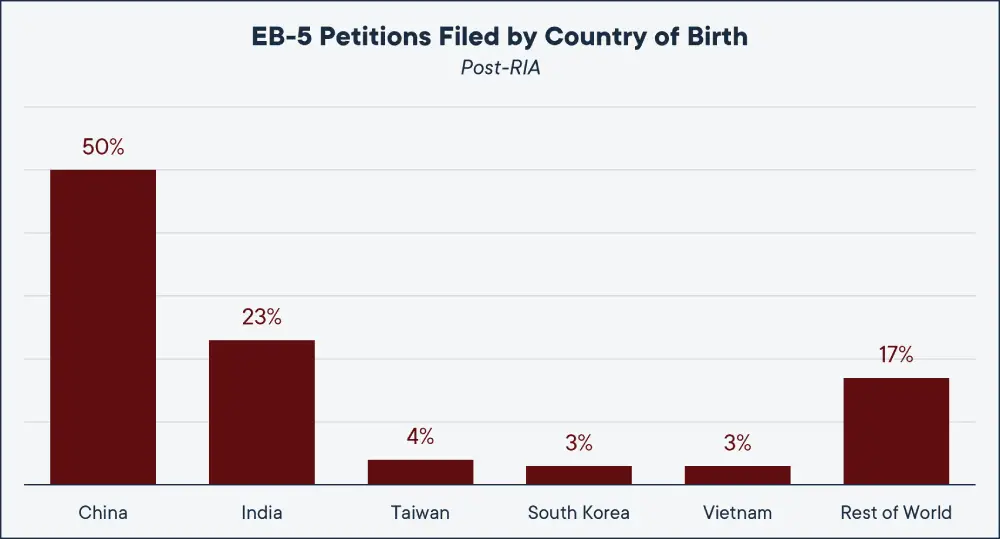
China remains the largest source of EB-5 petitions, accounting for approximately 50% of all filings since the RIA. India follows at 23%, with Taiwan at 4%, South Korea and Vietnam each at 3%, and the remaining 17% distributed across the rest of the world.
The headline trend, however, is growth. Every major market has seen an increase in filings compared to the pre-RIA baseline. India and South Korea stand out with triple-digit growth in fiscal year 2025 relative to earlier years. And the share of filings coming from outside China and India has expanded considerably: before the RIA, China and India together typically accounted for 85 to 90% of all petitions. That combined share has since declined to around 75%, reflecting a meaningful broadening of the investor base.
India: Urgency, Pathways, and Ongoing Complexity
India’s growth in EB-5 filings has been steep. The market roughly doubled year over year for several consecutive years, with the largest increases coming in fiscal years 2024 and 2025.
Christine attributed much of this acceleration to two converging forces. First, other U.S. visa pathways have become increasingly constrained for Indian nationals, making EB-5 a more attractive alternative. Second, a spike in USCIS adjudications in the fourth quarter of 2024 created concern that retrogression and the end of concurrent filing eligibility might be approaching, prompting a wave of filings from investors who had been considering EB-5 but had not yet committed.
A third factor, she noted, was a period of relative clarity around source-of-funds documentation for Indian investors. Pulling capital from multiple sources, as many Indian investors must do, is a complicated process. When certain approaches proved successful and established precedent, other prospective investors followed the same path, creating a clustering effect in filings.
That clarity, however, has since shifted. “We’re in another moment of flux with USCIS adjudications on source of funds,” Christine noted. Indian demand remains strong, but practitioners are navigating a less predictable adjudication environment than existed during the 2024 surge.
India is also notable for its heavy use of adjustment of status (AOS) concurrent filing. Among CanAm’s investor base, Christine estimated that a larger share of Indian investors are filing concurrently than in any other market, a pattern that carries its own implications for processing timelines and visa number usage.
South Korea: A Cautious Market Gaining Confidence
South Korea’s growth trajectory looks different from India’s. The market went quiet early in the RIA period as investors waited to see how the new framework would function. As approvals accumulated and Korean investors at consular posts began receiving visas, confidence returned.
“They are responsive to seeing a track record of success happening for South Koreans,” Christine explained. Unlike the Indian market, South Korean investors predominantly use consular processing rather than AOS. The market tends to move deliberately, but once momentum builds, it sustains.
One headwind to watch: the Korean won has depreciated against the U.S. dollar, and the January 2027 minimum investment increase will hit markets with weakened currencies harder. Vietnam faces a similar dynamic, where capital transfer costs create additional friction for families committing the required investment amount.
Rest of World: Geopolitics Driving New Markets
The most structurally interesting development in post-RIA EB-5 demand may be what’s happening outside the established source markets. In fiscal year 2022, investors from outside China and India accounted for 42% of all filings. That share has settled to around 25% in more recent years, but the absolute numbers have grown and the geographic composition has shifted.
Mexico and Canada have both seen larger filing volumes, driven in part by geopolitical uncertainty in their domestic environments. Christine noted that the industry is still catching up to this demand. “There are a lot of geopolitics going on within those countries that are driving that interest, and I think we’re all trying to catch up and respond.”
Charlie Oppenheim added an important clarification for rest-of-world investors specifically: even if a final action date were imposed in a reserved EB-5 category, investors from outside China and India who are doing consular processing retain the option to switch to unreserved processing, where they have always remained current. “The rest of world applicants have the best of both worlds,” Charlie noted. “I have no concern with rest of world applicants” at this time.
The diversification of the investor base has also created a division of expertise among regional centers. Investor conversations in newer markets tend to be longer and more relationship-intensive. As Christine put it, “you have to spend the time talking to them and their particular sensitivities, and it benefits to focus on certain markets and really become experts in those spaces.”
What Investor Demand Patterns Mean for Project Selection
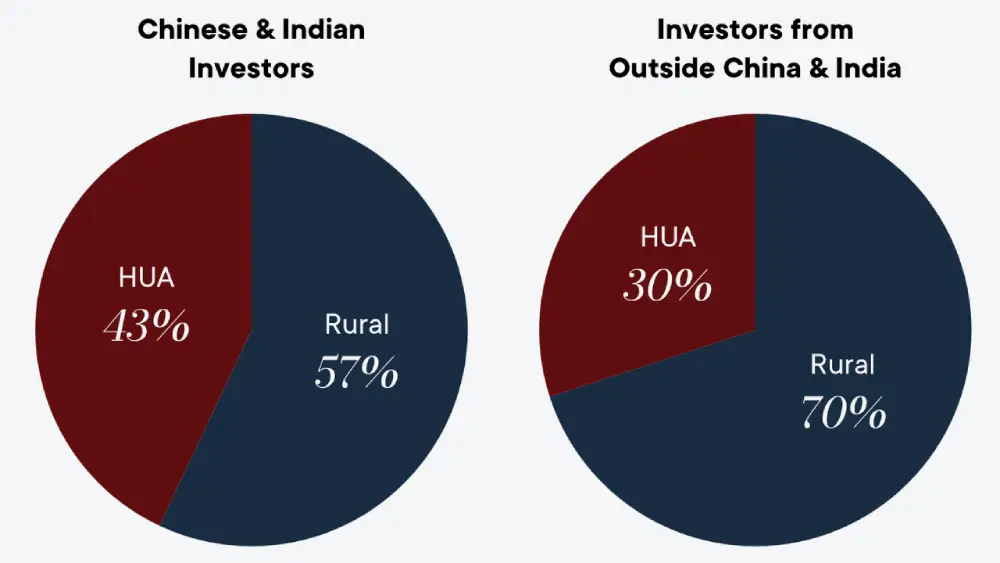
The demand data also maps onto project-type preferences in ways that matter for investors making decisions now. Among Chinese and Indian investors, 57% have chosen rural projects over HUA, reflecting the priority processing incentive and concern about eventual retrogression. Among investors from outside China and India, HUA projects still dominate at nearly 70%, in part because those investors face no meaningful retrogression risk in the foreseeable future and have more flexibility in choosing between categories.
For investors evaluating their options, understanding which market you come from, and what that means for your processing pathway, is as important as understanding the projects themselves. The demand trends make clear that the EB-5 investor community in 2026 is not a monolith. Different markets bring different constraints, different timelines, and different optimal strategies.
About This Panel
This post is based on a session from the 2026 IIUSA EB-5 Industry Forum, presented by Lee Li, Christine Chen, and Charlie Oppenheim. CanAm thanks IIUSA for its ongoing work collecting and publishing EB-5 program data. The full panel recording is available to IIUSA members through the IIUSA access library.
Learn More About EB-5 Investment Opportunities with CanAm
CanAm Enterprises has worked with investors from more than 90 countries over 30+ years, with $4B+ in EB-5 capital raised, $2.5B+ repaid, and 9,300+ permanent green cards issued across 75+ funded projects. Our team works with investors across all major source markets to help them find the right project and pathway for their situation.
Contact us at info@canamenterprises.com or +1 (212) 668-0690.
About the Panelists
Christine Chen, Chief Operating Officer, CanAm Enterprises
Christine Chen serves as COO of CanAm Enterprises, one of the longest-operating regional centers in the EB-5 industry. She oversees operations and investor relations across a portfolio that has raised over $4B in EB-5 capital and facilitated more than 17,100 conditional green cards.
Charlie Oppenheim, Consultant, WR Immigration
Charlie Oppenheim spent 23 years as Chief of Immigrant Visa Control at the U.S. Department of State, where he oversaw the Visa Bulletin and movement of final action dates across all immigrant visa categories. He now consults at WR Immigration, advising on visa availability and priority date strategy.
Lee Li, Director of Policy Research & Data Analytics, IIUSA
Lee Li is the Director of Policy Research & Data Analytics at IIUSA, where he leads the organization’s data collection and analysis efforts. His research provides the EB-5 industry with critical insights into filing trends, processing times, and program performance.