EB-5 Data Party with Lee Li & Friends | Part 1 of 5
For EB-5 investors, the monthly Visa Bulletin can feel like a cryptic document that alternately brings relief or anxiety. Dates move. Categories go current. Then they retrogress. What does it all mean, and when should investors actually start paying attention?
At the 2026 IIUSA EB-5 Industry Forum, Charlie Oppenheim, who spent 23 years as Chief of Immigrant Visa Control at the U.S. Department of State and now consults at WR Immigration, walked through the mechanics of the Visa Bulletin in detail. His explanation, delivered alongside CanAm COO Christine Chen and IIUSA data researcher Lee Li, gives investors a practical framework for understanding what matters, what to monitor, and what the current bulletin signals.
What the Visa Bulletin Actually Controls
The Visa Bulletin, published monthly by the U.S. Department of State, governs when immigrant visa numbers are available for use. For EB-5 investors, it determines when they can take the final steps toward obtaining a green card, whether through consular processing abroad or adjustment of status (AOS) in the United States.
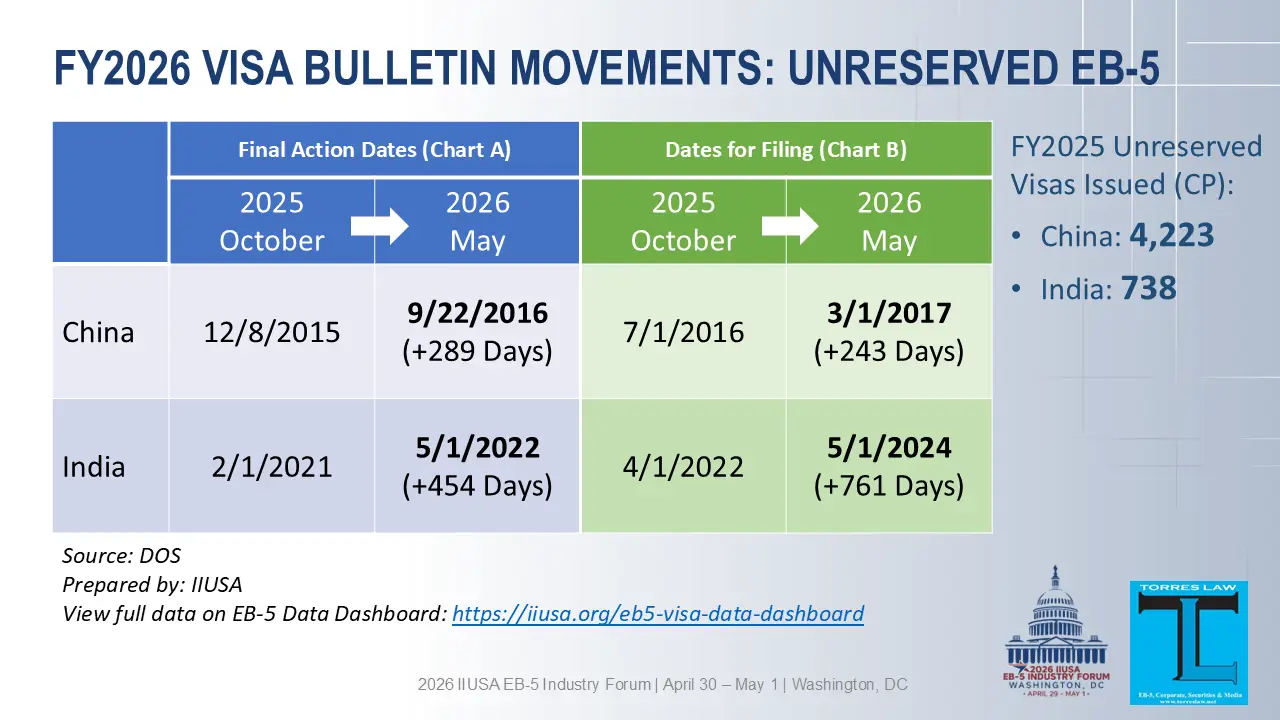
The bulletin contains two charts that serve different purposes:
- Chart A (Final Action Dates): This is the hard cutoff. An investor’s priority date must be earlier than the date listed in Chart A before USCIS or a consulate will take final action on a case.
- Chart B (Dates for Filing): When USCIS authorizes its use, Chart B allows investors to file for adjustment of status or submit final documentation even before their Chart A date is current. It reflects where the State Department expects dates to be at year-end, not where they are today.
The distinction matters. A date appearing in Chart B is an indication of the trajectory, not a guarantee of immediate availability for final action.
How Final Action Dates Get Set: The 27% Rule
A final action date is imposed in a visa category when demand threatens to exceed the annual supply. The mechanism is more precise than most people realize.
Under the Immigration and Nationality Act, the government is required to manage number use so that no more than 27% of the annual visa limit is consumed in each of the first three quarters of the fiscal year. This prevents the entire year’s allocation from being exhausted in the first few months.
As Charlie explained: “A final action date should only be imposed when the amount of visa numbers which have already been used and can reasonably be expected to be used in the coming months will exceed the total.” Dates get set on a rolling quarterly basis. If usage in a given quarter is on pace to hit the 27% threshold a date gets imposed. If not, the category remains current.
For the reserved EB-5 categories, this quarterly evaluation is what investors and their attorneys should track. As of the May 2026 Visa Bulletin, no final action dates have been imposed for rural, high unemployment area (HUA), or infrastructure categories.
Why the Note Section May Be the Most Important Part of the Bulletin
Most investors focus on the dates. Charlie’s advice is to look somewhere else first: the note section.
“The State Department should, and I always did, publish a notice in the Visa Bulletin at least one to two months before they see any type of negative action in any category,” he explained. “So the fact that we saw nothing in the May bulletin indicates definitely for June it should remain current and most likely July.”
This advance notice practice means investors and their attorneys will not be caught off guard by a sudden date imposition. When a date is coming, the bulletin will say so, in the notes, before it happens. The absence of such a note is itself informative.
Lee Li reinforced the takeaway: “Before a date would be established for the final action date, there will be a warning in the Visa Bulletin, one or two months in advance. So no more surprise. That’s why we always need to pay attention to the note section.”
Chart B Will Move Before Chart A Does
One key insight from Charlie’s presentation is that investors tracking reserved category availability should watch Chart B closely, because it will reflect developing conditions before Chart A does.
“I believe that Chart B will list dates in the reserved category well in advance of anything being listed in Chart A,” he said. “Chart B reflects where the State Department, in consultation with USCIS, believes the final action date will be at the end of that fiscal year.”
In practical terms: if a date appears in Chart B for the rural or HUA category, it signals that the State Department is anticipating the category will tighten. A Chart A date would follow. The sequence, as Lee Li summarized it, runs from note in the bulletin, to a Chart B date, to a Chart A final action date. All three must appear before a date is truly in effect for final action purposes.
As of the May 2026 bulletin, none of the three reserved EB-5 categories (rural, HUA, or infrastructure) have dates listed in either Chart A or Chart B.
What This Means for EB-5 Investors Right Now
Based on the panel discussion and available data, the picture for 2026 is stable but bears watching:
- No final action dates are anticipated for any reserved EB-5 category in 2026, based on current number usage trends.
- The absence of any note in the May 2026 bulletin strongly suggests June, and likely July, will remain current for reserved categories.
- Rural category investors (particularly from China and India) should monitor the bulletin most closely, as rural adjudications have been prioritized by USCIS and usage in that category is growing.
- HUA category investors are in a different position: because USCIS has been adjudicating far fewer HUA petitions, demand for HUA visa numbers has been limited, and a final action date in that category is not expected in the foreseeable future.
The broader message from Charlie is one of process over panic: the Visa Bulletin communicates in advance, through the note section and through Chart B, before any final action date impacts investors. Investors and attorneys who understand that communication sequence are better positioned than those reacting to headlines.
About This Panel
This post is based on a session from the 2026 IIUSA EB-5 Industry Forum, presented by Lee Li, Christine Chen, and Charlie Oppenheim. CanAm thanks IIUSA for convening this discussion and making industry data more accessible. The full panel recording is available to IIUSA members through the IIUSA access library.
Explore EB-5 Investment Opportunities with CanAm
CanAm Enterprises has been a leader in EB-5 investment for 30+ years, with $4B+ in EB-5 capital raised, $2.5B+ repaid, and 9,300+ permanent green cards issued across 75+ funded projects. Our team helps prospective investors understand visa timing, project selection, and the full EB-5 process.
Contact us at info@canamenterprises.com or +1 (212) 668-0690.
About the Panelists
Christine Chen, Chief Operating Officer, CanAm Enterprises
Christine Chen serves as COO of CanAm Enterprises, one of the longest-operating regional centers in the EB-5 industry. She oversees operations and investor relations across a portfolio that has raised over $4B in EB-5 capital and facilitated more than 17,100 conditional green cards.
Charlie Oppenheim, Director of Visa Consulting, WR Immigration
Charlie Oppenheim spent 23 years as Chief of Immigrant Visa Control at the U.S. Department of State, where he oversaw the Visa Bulletin and movement of final action dates across all immigrant visa categories. He now consults at WR Immigration, advising on visa availability and priority date strategy.
Lee Li, Director of Policy Research & Data Analytics, IIUSA
Lee Li is the Director of Policy Research & Data Analytics at IIUSA, where he leads the organization’s data collection and analysis efforts. His research provides the EB-5 industry with critical insights into filing trends, processing times, and program performance.