When regional centers prepare an I-956F petition for USCIS, they’re compiling what Walter Gindin, General Counsel at CanAm Enterprises, describes as a “robust, fulsome application” that can span hundreds of pages. For EB-5 investors, understanding the contents of an I-956F package offers important insight into what distinguishes thoroughly prepared projects from those that may face challenges.
The I-956F—introduced under the EB-5 Reform and Integrity Act of 2022 (RIA)—replaced the previous I-924 exemplar process. While investors don’t need to wait for I-956F approval to file their I-526E petitions, USCIS cannot approve an investor’s petition until the underlying I-956F receives approval.
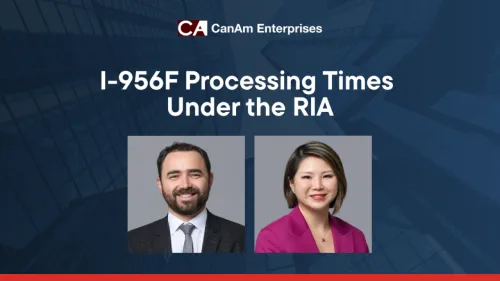
In a recent webinar, Min Wu (Head of Sales at CanAm) and Walter Gindin discussed what comprises these extensive filing packages.
Inside the I-956F Filing: The Three Pillars Every Regional Center Must Submit
The statute outlines three primary documentation categories: the comprehensive business plan, the economic impact analysis (job study), and the offering documentation. Each demonstrates to USCIS that the proposed project meets program requirements and has reasonable prospects of success.
- The Comprehensive Business Plan
At the heart of every I-956F filing sits a detailed business plan describing the entire project and investment structure. This document must be comprehensive and credible, meeting “Matter of Ho compliance” standards established through USCIS precedent.
The business plan typically includes exhibits such as project financing documentation, construction budgets and timelines, letters from general contractors, governmental permits, and information about the development team’s expertise.
Walter emphasizes that CanAm writes business plans in-house. “We truly understand what this project is all about from the beginning, all the way until we file the F,” he explains. This allows CanAm to address each project’s characteristics and potential USCIS concerns proactively.
- The Economic Impact Analysis (Job Study)
The job study demonstrates how the project will create the required number of jobs. Under the RIA, job creation methodology changed from the pre-RIA period, and USCIS carefully scrutinizes these analyses for credibility and regulatory compliance.
The analysis must align with the project’s budget and construction timeline. As Walter notes, “The budget and the schedule will tie into the jobs.” Any inconsistencies can trigger requests for evidence (RFEs) or denials.
For rural or targeted employment area (TEA) projects, regional centers must also submit a T-8 letter establishing eligibility for priority processing and lower investment thresholds.
- Offering Documentation
The third pillar consists of offering documents—the Private Placement Memorandum (PPM) and related materials. These documents provide investors with comprehensive disclosure, establish the New Commercial Enterprise (NCE) legal structure, document capital flow to the job-creating entity (JCE), and demonstrate securities regulations compliance.
These aren’t supplementary materials—USCIS reviews them to understand the complete investment structure and ensure investor funds will be deployed as described.
Beyond the Big Three: Additional I-956F Filing Requirements
While the business plan, job study, and offering documents form the foundation of the I-956F package, regional centers must include several additional categories of documentation to complete the filing.
SEC Filings
For projects raising capital within the United States, regional centers must file Form D with the Securities and Exchange Commission and include proof of SEC acceptance. This ensures EB-5 offerings comply with federal securities regulations.
Escrow and Administrative Agent Documentation
The RIA introduced enhanced escrow and fund monitoring requirements. Regional centers must document that investor funds will be held in escrow until I-526E approval and that proper administrative oversight exists.
Capital Stack Documentation
Perhaps no element receives more scrutiny than the capital stack—the complete picture of project financing. The I-956F must show how EB-5 capital fits alongside any senior loans, equity, or government financing.
Walter emphasizes having financing commitments in place: “If the financing is not in place at the time of your file, USCIS will issue maybe an RFE. Maybe they’ll issue a [notice of intent to deny].” If financing isn’t secured at filing, there must be a reasonable plan and short timeframe to secure it.
The I-956F’s Interconnected Structure: Why Consistency Matters
A critical aspect of I-956F preparation is the interconnected nature of all documents—each element must align with and support the others.
The construction budget must support job creation projections. The timeline must be realistic. The offering documents must accurately reflect the capital structure. Any inconsistencies raise red flags for USCIS adjudicators.
To demonstrate reasonableness, CanAm works with development sponsors and general contractors to provide not only budgets and schedules, but also letters confirming these estimates are credible at filing.
This coordination requirement is why thorough I-956F preparation takes time. As Walter notes, CanAm’s “primary goal is to get that approval without an RFE, without a [notice of intent to deny], and we want to give them the most comprehensive, credible application.”
Preparing a Successful I-956F: Quality Over Speed
CanAm’s approach prioritizes thoroughness over speed. “We don’t want to put any project on the market or file the petition to USCIS unless we feel comfortable that every element of the project is almost ready,” Min explains.
Rather than experimenting with novel structures, CanAm relies on proven documentation strategies refined over three decades. The results validate this approach: 15 I-956F approvals under the RIA, most within four to nine months.
Understanding I-956F Documentation Matters for Investors
While EB-5 investors don’t prepare I-956F packages themselves, understanding what goes into these filings provides valuable context for evaluating regional centers and projects. The comprehensiveness isn’t bureaucratic excess—it ensures projects have genuine success prospects.
Regional centers that invest time and expertise to prepare thorough I-956F packages demonstrate commitment to both regulatory compliance and investor protection. For investors, choosing projects backed by well-prepared filings means choosing sponsors who understand USCIS requirements and have structured offerings to withstand regulatory scrutiny.
Partner with a Regional Center That Gets I-956F Approvals
Understanding what goes into an I-956F filing package is the first step—choosing a regional center with proven expertise is what matters most. CanAm Enterprises brings three decades of EB-5 experience and a track record that speaks to our commitment to quality documentation:
- $3.9+ billion raised in EB-5 capital across 75+ projects
- $2.5+ billion in capital successfully returned to investors
- 16,900+ conditional green cards issued to CanAm investors
- 9,300+ permanent green cards issued—demonstrating successful I-829 petition outcomes
- 15 I-956F approvals under the new RIA—with most approved within 4-9 months
- 100% USCIS project approval rate—every project we’ve sponsored has been approved
Our legal team doesn’t rush projects to market. We invest the time needed to prepare comprehensive, credible I-956F packages that address USCIS requirements from the outset, reducing RFE risk and positioning investor petitions for success.
Whether you’re evaluating rural projects, high-unemployment area investments, or infrastructure opportunities, our team provides transparent guidance throughout your EB-5 journey.
Ready to learn more about CanAm’s current projects and how our I-956F preparation process protects your investment?
Contact our sales team today to discuss your EB-5 options and get personalized guidance on choosing projects backed by thorough documentation and proven regional center expertise.
Contact us at info@canamenterprises.com or +1 (212) 668-0690.
About the Contributors
Walter S. Gindin, General Counsel
Walter S. Gindin is General Counsel at CanAm Enterprises. Mr. Gindin oversees all EB-5 and corporate legal matters at CanAm and provides strategic guidance and consultation to CanAm’s executives and senior management. He earned a bachelor’s degree in economics and a master’s degree in political science from New York University. He earned his Juris Doctor (with Distinction) from the University of Iowa College of Law where he served as an Editor on the Iowa Law Review. He is a member of the EB-5 Investor Committee of the American Immigration Lawyers Association (AILA).
Min Wu, Head of Sales
Min Wu is Head of Sales at CanAm Enterprises. Ms. Wu manages CanAm’s global sales team across Asia, India, the Middle East, South America, and the U.S., focusing on maintaining and growing CanAm’s core network of institutional partners, including global law firms, immigration agencies, private banks, and family offices. Since joining CanAm in early 2016, Ms. Wu has worked extensively with investors and consultants worldwide, assisting them through their entire EB-5 investment cycle. Prior to CanAm, she had more than 10 years of experience as a financial analyst and institutional sales manager. Ms. Wu is a Chartered Financial Analyst and holds FINRA Series 7 and 63 licenses. She earned a master’s degree in financial management in the U.S. and a bachelor’s degree in accounting & taxation in China.