For EB-5 investors evaluating projects under the Reform and Integrity Act (RIA), I-956F processing times have improved dramatically. Rural projects are now averaging four to nine months to USCIS approval, and even high-unemployment-area (HUA) projects, which historically took two to three years, are now adjudicating in roughly one year. That shift matters because an investor’s I-526E petition cannot receive final approval until the underlying I-956F is approved. Processing time determines when conditional green cards are issued and when families can plan around permanent residency.
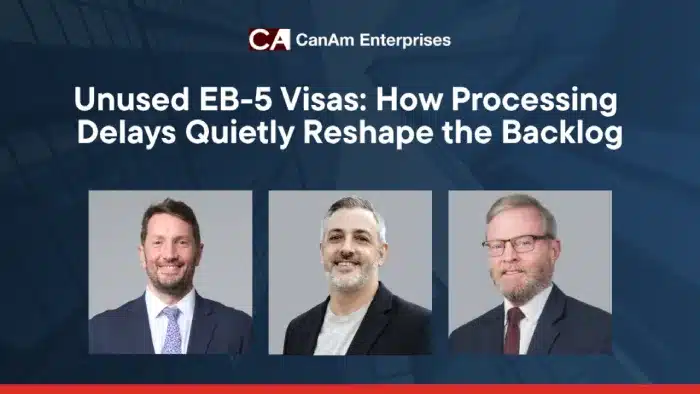
The drivers behind these improvements, and the risks that could complicate them, are what this article examines. In a recent webinar, Walter Gindin, General Counsel at CanAm Enterprises, and Min Wu, Head of Sales, discussed what investors should realistically expect from I-956F processing under the RIA and why CanAm’s results have been consistently strong.
What Did I-956F Processing Times Look Like Before the RIA?
To appreciate the current environment, it helps to understand where the program came from. Before the RIA, USCIS could take two to three years to adjudicate a project-level filing. For investors already waiting on their individual petitions, lengthy project-level delays compounded an already frustrating process.
Walter Gindin recalls the historical baseline clearly: “Everyone doesn’t remember back in the day, it took two to three years to approve any project, rural or high unemployment.” That context makes the current environment notably different, and considerably more workable for investors.
What Do CanAm’s I-956F Results Show About Realistic Timelines?
CanAm’s 15 I-956F approvals under the RIA offer a meaningful data point on what investors can realistically expect from a well-prepared filing. According to Min Wu, the results have been consistently encouraging.
“Most of our projects are approved within four to nine months,” Min notes. For rural projects in particular, outcomes have been even faster. The Four Seasons Telluride, CanAm’s 15th I-956F approval, is a recent example. As Walter explains, rural projects like Telluride benefit directly from RIA policy: “In the RIA it says those types of projects are supposed to be prioritized by USCIS. Those projects have certainly been adjudicated faster than the historical average.”
For HUA projects, approval timelines have also improved substantially, with Walter noting that even these are now adjudicating in roughly one year, a far cry from the two to three year waits of the pre-RIA era.
Why Do Rural EB-5 Projects Receive Priority Processing?
The RIA’s rural priority processing provision is not incidental. Congress built it into the statute deliberately, reflecting a policy goal of directing EB-5 capital toward communities that have historically seen little of it.
The incentive structure works: IIUSA data shows that rural EB-5 filings have grown from a small fraction of all petitions to near-parity with urban targeted employment area (TEA) filings since the RIA. Investors from high-demand countries such as China and India have pivoted strongly toward rural projects, in part because priority processing shortens expected wait times. The combination of reserved visa allocations and faster adjudications makes rural projects structurally more attractive for investors concerned about retrogression.
For investors evaluating projects, rural designation is now a meaningful variable in processing time expectations, not just a geographic category.
How Do Post-RIA Approval Rates Compare to the Pre-RIA Era?
Processing time is only one dimension. Approval rates matter equally. An investor in a project with a high denial risk faces not just delays but the possibility that their I-526E will never receive a favorable decision.
Post-RIA data from IIUSA shows that I-526E approval rates for regional center investors have been running above 90% in 2025. That is a striking contrast to standalone I-526 investors, who have seen approval rates closer to 25%. The difference reflects the structural protection the RIA introduced: because I-956F project petitions must be filed and received by USCIS before investors can file I-526Es, and because they must be approved before I-526Es can be approved, projects with serious deficiencies are filtered out earlier in the process.
As Christine Chen, CanAm’s COO, noted in a separate industry discussion: “The fact that projects have to be approved before individual investor petitions get approved also means that there’s a stage of certainty at that level.” That structural clarity benefits investors who choose well-vetted, experienced regional centers.
What Drives Faster Adjudications: The Preparation Factor
Not all I-956F petitions move at the same pace. The quality and completeness of the filing plays a direct role in how quickly USCIS can adjudicate, and whether the agency issues Requests for Evidence (RFEs) or Notices of Intent to Deny (NOIDs) that extend timelines.
Walter Gindin is direct about CanAm’s philosophy: “Our primary goal is to get that approval without an RFE, without a NOID. We want to give them the most comprehensive, credible application because that is how we interact with the agency.”
In practice, that means addressing USCIS’s likely questions before they are asked. Capital stack financing should be in place, or a clear and near-term plan should be documented. Budget and schedule information needs to be supported by contractor representations. Permits and governmental approvals should be on hand, or a realistic timeline for obtaining them should be explained. The business plan must be what USCIS calls “Matter of Ho compliant,” meaning comprehensive, specific, and credible.
Regional centers that file before these elements are ready invite RFEs that can push adjudications out by months. CanAm’s conservative approach to project readiness, sometimes a source of investor questions about why packages take longer to prepare, is precisely what produces faster outcomes once the filing is made.
Min Wu frames it plainly: “We try to show USCIS how ready the project is. We don’t want to put any project on the market or file the petition unless we feel comfortable that every element of the project is almost ready.” Walter confirms: “If it takes a little bit longer, there’s a reason to it. It’s worth the wait.”
Will Current Processing Trends Continue?
The honest answer is that processing times will depend on several variables, some within the industry’s control and some not.
USCIS demonstrated in Q3 2025 that it has the capacity to significantly increase its adjudication pace. Before that quarter, approvals had been running at roughly 400 cases per quarter across all petition types. In Q3 2025 alone, USCIS approved over 1,000 cases. Whether that pace is sustained will be a key indicator for the program’s near-term health.
If adjudication volumes stay elevated, investors in rural and HUA projects may begin to see earlier-than-expected visa usage, potentially triggering final action dates for high-demand countries like China and India sometime in the second half of fiscal year 2026. That would add a new layer of planning for investors from those markets, but it would also reflect a program operating at genuine scale, with real investor demand being met by real adjudicatory capacity.
Walter’s read is cautiously optimistic: “I think that USCIS has shown that it has the ability and capacity to continue these faster adjudications. Our job is to make it straightforward for them, to make them feel good about approving something because we’ve given them an application that is comprehensive and credible.”
Frequently Asked Questions: I-956F Processing Times
How long does an I-956F petition take to get approved?
Under the RIA, well-prepared rural I-956F petitions are currently averaging four to nine months, based on CanAm’s track record of 15 I-956F approvals. For high-unemployment-area (HUA) projects, Walter Gindin notes that adjudications are now coming in at roughly one year, though this reflects his experience rather than a formally measured average. Both represent a significant improvement over the two to three year timelines common before the RIA.
Do rural EB-5 projects get approved faster than urban TEA projects?
Yes. The RIA includes a statutory rural priority processing provision, meaning USCIS is required to prioritize rural I-956F petitions. IIUSA data and CanAm’s own track record confirm that rural projects are adjudicating faster and at a higher rate than HUA projects under the current framework.
What is the I-956F approval rate under the RIA?
Post-RIA I-526E approval rates for regional center investors have been running above 90% in 2025, according to IIUSA data. This is significantly higher than the roughly 25% approval rate seen for standalone I-526 investors, reflecting the structural quality control the I-956F process introduces.
What can slow down an I-956F approval?
Incomplete capital stack documentation, unresolved budget or schedule questions, and missing permits are the most common triggers for RFEs that delay adjudications. Regional centers that file before these elements are in place, or that use complex financing structures USCIS is unfamiliar with, are more likely to face delays. Choosing a regional center with a documented, consistent track record of RFE-free approvals is the most reliable way to reduce this risk.
Does the regional center I choose affect my processing time?
Significantly. A well-prepared filing from an experienced regional center reduces the likelihood of RFEs and NOIDs, both of which extend timelines. CanAm’s 15 I-956F approvals under the RIA, most within four to nine months, provide a concrete benchmark for what a preparation-first approach can achieve.
Ready to Explore EB-5 Projects with a Proven Processing Record?
CanAm Enterprises has navigated every phase of the EB-5 program’s evolution over more than 20 years of EB-5 experience. Our I-956F results speak for themselves:
- 15 I-956F approvals under the RIA, most within four to nine months
- 100% USCIS project approval rate across 75+ projects
- 8,400+ investors served globally across 30+ years of investment-linked immigration experience
- $4B+ raised in EB-5 capital, with $2.5B+ successfully returned
- 17,100+ conditional green cards and 9,300+ permanent green cards facilitated
Contact our sales team to discuss your EB-5 options and learn how CanAm’s preparation-first approach translates to faster, more reliable approvals.
Email: info@canamenterprises.com | Phone: +1 (212) 668-0690
About the Webinar Speakers
Walter S. Gindin, General Counsel, CanAm Enterprises
Walter S. Gindin is General Counsel at CanAm Enterprises, where he oversees all EB-5 and corporate legal matters. He has led the preparation of CanAm’s I-956F filings since the RIA took effect, including 15 approvals under the new framework. Mr. Gindin earned his Juris Doctor (with Distinction) from the University of Iowa College of Law, where he served as an Editor on the Iowa Law Review, and holds a bachelor’s degree in economics and a master’s degree in political science from New York University. He is a member of the EB-5 Investor Committee of the American Immigration Lawyers Association (AILA).
Min Wu, Head of Sales, CanAm Enterprises
As Head of Sales, Min Wu manages CanAm’s global sales team across Asia, India, the Middle East, South America, and the U.S. She focuses on the setting and execution of CanAm’s overall sales strategy and works extensively with investors and institutional partners worldwide. Prior to joining CanAm in 2016, Ms. Wu had more than 10 years of experience as a financial analyst and institutional sales manager. She is a Chartered Financial Analyst and holds FINRA Series 7 and 63 licenses.