March 2026 Visa Bulletin Webinar Series | Post 1
An analysis with Charlie Oppenheim, former 23-year Chief of Immigrant Visa Control at the U.S. Department of State, and Joey Barnett, Partner at WR Immigration
When the March 2026 Visa Bulletin dropped, one detail caught the attention of EB-5 investors, immigration attorneys, and industry observers across the board: employment-based priority dates had moved forward at a striking pace. For the millions of people waiting in EB-2 and EB-3 backlogs, the advance looked like a breakthrough. For EB-5 investors, the question was whether the same momentum applied to their categories.
The short answer is no. And understanding why matters enormously for anyone making decisions about EB-5 in the months ahead.
In CanAm’s webinar on the March 2026 Visa Bulletin, Charlie Oppenheim and Joey Barnett of WR Immigration walked through exactly what drove those date movements, why they are artificial, and what investors should actually be watching instead.
What Happened to Employment-Based Priority Dates in March 2026
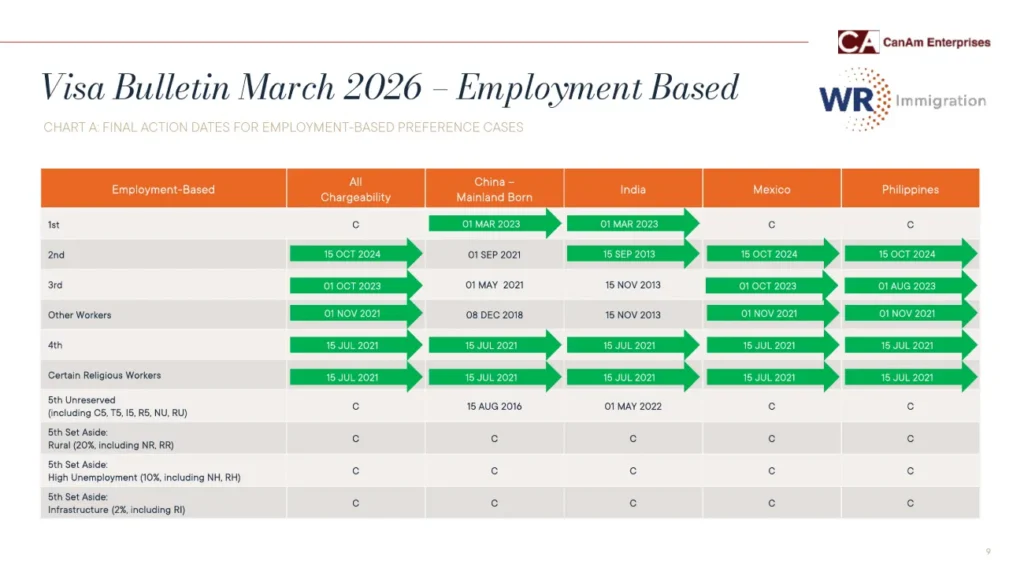
The March 2026 Visa Bulletin showed significant forward movement across multiple employment-based preference categories. EB-2 rest-of-world application filing dates became current. India EB-2 final action dates advanced. Several other categories moved forward by months in a single bulletin release.
To people who have spent years watching these dates move by a few weeks at a time, this looked remarkable. But Charlie was direct about what it actually means:
“This is an artificial movement. When and if the policy were to change regarding these 75 countries, when those are processing again, that will result in higher demand by applicants with early priority dates and therefore the dates could hold or retrogress at some point in the future. Do not read too much into these movements.”
— Charlie Oppenheim, Director of Visa Consulting, WR Immigration
The movement is a direct result of a Presidential Proclamation currently limiting visa processing for nationals of approximately 75 countries. With those nationals temporarily removed from the demand pool, the State Department is advancing dates to maximize use of available visa numbers. When the proclamation is eventually lifted, that demand returns, and the dates may need to retrogress to compensate.
The 75-Country Presidential Proclamation: What EB-5 Investors Need to Know
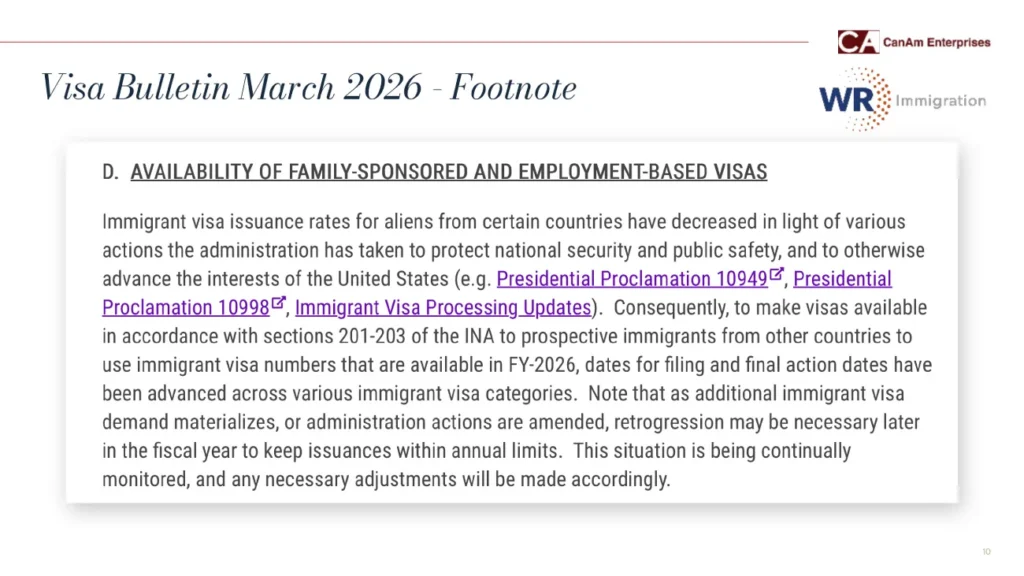
The March bulletin included a footnote explaining the proclamation’s effect on date movements. The footnote was the subject of significant discussion during the webinar, both for what it said and for what it means for how to interpret the bulletin going forward.
Charlie noted the footnote reflects a deliberate State Department strategy:
“This note reflects the proclamation which is limiting processing of roughly 75 countries. This policy was likely to result in the State Department beginning to advance final action dates in an attempt to maximize number use. They would advance the dates at a faster pace to compensate for the lack of demand by these 75 countries. And that is exactly what this footnote reflects.” — Charlie Oppenheim
The footnote also included language noting that retrogression may be necessary later in the fiscal year if conditions change. That caveat was deliberate. The State Department is signaling clearly that the current movement is contingent and conditional, not a stable trend investors should plan around.
For EB-5 investors specifically, the important point is that neither the unreserved EB-5 category nor the three reserved categories (rural, high unemployment area, or infrastructure) are meaningfully affected by the proclamation in terms of wait times. The proclamation-driven advancement applies primarily to other employment-based categories, and its main significance for EB-5 is as a signal to not misread positive momentum in other categories as an indicator of what is coming for EB-5.
The Delayed Bulletin: Why It Happened and What It Means
The March 2026 Visa Bulletin was released later than the typical schedule. That delay generated its own anxiety in the EB-5 community. When a bulletin is held, one natural fear is that the State Department gathered new data and is preparing to impose final action dates.
Charlie’s assessment was reassuring on that front, and specific about the actual cause:
“I believe that the reason the bulletin was delayed was strictly because of the clearance process, which is required. The lawyers want to make sure everything, all the I’s are dotted and the T’s are crossed, so there’s no ambiguity in whatever is announced. And that is further emphasized by the fact that the visa bulletin itself was dated February 4th, even though it didn’t come out until recently.” — Charlie Oppenheim
Joey confirmed his own read of the delay, noting that his concern had been that new data prompted the hold. That concern turned out to be unfounded. The delay was procedural, tied to the language around the proclamation footnote, and had no bearing on the reserved category status.
EB-5 Reserved Categories: What Chart A and Chart B Show for March
The most directly relevant news in the March bulletin for EB-5 investors is that all three reserved categories remain current. Rural (20% of reserved visa numbers), high unemployment area (10%), and infrastructure (2%) are all showing a final action date of C, meaning current, for every chargeability area including China and India.
Critically, Chart B also remains available. Chart B governs adjustment of status filing dates, and its availability means investors physically present in the United States can continue to file their I-526E petition and I-485 adjustment application simultaneously.
Joey described the significance of that in plain terms:
“This is a once in a lifetime opportunity for eligible investors. The ability to file concurrently, to remain in the United States while your petition is processed, has never been available in prior EB-5 eras.” — Joey Barnett, Partner, WR Immigration
Both Charlie and Joey were clear that this status will not last indefinitely. Based on current data and the absence of any warning footnote in the March bulletin, they projected the reserved categories will remain current through at least April or May 2026. After that, the picture becomes harder to predict. The data available only runs through July 2025, and significant additional filings have occurred since then.
Why the EB-5 Reserved Categories Are Not Affected by the Proclamation Movement
A key distinction for EB-5 investors is understanding what the employment-based date movements do and do not signal about the reserved categories.
The proclamation affects how the State Department manages visa number usage across all employment-based categories to prevent annual limits from going unused. That management can produce large apparent date movements in categories where demand has been reduced.
For EB-5 reserved categories, the dynamic is different. Demand has been growing, not shrinking. The reserved pool is not subject to the same kind of demand reduction effect that is making other categories advance rapidly. The reserved categories are current because adjudications and visa issuances have not yet consumed the available quota for the fiscal year, not because the policy has created an opening.
Peter Calabrese made the practical implication clear:
“Just because this has moved forward a little bit now, that doesn’t mean there wouldn’t be potential backtracking of this later on. And the visa bulletin footnote alluded to the same thing.” — Peter Calabrese, CEO, CanAm Investor Services
The advice holds for EB-5 investors as well: the positive signals in the March bulletin are real, but they reflect present conditions that are subject to change. Acting on them promptly has more value than waiting to see if they persist.
What This Means for EB-5 Decision-Making Right Now
The core takeaway from this section of the webinar is that the March bulletin’s employment-based date movements are not a reason for EB-5 investors to wait or reconsider. If anything, they are a reminder of exactly the kind of conditional and temporary dynamics that can shift the immigration landscape.
For EB-5 investors specifically:
- The reserved categories are current. Concurrent filing remains available.
- The employment-based movements in other categories are artificial and should not be interpreted as a general opening of the immigration pipeline.
- The absence of a warning footnote in the March bulletin is a positive signal, but it provides a window measured in months, not years.
- Charlie and Joey estimate the reserved categories will remain current through at least April or May 2026. That assessment is based on data through July 2025 and could change as new information becomes available.
The next post in this series goes deeper on the FOIA data that forms the basis for those projections, including what it shows about petition receipts, approvals, and the significant data gaps that make precise forecasting difficult.
Ready to Discuss Your EB-5 Options?
CanAm Enterprises has spent over 35 years helping investors navigate EB-5, including every market cycle, program lapse, and legislative change the program has seen. Our track record speaks for itself:
- $2.5B repaid to our investors
- $4B in EB-5 capital raised from 8,000+ investors
- 75+ projects funded across real estate, life sciences, clean energy, and digital infrastructure
- 100% USCIS project approval rate
- 5,800+ I-526 and I-526E petition approvals
The window for concurrent filing is still open. Contact our team to learn more about current EB-5 opportunities and get personalized guidance on your path to U.S. permanent residency.
Contact us at info@canamenterprises.com or +1 (212) 668-0690.
About the Webinar Speakers
Charlie Oppenheim, Director of Visa Consulting, WR Immigration
Charlie Oppenheim served for 23 years as Chief of Immigrant Visa Control at the U.S. Department of State, where he was personally responsible for setting the final action dates published in each monthly Visa Bulletin. His decisions facilitated the immigration of over 9 million people to the United States. He has testified before congressional immigration subcommittees and consulted with the White House on immigration policy. He now serves as Director of Visa Consulting at WR Immigration.
Joey Barnett, Partner, WR Immigration
Joey Barnett is a Partner at WR Immigration, one of the largest EB-5 immigration law firms in the world, with 15 attorneys holding over 10 years of EB-5 experience. WR Immigration files approximately 15% of all EB-5 cases annually. Joey advises investors and regional centers on the full EB-5 process, from source of funds through permanent green card.
Peter Calabrese, CEO, CanAm Investor Services
Peter Calabrese serves as CEO of CanAm Investor Services, the FINRA-registered broker-dealer affiliate of CanAm Enterprises. He has been a leading voice in EB-5 investment immigration and oversees CanAm’s investor-facing operations and business development.