March 2026 Visa Bulletin Webinar Series | Post 4
An analysis with Charlie Oppenheim, former 23-year Chief of Immigrant Visa Control at the U.S. Department of State, and Joey Barnett, Partner at WR Immigration
Every EB-5 investor eventually faces the same question: when will my category retrogress, and what does that mean for my green card timeline? It is the most consequential unknown in the post-RIA program, and it is also the one with the least reliable data behind it.
In CanAm’s March 2026 Visa Bulletin webinar, Charlie Oppenheim, the former State Department official who set final action dates for 23 years, and Joey Barnett of WR Immigration offered their most detailed public analysis to date of where final action dates stand, when they may arrive, and what the boomerang effect could mean for investors who think a current priority date is a safe harbor.
This post, the final installment in our March 2026 Visa Bulletin series, covers what the speakers said about final action date mechanics, the concurrent filing window, and the specific decisions investors face right now.
How Final Action Dates Work: The Quarterly Threshold Mechanism
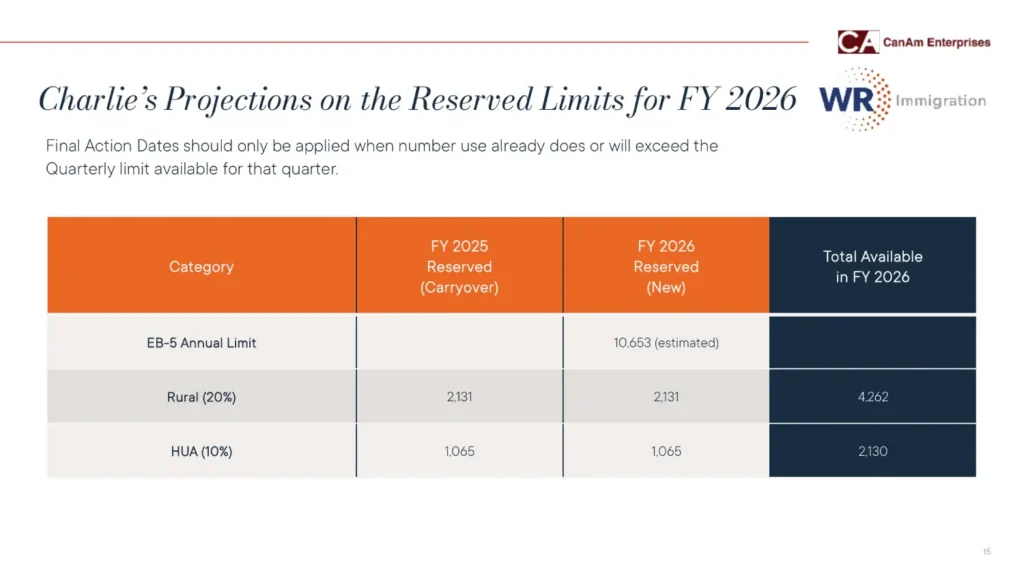
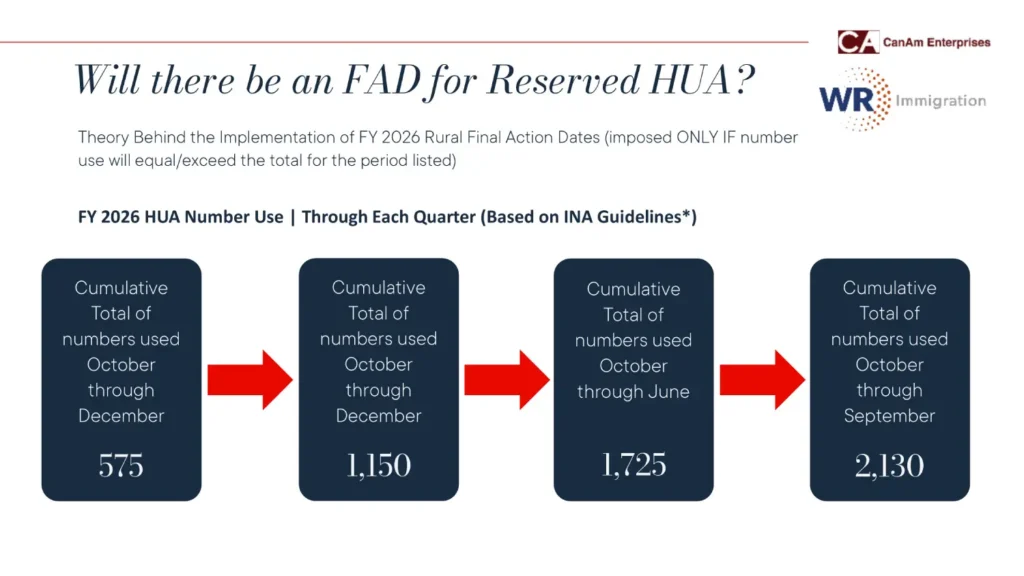
Final action dates are not imposed based on total annual demand alone. Under the Immigration and Nationality Act, the State Department divides the annual visa limit into quarterly thresholds. A final action date is imposed only when actual number use in a given quarter equals or will exceed the cumulative threshold for that quarter.
Charlie explained the specific math for FY2026:
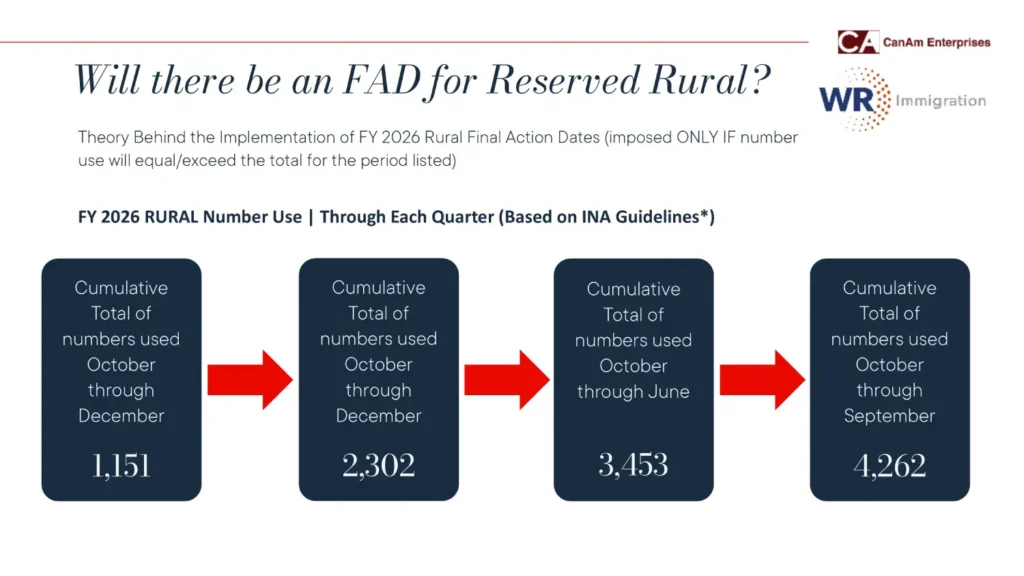
“Only 27% of the annual limit should be used in each of the first three quarters. For rural, that means 1,151 numbers in Q1, 2,302 through Q2, 3,453 through Q3, and then 19% remain for the final quarter. The State Department would only impose a final action date when they saw that actual number use would exceed one of these totals in a quarter.” — Charlie Oppenheim, Director of Visa Consulting, WR Immigration
This threshold mechanism is why the reserved categories can remain current even as overall demand grows. As long as visa issuances plus approved adjustments are not hitting the quarterly limits, no final action date is triggered.
Based on the data available through July 2025, Charlie assessed that the thresholds have not been reached and that no final action date appears necessary for the remainder of FY2026, at least based on current trends.
“At this point, based on the data we have through July, it does not appear that there would be any need for final action dates this fiscal year. It looks very positive for this fiscal year staying current.” — Charlie Oppenheim
Why the Reserved Categories Will Likely Stay Current Through April or May 2026
Both Charlie and Joey noted a specific signal that the industry watches closely: whether the monthly Visa Bulletin contains a warning footnote about upcoming final action dates. The State Department typically provides at least one to two months of advance notice before imposing a date.
“The fact that no note has been placed in the bulletin means they should give at least one to two months advance warning. So I think we’re clear through April or May. There’s no indication there would be any reason to impose final action dates this fiscal year. I think we are in very good shape.” — Charlie Oppenheim
Joey described what he had been watching for, and why the March bulletin’s absence of a warning footnote was meaningful:
“My concern with the delayed March visa bulletin was that they got a bunch of data and then thought, we didn’t see this demand, and then they would have made a final action date. That’s what I was scared about with the delay.” — Joey Barnett, Partner, WR Immigration
That concern turned out to be unfounded. The delay was procedural, not data-driven. And the absence of a footnote in the March bulletin means investors who act now have a window of roughly 60 days before the status of that guidance should be reassessed.
The Non-FIFO Processing Problem and the Boomerang Effect
One of the most important and least-discussed aspects of the current EB-5 situation is that USCIS does not appear to be processing rural or HUA petitions in strict filing date order. This has significant implications for where final action dates will land when they do eventually arrive.
Charlie explained the consequence:
“We have no indication that cases are being processed in first-in, first-out order. What this means is that when final action dates are finally imposed, they are not likely to be very early, say in 2022 or 2023, when the program initially started. They could very well be in 2024 or 2025. Because if they’re not processing strictly in filing date order, the final action dates may be much closer to the current date within a year or two.” — Charlie Oppenheim
That might initially sound like good news. A final action date set in 2024 or 2025 would be current for most recent filers. But Charlie immediately identified the problem:
“That again would be a false sense of security. Once the petitions with earlier priority dates are approved and get ready for final action, it could and would likely result in corrective action in the final action dates. Although it may be good initially, it’s going to have a potential boomerang effect months later or at some point.” — Charlie Oppenheim
The boomerang effect works like this: when USCIS eventually works through earlier-priority cases and those investors become ready for final action, the State Department will need to retrogress the final action date to accommodate the backlog of cases with earlier priority dates. An investor who filed in 2024 might see an initially current priority date snap back to accommodate the 2022 and 2023 filers who were approved later but have earlier priority dates.
Charlie added a reminder about what a final action date actually means:
“Final action dates are an indication of cases which can be processed, as known at the time the visa bulletin is announced. It does not indicate that everybody with a priority date earlier than that date has been taken care of. Applicants become ready for final action at their own pace.” — Charlie Oppenheim
The Concurrent Filing Benefit: What It Protects and What It Doesn’t
For investors currently in the United States, the ability to file an adjustment of status application (Form I-485) simultaneously with their I-526E petition is one of the most significant benefits the post-RIA program has ever offered. It has no historical precedent in the EB-5 program.
“These concurrent filing benefits have never been available to applicants in the past. So this is something people can and should take advantage of if they’re able to.” — Charlie Oppenheim
The protection concurrent filing offers is specific: once filed, an investor who has submitted their I-485 can generally remain in the United States even if a final action date is later imposed. They do not lose their place in the adjustment queue when dates retrogress, provided the I-485 was already on file.
“One of the benefits of concurrent filing is that once somebody files concurrently, even if a final action date is imposed in the future, they would be able to remain in the US most likely unless there’s a change.” — Charlie Oppenheim
What concurrent filing does not protect against is the wait for final action itself. An investor who filed their I-485 today would still need their priority date to become current before their adjustment can be fully adjudicated. Filing concurrently secures your place in the adjustment queue. It does not bypass the queue.
Joey framed this with useful clarity:
“People need to have in their mind that there’s going to be some sort of wait time for somebody who is filing today, after your I-526 is approved, before you’re actually able to activate the green card.” — Joey Barnett
The Path to the Green Card: Overseas vs. In-Country Applicants
For investors outside the United States, the path to the green card runs through a U.S. consulate rather than USCIS. That creates additional timing variables. Consular capacity is limited, and current conditions in China are particularly relevant.
“At least in Guangzhou, the US consulate seems to be focused on investors who filed under the old program. They’re scheduling only consulate appointments for those folks, and rightfully so, they’ve been waiting for 10 years. But there’s only so much capacity that they have. And so that could limit the number of reserved visa appointments that are available this year.” — Joey Barnett
Overseas applicants cannot file for adjustment of status and are therefore not protected by the concurrent filing benefit. They remain subject to both final action date timing and consular appointment availability. This structural difference may give in-country applicants an effective processing advantage for the near term.
What the Infrastructure Category Offers Right Now
Post 3 covered infrastructure as a lower-competition option. In Post 4’s discussion of final action dates, both Charlie and Joey reinforced that point with specific language about queue positioning.
“People that are filing in the infrastructure category are likely to be at the front or near the front of any line which may develop at some point in the future. A very attractive option at this point.” — Charlie Oppenheim
The category’s 2% annual allocation is small, but demand appears to be significantly below rural and HUA. For Chinese and Indian nationals, infrastructure also offers potential access to unused rest-of-world numbers. The combination of a shallow queue and possible number fallover makes it worth evaluating seriously for investors whose primary concern is timeline.
What to Do With All of This Information
Joey closed the webinar with advice that is easier said than believed, but probably the most useful framing available:
“Control what you can. Don’t worry about the other stuff. There’s time to file EB-5. I think it is to some extent a once-in-a-lifetime opportunity to do it with the concurrent option. And people still have the ability to take advantage of that and get your spot in line.” — Joey Barnett
The core takeaways for investors making decisions today:
- The window for concurrent filing is real and still open, but it is measured in months, not years. No warning footnote in March means roughly 60 days of confidence before reassessment.
- Filing sooner gets a better priority date and secures adjustment of status protections while the categories are current.
- A final action date arriving in 2024 or 2025 terms does not mean investors with 2024 or 2025 priority dates are safe permanently. The boomerang effect is a real risk.
- Project selection matters. With denial rates potentially rising as weaker I-956F applications enter the pipeline, working with a sponsor with a demonstrated approval track record reduces downside risk.
- Overseas investors face additional constraints through consulate capacity. If in the United States, concurrent filing remains the most valuable tool available.
Peter Calabrese captured the honest picture well:
“This is still likely to be the best option for many of these people to be able to get their long-term permanent residency in the U.S. You look at the wait time that so many of these other categories have. Even though it isn’t as straightforward and there are still going to be some differences in the timing that you’re looking at, this is still likely to be the best option.” — Peter Calabrese, CEO, CanAm Investor Services
Ready to Discuss Your EB-5 Options?
CanAm Enterprises has spent over 35 years helping investors navigate EB-5, including every market cycle, program lapse, and legislative change the program has seen. Our track record speaks for itself:
- $4B+ in EB-5 capital raised from 8,000+ investors
- 75+ projects funded across real estate, life sciences, clean energy, and digital infrastructure
- 100% USCIS project approval rate
- 4,580+ investor families repaid
- 5,800+ I-526 and I-526E petition approvals
The window for concurrent filing is still open. Contact our team to learn more about current EB-5 opportunities and get personalized guidance on your path to U.S. permanent residency.
Contact us at info@canamenterprises.com or +1 (212) 668-0690.
About the Webinar Speakers
Charlie Oppenheim, Director of Visa Consulting, WR Immigration
Charlie Oppenheim served for 23 years as Chief of Immigrant Visa Control at the U.S. Department of State, where he was personally responsible for setting the final action dates published in each monthly Visa Bulletin. His decisions facilitated the immigration of over 9 million people to the United States. He has testified before congressional immigration subcommittees and consulted with the White House on immigration policy. He now serves as Director of Visa Consulting at WR Immigration.
Joey Barnett, Partner, WR Immigration
Joey Barnett is a Partner at WR Immigration, one of the largest EB-5 immigration law firms in the world, with 15 attorneys holding over 10 years of EB-5 experience. WR Immigration files approximately 15% of all EB-5 cases annually. Joey advises investors and regional centers on the full EB-5 process, from source of funds through permanent green card.
Peter Calabrese, CEO, CanAm Investor Services
Peter Calabrese serves as CEO of CanAm Investor Services, the FINRA-registered broker-dealer affiliate of CanAm Enterprises. He has been a leading voice in EB-5 investment immigration and oversees CanAm’s investor-facing operations and business development.