March 2026 Visa Bulletin Webinar Series | Post 3
An analysis with Charlie Oppenheim, former 23-year Chief of Immigrant Visa Control at the U.S. Department of State, and Joey Barnett, Partner at WR Immigration
One of the most consequential choices an EB-5 investor makes is which category to invest in: rural, high unemployment area, or infrastructure. The choice affects processing priority, final action date risk, and ultimately how long the path to a green card takes.
FOIA data through July 2025 makes the current picture unusually clear on one point: USCIS is processing rural petitions at a dramatically higher rate than high unemployment area petitions, even though both categories have nearly the same number of total receipts. Understanding why, and what it means for investors choosing today, was a central focus of CanAm’s March 2026 Visa Bulletin webinar with Charlie Oppenheim and Joey Barnett of WR Immigration.
The Adjudication Gap: What the Numbers Actually Show
The FOIA data covering April 2022 through July 2025 shows that rural petitions account for 81% of all reserved-category adjudications. High unemployment area accounts for 16%. The remaining 3% covers the combined rural-and-HUA category, the unreserved category, and infrastructure.
The receipt volumes for rural and HUA are almost identical: 6,406 rural receipts versus 6,582 HUA receipts. But the adjudication outcomes are dramatically different. Of all rural receipts, 45% have been adjudicated. Of all HUA receipts, just 8% have reached a decision.
Joey framed this plainly:
“When you look at the actual adjudications, you can see that rural is being prioritized over high unemployment area. When you look at the 16% versus the 81%, I think that’s pretty stark.” — Joey Barnett, Partner, WR Immigration
That disparity is not a processing backlog artifact. It is the intended result of priority processing, a provision introduced by the RIA specifically to direct more investment and processing attention to rural projects.
Why Rural Is Prioritized: What the RIA Built In
The Reform and Integrity Act of 2022 established priority processing for rural EB-5 petitions as a policy goal, not just a preference. Rural investment had historically been minimal within EB-5. The program had concentrated capital in urban high-unemployment areas, many of which were in major metros. Congress wanted that to change.
The priority processing provision means USCIS is actively handling rural cases before HUA cases, independent of filing date order. Combined with a dedicated reserved visa allocation of 20% of the annual EB-5 limit, rural projects have both processing and visa supply advantages built into the program structure.
“I think that was the point of the RIA. They wanted to prioritize investments into rural areas. They have succeeded. The purpose of that statute has been fulfilled.” — Joey Barnett
What the Visa Supply Math Looks Like for Rural and HUA
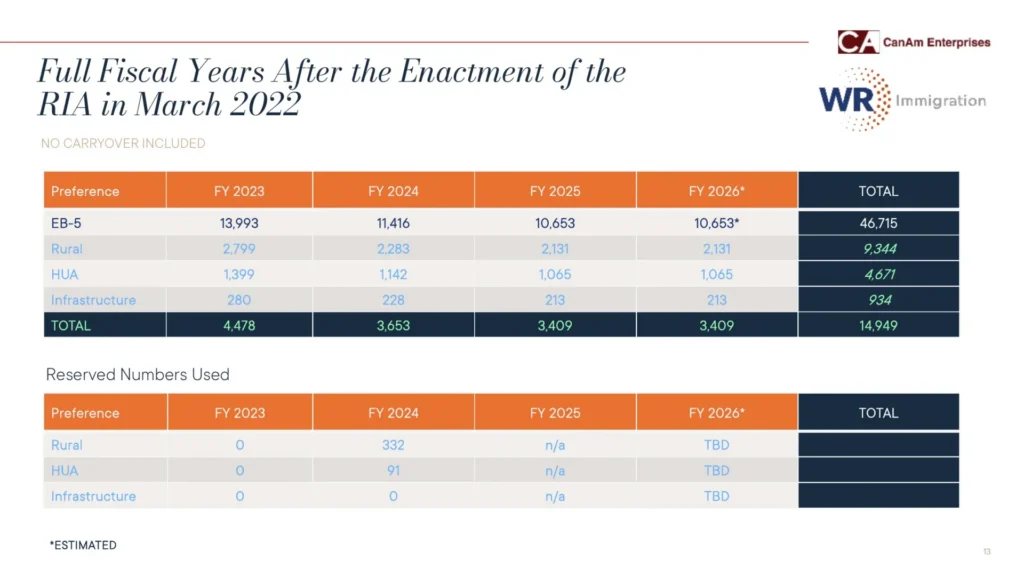
Looking at the annual visa allocation numbers makes the demand-supply tension concrete. Based on the estimated FY2026 figures:
- Rural (20% of annual EB-5 limit): approximately 2,131 visas per fiscal year, plus an estimated 2,131 carryover from FY2025, for a total of approximately 4,262 available in FY2026
- HUA (10% of annual EB-5 limit): approximately 1,065 visas per fiscal year, plus approximately 1,065 carryover, for a total of approximately 2,130 available in FY2026
- Infrastructure (2% of annual EB-5 limit): approximately 213 visas per fiscal year plus carryover
Set against estimated receipt volumes of over 7,500 rural and approaching 7,000 HUA filings, the arithmetic is clear: demand in both categories significantly exceeds the annual supply. A final action date in both categories is not a question of whether but when.
Charlie noted a broader context that makes the situation more acute: the early years of the post-RIA program saw large numbers of reserved visas go unused because petitions were not being processed quickly enough to consume them. Those unused numbers did not carry forward in the reserved categories, they fell to the unreserved pool. That means the reserved category supply is effectively smaller than it might have been if adjudications had kept pace from the beginning.
“Several thousand reserved applicants who could have been processed in the past will now have to be processed in the future under the lower annual limits. It’s very unfortunate that when the bill was drafted, they did not take this into account.” — Charlie Oppenheim, Director of Visa Consulting, WR Immigration
The Per-Country Cap: How It Affects China and India
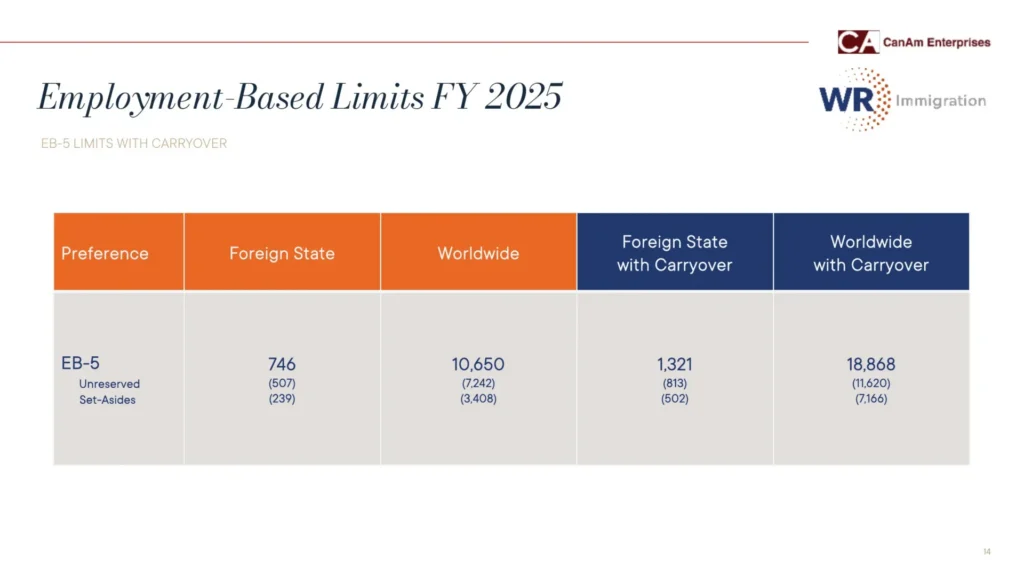
EB-5 petitions are subject to the same per-country caps as other employment-based categories. No single country can use more than 7% of the annual EB-5 visa limit. But unused numbers from rest-of-world applicants can fall across to oversubscribed countries like China and India, allowing nationals from those countries to receive more than 7%.
The degree to which China and India will benefit from unused rest-of-world numbers is a critical unknown. Joey explained how the post-RIA dynamic may be different from the original EB-5 era:
“In the original EB-5 program, the Chinese were the country where applicants took advantage of the EB-5 program from the get-go. So they were using far more numbers because there weren’t as many applicants from other countries. Under the reserved categories, everybody potentially was out of the starting gate on an equal playing field.” — Charlie Oppenheim
Under the original program, China dominated early filings and consumed most available unused numbers as a result. Under the RIA, multiple countries entered simultaneously. India and China have both filed heavily in rural, but rest-of-world has also contributed meaningfully. The initial final action dates for India and China, when imposed, may be closer to each other than they were historically.
The country-by-country receipt data through July 2025 shows:
- China: 1,514 rural receipts and 844 HUA receipts in 2025 year-to-date (through July)
- India: 931 rural receipts and 398 HUA receipts in 2025 year-to-date
- Rest of world: 336 rural receipts and 664 HUA receipts in 2025 year-to-date
The rural-heavy filing pattern for China and India reflects the priority processing incentive. Rest-of-world applicants, who do not face the same backlog risk, are more balanced between rural and HUA.
The Infrastructure Category: Lower Competition, Possible Advantage
Infrastructure, which receives 2% of the annual EB-5 limit, appears to have the shallowest demand queue of the three reserved categories. The FOIA data showed zero infrastructure adjudications, but as covered in Post 2, this is a known data error resulting from how USCIS structured the FOIA query. Infrastructure petitions do exist and are being processed.
The significance, as both Charlie and Joey noted, is that the infrastructure category may represent a lower-competition path. Charlie made the point directly:
“The fact that they’re very low at this point means that people that are filing in the infrastructure category are likely to be at the front or near the front of any line which may develop at some point in the future. A very attractive option at this point.” — Charlie Oppenheim
Joey added a counterintuitive note about the annual visa limit:
“Even though rural has 10 times the amount of supply as infrastructure, if there’s 20 times the amount of demand in rural than infrastructure, that doesn’t necessarily mean that rural is faster. The data that we’re missing will help guide us on that.” — Joey Barnett
For Chinese and Indian nationals specifically, the infrastructure category also offers a potential avenue for capturing unused rest-of-world numbers, which could provide additional visa availability beyond the strict per-country cap.
What This Means for Investors Choosing Between Categories Today
The choice between rural, HUA, and infrastructure involves tradeoffs that the current data makes clearer, though not fully resolved.
- Rural offers the fastest current adjudications and the largest reserved visa pool, but demand substantially exceeds supply and priority processing may become less of an advantage once final action dates are imposed.
- HUA has a smaller visa pool and significantly slower adjudications under current USCIS processing patterns. An HUA investor filing today may face a longer wait even though there are fewer HUA visas and therefore, in theory, less competition per available number.
- Infrastructure has the smallest visa pool and the lowest current demand. For investors willing to invest in qualifying projects, it may offer a shorter queue and potential access to unused rest-of-world numbers.
Post 4 of this series focuses on when final action dates may arrive for rural and HUA specifically, and what concurrent filing options remain available in the meantime.
Ready to Discuss Your EB-5 Options?
CanAm Enterprises has spent over 35 years helping investors navigate EB-5, including every market cycle, program lapse, and legislative change the program has seen. Our track record speaks for itself:
- $4B+ in EB-5 capital raised from 8,000+ investors
- 75+ projects funded across real estate, life sciences, clean energy, and digital infrastructure
- 100% USCIS project approval rate
- 4,580+ investor families repaid
- 5,800+ I-526 and I-526E petition approvals
The window for concurrent filing is still open. Contact our team to learn more about current EB-5 opportunities and get personalized guidance on your path to U.S. permanent residency.
Contact us at info@canamenterprises.com or +1 (212) 668-0690.
About the Webinar Speakers
Charlie Oppenheim, Director of Visa Consulting, WR Immigration
Charlie Oppenheim served for 23 years as Chief of Immigrant Visa Control at the U.S. Department of State, where he was personally responsible for setting the final action dates published in each monthly Visa Bulletin. His decisions facilitated the immigration of over 9 million people to the United States. He has testified before congressional immigration subcommittees and consulted with the White House on immigration policy. He now serves as Director of Visa Consulting at WR Immigration.
Joey Barnett, Partner, WR Immigration
Joey Barnett is a Partner at WR Immigration, one of the largest EB-5 immigration law firms in the world, with 15 attorneys holding over 10 years of EB-5 experience. WR Immigration files approximately 15% of all EB-5 cases annually. Joey advises investors and regional centers on the full EB-5 process, from source of funds through permanent green card.
Peter Calabrese, CEO, CanAm Investor Services
Peter Calabrese serves as CEO of CanAm Investor Services, the FINRA-registered broker-dealer affiliate of CanAm Enterprises. He has been a leading voice in EB-5 investment immigration and oversees CanAm’s investor-facing operations and business development.