An analysis with Charlie Oppenheim, former 23-year Chief of Immigrant Visa Control at the U.S. Department of State, and Joey Barnett, Partner at WR Immigration
The EB-5 industry has always operated with incomplete data. But the information gap facing investors and advisors right now is more significant than at any point in the post-RIA era. USCIS has slowed its public reporting. The State Department stopped publishing monthly visa issuance data after May 2025. A critical National Visa Center report has not been updated since November 2023.
What the industry does have is FOIA data. In CanAm’s March 2026 Visa Bulletin webinar, Joey Barnett and Charlie Oppenheim walked through the most current FOIA dataset available, covering receipts, approvals, and denials through July 2025. What that data shows, and just as importantly, what it doesn’t show, is essential context for anyone trying to understand what the EB-5 pipeline actually looks like right now.
What Is the FOIA Data and Where Does It Come From?
FOIA stands for the Freedom of Information Act. When government agencies like USCIS fail to publish data publicly, interested parties can request it directly. Joey Barnett has been filing and, when necessary, litigating these requests to obtain EB-5 petition data that would otherwise remain inaccessible.
The most current dataset available during the webinar covered I-526 and I-526E receipts, approvals, and denials through July 2025, broken down by Targeted Employment Area category: high unemployment area (HUA), rural, rural and HUA combined, infrastructure, and unreserved. The data was obtained with assistance from the American Immigration Alliance (AIAA) and other groups working to close information gaps in the post-RIA era.
“It’s really tough from where we’re sitting to advise when we don’t have the data that USCIS has, that the Department of State has, that frankly they’re not releasing to us the way they used to.” — Joey Barnett, Partner, WR Immigration
What the FOIA Table Shows: Receipts, Approvals, and Denials by Category
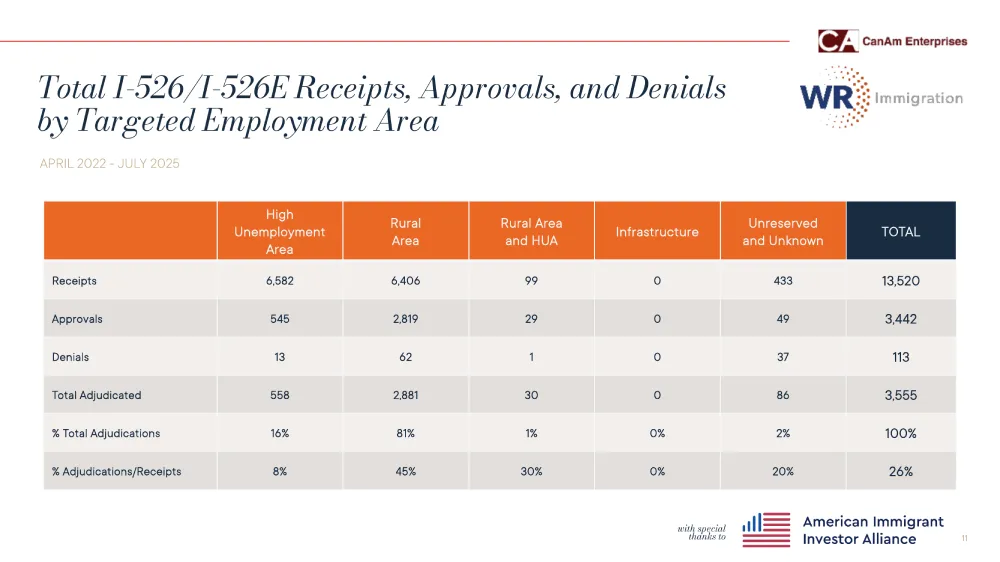
The table covering April 2022 through July 2025 shows total I-526 and I-526E activity across all EB-5 categories. The headline numbers:
- 13,520 total receipts across all categories
- 3,442 total approvals
- 113 total denials
- 3,555 total adjudications (approvals plus denials)
The overall adjudication-to-receipt ratio is 26%. That means roughly one in four petitions filed since the RIA has reached a final decision as of July 2025. The majority remain pending.
Breaking this down by category reveals something more striking. Rural has 6,406 receipts and 2,819 approvals, an adjudication rate of 45% of all rural receipts. The high-unemployment area has 6,582 receipts but only 545 approvals, an adjudication rate of just 8% of all HUA receipts.
“When you look at the actual adjudications, you can see that rural is being prioritized over high-unemployment areas. When you look at the 16% versus the 81%, I think that’s pretty stark.” — Joey Barnett
The 81% figure refers to rural’s share of all adjudications in the reserved pool. Despite having nearly the same number of receipts as HUA, rural accounts for the overwhelming majority of decisions being made.
The Infrastructure Data Error
One number in the FOIA table stands out immediately: infrastructure shows zero adjudications. This is not accurate.
Joey explained the reason:
“The query that USCIS ran for the FOIA did not include infrastructure filings. So that’s why those are zero. We know there are projects out there in the infrastructure category where they have had I-526 adjudications and certainly receipts. And so that data isn’t accurate.” — Joey Barnett
The infrastructure data gap is significant because the category has generated meaningful interest from Chinese and Indian nationals, specifically, for reasons covered in Post 3 of this series. The absence of accurate infrastructure data makes it harder to estimate demand, queue depth, and projected final action date timing for that category.
The practical implication, as both Charlie and Joey noted: because the infrastructure queue is known to be relatively short, investors filing in the infrastructure category today are likely near the front of any line that develops.
Denial Rates: A Low Number With an Important Caveat
The 113 total denials across more than 13,500 receipts represents a very low denial rate. Joey attributed this partly to improved source-of-funds preparation by investors and attorneys since the RIA.
But he added a forward-looking caution:
“We may start to see those numbers creep up in the event that there is a project denial and an I-956F denial, which could cause I-526E denials for the investors. And that’s why it’s so important that when you’re looking at these different projects on the market, you need to make sure that that project application is going to get approved and that you’re working with someone who has a track record of getting those approvals in the past.” — Joey Barnett
This is a direct link between project-level risk and investor-level outcomes. A project whose I-956F is denied can pull down the I-526E approval prospects for every investor in that project. With a growing number of projects entering the market and not all of them carrying established approval track records, this risk is worth taking seriously.
What the FOIA Data Cannot Tell Us: The Critical Gaps
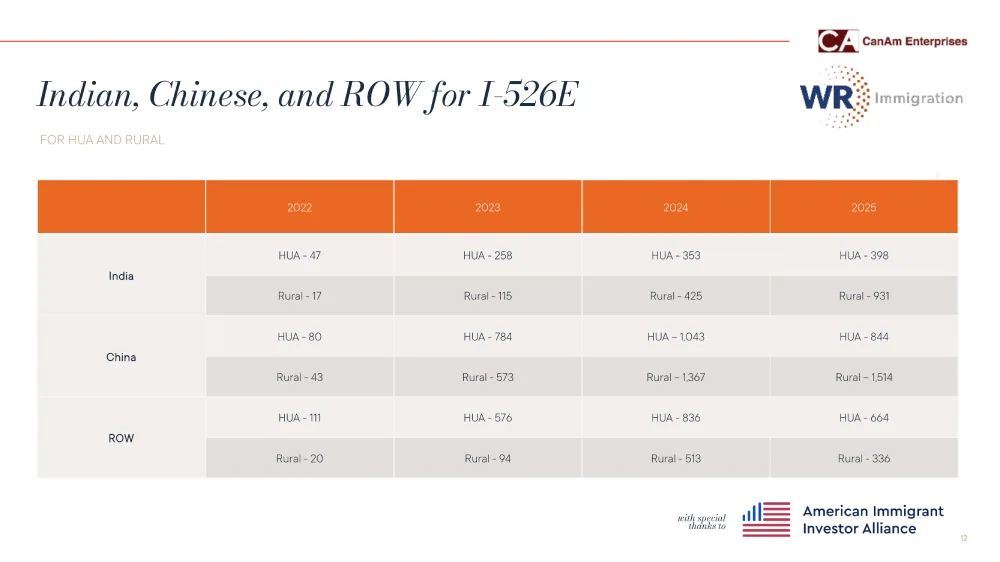
The data available through July 2025 is already six to seven months old. Joey’s estimate during the webinar was that total rural receipts may already exceed 7,500, and HUA receipts may be approaching or exceeding 7,000. Those figures are projections, not confirmed totals, precisely because no updated data has been released.
Charlie identified the specific reporting failures that are making analysis so difficult:
“The State Department had been providing at least monthly issuance data, but they only did so through May of last year. Then they stopped. They have not published anything in terms of what number use looked like in fiscal 2025.” — Charlie Oppenheim, Director of Visa Consulting, WR Immigration
Three specific data points that would significantly improve projections are missing:
- Monthly immigrant visa issuance data from the State Department (last published through May 2025)
- The National Visa Center waiting list report as of November 2025 (last published November 2023)
- Table Five and Table Six from the 2025 Annual Report of the Visa’s Office, which would show overseas versus USCIS processing splits
Charlie’s point about the overseas versus USCIS split matters particularly for EB-5. In the original EB-5 program, approximately 90 to 95% of cases were processed overseas through consular appointments. Under the post-RIA structure with reserved categories, Charlie estimated that 40% or more of cases could be processed domestically through adjustment of status. That shift has large implications for how visa numbers are being consumed, but the data to confirm it is not publicly available.
What Happens to the Missing Data: The New FOIA Request
Joey filed a new FOIA request for data through January 2026 at the end of February 2026. Under the litigation timeline, if USCIS does not respond appropriately, it will need to be litigated by the end of March 2026.
“When we get that, we’ll share that with everyone.” — Joey Barnett
The January 2026 dataset, once available, will provide roughly six months of additional filings and adjudications that are currently invisible. It will also capture some of the Q1 FY2026 processing activity that is critical for estimating when final action dates may be imposed.
What This Means for EB-5 Investors Today
The data gap creates real challenges for precise advice, but it does not prevent investors from drawing useful conclusions.
- Demand clearly outpaces supply across all reserved categories. With over 13,500 receipts against annual visa limits in the low thousands, the math points toward eventual retrogression.
- Rural is being processed significantly faster than HUA. That priority is built into the RIA and shows no sign of changing.
- Infrastructure data is missing, but the category’s low queue depth makes it an attractive option for early filers.
- Denial rates are currently low, but project selection matters. Investing in projects without established approval track records carries real risk.
- Updated data is coming. The January 2026 FOIA dataset will change the picture meaningfully when it is released.
Post 3 of this series goes deeper on how the demand patterns visible in the FOIA data translate into projections for rural versus HUA processing timelines, and what the visa supply math suggests about when final action dates may arrive.
Ready to Discuss Your EB-5 Options?
CanAm Enterprises has spent over 35 years helping investors navigate EB-5, including every market cycle, program lapse, and legislative change the program has seen. Our track record speaks for itself:
- $4B+ in EB-5 capital raised from 8,000+ investors
- 75+ projects funded across real estate, life sciences, clean energy, and digital infrastructure
- 100% USCIS project approval rate
- 4,580+ investor families repaid
- 5,800+ I-526 and I-526E petition approvals
The window for concurrent filing is still open. Contact our team to learn more about current EB-5 opportunities and get personalized guidance on your path to U.S. permanent residency.
Contact us at info@canamenterprises.com or +1 (212) 668-0690.
About the Webinar Speakers
Charlie Oppenheim, Director of Visa Consulting, WR Immigration
Charlie Oppenheim served for 23 years as Chief of Immigrant Visa Control at the U.S. Department of State, where he was personally responsible for setting the final action dates published in each monthly Visa Bulletin. His decisions facilitated the immigration of over 9 million people to the United States. He has testified before congressional immigration subcommittees and consulted with the White House on immigration policy. He now serves as Director of Visa Consulting at WR Immigration.
Joey Barnett, Partner, WR Immigration
Joey Barnett is a Partner at WR Immigration, one of the largest EB-5 immigration law firms in the world, with 15 attorneys holding over 10 years of EB-5 experience. WR Immigration files approximately 15% of all EB-5 cases annually. Joey advises investors and regional centers on the full EB-5 process, from source of funds through permanent green card.
Peter Calabrese, CEO, CanAm Investor Services
Peter Calabrese serves as CEO of CanAm Investor Services, the FINRA-registered broker-dealer affiliate of CanAm Enterprises. He has been a leading voice in EB-5 investment immigration and oversees CanAm’s investor-facing operations and business development.