In the fast-moving world of U.S. immigration, few topics have sparked more conversation in recent months than President Trump’s newly announced Gold Card and Platinum Card programs. These proposals—promising U.S. residence in exchange for multimillion-dollar “donations”—have raised a critical question among global families: What does this mean for EB-5 investors?
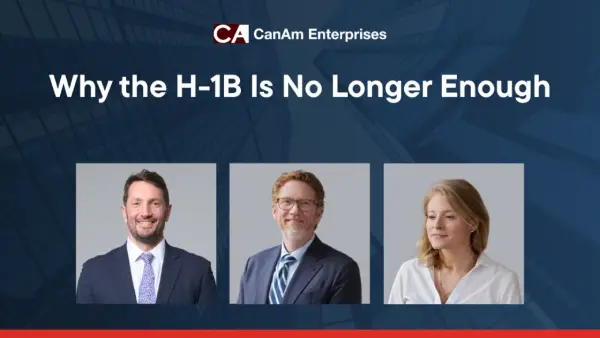
To help clarify the facts, Henley & Partners and CanAm Enterprises co-hosted a global webinar featuring Shhalu Hasarram, Director at Henley & Partners in Singapore; George Gainey, U.S. immigration attorney and founder of Gainey Law Group; and Min Wu, Global Head of Sales at CanAm Enterprises. Together, they offered a clear, practical comparison between Trump’s new proposals and the established EB-5 Immigrant Investor Program—and explained why EB-5 remains the most secure and legislated pathway to U.S. permanent residency.
Setting the Stage: The Gold Card’s Sudden Rise
Opening the session, Shhalu Hasarram provided context for the growing uncertainty investors are feeling. She explained that while Henley & Partners manages more than 40 global residence and citizenship-by-investment programs, none has drawn as much attention recently as EB-5—particularly since Trump’s recent executive orders.
“Ever since President Trump took office and began promoting the so-called Gold Card and Platinum Card, there’s been a great deal of confusion,” Hasarram said. “Clients want to know whether this changes EB-5—and the short answer is, it doesn’t. EB-5 is written into law; these new ideas are not.”
Hasarram summarized how the “Trump Gold Card,” first teased as a $5 million contribution earlier in the year, has been rebranded into two tiers:
- Gold Card: A $1 million donation for individuals, or $2 million for company sponsorships.
- Platinum Card: The higher-tier option, offering potential tax advantages for ultra-high-net-worth applicants who spend fewer than 270 days in the U.S.
She noted that while the concept has generated buzz, “no details have been finalized and nothing has been approved by Congress.” Her message was clear: EB-5 remains the only legislated, functioning program providing a definite path to U.S. permanent residency.
Understanding the Gold Card’s Legal Limits
Attorney George Gainey then walked attendees through the fine print of the Gold Card’s executive order. The $1 million “donation,” he explained, would be treated as proof of an individual’s “extraordinary ability” or “national interest”—criteria typically used in the EB-1 and EB-2 employment-based visa categories.
However, that creates an immediate problem for investors from India and China, which already face long backlogs in those categories.
“For individuals born in India or China, the Gold Card won’t be a workable option,” Gainey said. “You could make the donation, but your application would still be stuck in the same queue.”
He added that, unlike early rumors, the Gold Card does not exempt holders from U.S. taxes on global income. “That benefit disappeared in the final order,” he confirmed.
Gainey contrasted the two programs bluntly:
“The Gold Card is a $1 million donation for a green card. EB-5 is an $800,000 investment that can come back to you.”
Why EB-5 Still Stands Apart
The EB-5 Program—reauthorized by Congress under the Reform and Integrity Act of 2022—requires a minimum $800,000 investment that creates 10 new full-time U.S. jobs. It’s been a mainstay of U.S. immigration policy since the early 1990s.
Gainey outlined the “five S’s” investors should consider: simplicity, speed, stability, status, and spend. While the Gold Card may sound simpler, EB-5 wins on every other front—especially stability.
“EB-5 has been tested for decades. The Gold Card will be subject to lawsuits and uncertainty,” he said. “Only EB-5 offers a lawful, proven framework that investors can rely on.”
Min Wu: A Real-World Perspective from CanAm
Taking the discussion further, Min Wu, Global Head of Sales at CanAm Enterprises, spoke from both professional and personal experience. A former international student who became a U.S. citizen through employment-based immigration, Wu said the new wave of policy changes has “turned the U.S. immigration world upside down.”
“The Gold Card has created anxiety, especially among H-1B holders and students,” she said. “But EB-5 is still the only reliable option—particularly for Indian and Chinese nationals facing EB-1 and EB-2 backlogs.”
Wu reassured current investors that EB-5 petitions filed before September 2026 remain fully protected under existing law. Many CanAm clients who already adjusted status through EB-5 are now insulated from Trump’s new restrictions, such as the proposed $100,000 H-1B visa fee and possible travel limitations.
Inside CanAm’s Proven EB-5 Platform
Wu also outlined how CanAm Enterprises has become one of the most trusted names in EB-5 investment:
- Founded in 1987; first EB-5 Regional Center established in 2002.
- 72 projects sponsored across real estate, infrastructure, industrial, and energy sectors.
- 100 percent immigration approval rate.
- $2.5 billion repaid to more than 7,000 investor families.
CanAm operates as both a FINRA-registered broker-dealer and an SEC-registered investment adviser, providing U.S.-level compliance oversight. The firm also conducts annual independent audits to verify green-card and repayment results—something Wu encourages all regional centers to do.
“Transparency builds trust,” she said. “Investors can even verify our licenses on the FINRA website.”
Real EB-5 Projects Creating Real Impact
Wu highlighted several CanAm projects that exemplify EB-5’s job-creation mission and investment rigor:
- The Bellwether District (Philadelphia) – A transformational industrial redevelopment supported by the Philadelphia Industrial Development Corporation, located near the University of Pennsylvania. Investors have already received I-526E approvals and conditional green cards.
- Consolidated Communications Rural Broadband Project – A $160 million fiber-optic expansion bringing high-speed internet to rural communities. Classified as a Rural TEA, it provides priority processing for investors.
- Four Seasons Resort & Residences Telluride (Colorado) – A luxury mountain resort financed with JPMorgan Chase as senior lender, demonstrating how EB-5 capital complements institutional investment in large-scale developments.
“These are not speculative deals,” Wu emphasized. “They’re tangible U.S. projects with strong partners, real collateral, and clear job-creation metrics.”
A Precious Window for Investors
Wu and Gainey both urged families considering EB-5 to act within the current window of opportunity. Reserved-category visas for rural and high-unemployment projects remain available and can be filed concurrently by qualified applicants already in the U.S.—granting them immediate work and travel authorization while their green cards are processed.
“We probably have less than a year before set-aside visas tighten,” Wu said. “For H-1B holders and international students, EB-5 is the best option right now.”
Hasarram echoed the point in her closing remarks:
“If you look at the facts side by side, EB-5 is a law backed by Congress. The Gold Card is an executive proposal that hasn’t even been implemented. For investors seeking certainty, EB-5 is the way forward.”
EB-5 vs. Gold Card: A Side-by-Side Comparison
| Feature | EB-5 Program | Gold Card |
| Legal Authority | Statutory (Congress-approved) | Executive order (subject to litigation) |
| Minimum Capital | $800,000 investment | $1 million donation |
| Return on Funds | Potential repayment | No return (pure donation) |
| Job Creation | 10 U.S. full-time jobs required | None |
| Eligibility for India/China | Available under reserved visas | Backlogged under EB-1/EB-2 |
| Tax Treatment | U.S. worldwide taxation | Same—no exemption |
| Stability | Three decades of success | Unproven, politically volatile |
Final Takeaway
The panelists agreed on one central message: EB-5 is stable, proven, and legislated; the Gold Card is speculative, untested, and uncertain.
As George Gainey concluded, “The Gold Card will almost certainly happen in some form—but it will face lawsuits and delays. EB-5 is law today and continues to deliver results.”
And as Min Wu put it plainly:
“Change is constant in U.S. immigration, but EB-5 remains the one program that offers a real investment, a real return, and a real path to U.S. residency.”
For global families weighing their options, the verdict from this panel was unanimous: EB-5 continues to be the gold standard.