The EB-5 adjudication environment changed in 2026. Processing slowed, source-of-funds documentation drew closer review, and USCIS can now deny a petition without issuing a Request for Evidence first. For investors with a petition in process or a filing decision ahead, the headlines have been unsettling.
The fuller picture is more reassuring, and more useful to anyone weighing a filing. In a recent CanAm panel discussion, three experienced EB-5 immigration attorneys described what they are actually seeing day to day. The volume of Requests for Evidence and Notices of Intent to Deny has climbed, and the scrutiny has deepened. Approval rates for well-prepared petitions have held steady. The question for 2026 is not whether EB-5 still works. It is what a petition needs to look like now to clear on the first pass.
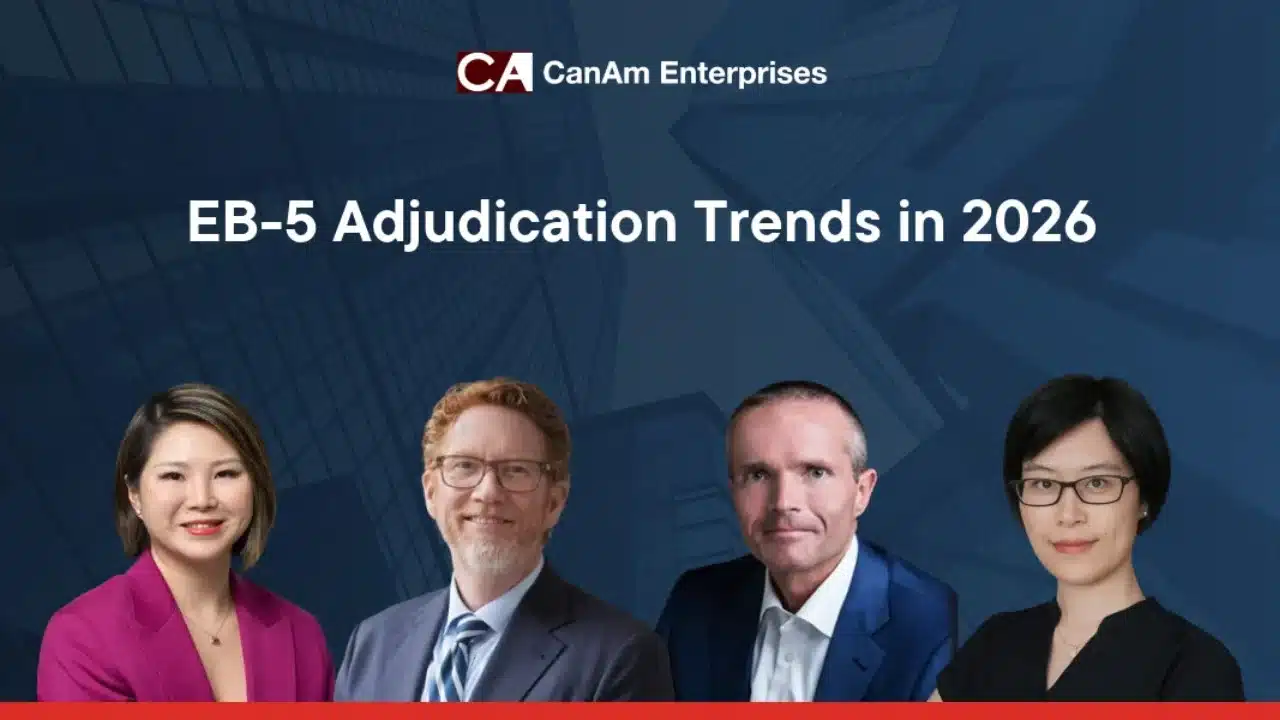
The discussion brought together Nicolai Hinrichsen, a partner at Miller Mayer; Michael Dye, founder of a full-service immigration firm in Southern California and a former U.S. diplomat; and Sophie Zhang, a partner at Reid & Wise who has represented EB-5 investors since 2009. What follows is an overview of their conversation. The full recording is linked below.
The Panel
Nicolai Hinrichsen, Partner, Miller Mayer, LLP. Based in Ithaca, New York, Hinrichsen has more than a decade of EB-5 experience and represents regional centers, developers, and individual investors. He practiced corporate and securities law in San Francisco and Paris before focusing on immigration, and holds a J.D. from Boston University School of Law and a B.A. from UC Berkeley. He is admitted in New York and California and speaks regularly at EB-5 events worldwide.
Michael B. Dye, Founder, Law Office of Michael B. Dye. A former U.S. diplomat, Dye spent more than 15 years in U.S. government roles across Asia, the Middle East, Europe, and Latin America before founding his full-service immigration firm in Aliso Viejo, California. He advises investors, entrepreneurs, and companies on EB-5, business expansion, and consular processing. He is admitted in California and the District of Columbia and is a member of the American Immigration Lawyers Association.
Yuxia “Sophie” Zhang, Member, Reid & Wise LLC. Based in New York, Zhang has extensive EB-5 experience across both regional center and direct investment cases, representing individual investors, companies, regional centers, and industry associations. Qualified to practice Chinese law, she frequently works with Chinese investors and companies operating in the U.S. She holds an LL.M. from Columbia Law School, is admitted in New York, and is a member of AILA and IIUSA.
The discussion was moderated by Min Wu, Head of Sales at CanAm Enterprises.
More Requests, Steady Approvals
The most important clarification from the panel: the rise is in Requests for Evidence and Notices of Intent to Deny, not necessarily in denials themselves.
“I’m not sure there are more denials,” Hinrichsen said. “There are more RFEs and NOIDs, but our approval rate is holding more or less steady.” Dye made the same point, describing denials as still a small percentage of the cases that come through. The experience of a tougher environment is real, but it shows up as more scrutiny and more back-and-forth, not as a collapse in approval odds.
What has changed is the margin for error. A Notice of Intent to Deny can now arrive where a Request for Evidence once would have, and the window to respond is shorter. The petitions that clear cleanly are the ones prepared with that reality in mind.
The Algorithm Is Reading the File
The panel’s most striking observation was shared by all three attorneys independently: USCIS appears to be using artificial intelligence to cross-check EB-5 petitions against an applicant’s earlier immigration filings.
“We think USCIS is probably using AI in some capacity,” Hinrichsen said. “It does seem to be picking up things that they ordinarily would not have seen.” Dye described Requests for Evidence that flagged mismatched apartment numbers between an EB-5 petition and prior nonimmigrant visa applications. Zhang reported the same pattern, extending to local-law and tax-compliance questions across filings.
Consistency across every application in a family’s immigration history now matters as much as the strength of any single document.
When the Request Is for Records That No Longer Exist
Source of funds drew the sharpest scrutiny of any topic on the panel. The attorneys described Requests for Evidence asking for documentation that reaches back decades. “A typical request now is bank statements or tax documents from twenty or thirty years ago,” Zhang said, records that in many cases no longer exist.
The answer is preparation, not alarm. Experienced counsel has a set of approaches for proving a source of funds when original records are gone. The full discussion covers what those look like.
A Tough Notice Is Not a Verdict
For investors who receive a Request for Evidence or a Notice of Intent to Deny, the panel’s message was steady. These notices are serious and time-sensitive, but they are not the end of a case. “Don’t be scared by those three or four pages,” Zhang said, noting that a multi-page notice is often a template and that alternative proof almost always exists.
The attorneys shared specific cases that turned around after a denial, along with a practical sequence for responding when a notice arrives. The full discussion walks through both.
The throughline was preparation. The environment has tightened, but a well-documented petition, an experienced attorney, and a credible regional center remain the combination that works.
Also in the Discussion
The discussion covered three further topics worth noting. The window to file before the year-end investment threshold increase is closing fast; the attorneys said only straightforward cases still have enough runway to file in time. They also weighed when a partial-fund filing makes sense and when it does not, a decision that turns on how fully the source of funds is identified and ready. And they noted that motion-to-reopen response times have shortened considerably, from more than a year to as little as one to three months, which changes the calculus after a denial. Each of these is covered in full in the recording.
Watch the Full Discussion
The complete panel discussion covers each of these topics in depth, including real case examples and the attorneys’ advice for investors preparing to file before the year-end investment threshold increase. The full webinar is now available on our YouTube channel.
About CanAm Enterprises
CanAm Enterprises is one of the longest-running EB-5 regional center operators, with more than 20 years of focus on the EB-5 program and a verified track record: over $4.3 billion in EB-5 capital raised, more than $2.5 billion repaid to investors, and over 6,100 I-526 and I-526E petition approvals. In an environment that rewards preparation and documentation rigor, that experience is the difference between a petition that stalls and one that clears.
Ready to explore EB-5? See CanAm’s current EB-5 offerings.