Disponibilidad y asignación de visados EB-5: Preguntas y respuestas para 2025
A medida que crece la demanda de EB-5 y se reduce la oferta de visados, la selección del momento oportuno y de la categoría es más importante que nunca. Para ayudar a navegar por estas complejidades, CanAm encargó a Suzanne Lazicki la redacción de este libro blanco, que ofrece respuestas basadas en datos a las preguntas más habituales sobre los retrasos en la tramitación de visados, la elección de categorías y el Boletín de Visados.
Compara el historial de reembolso de capital de CanAm con el de cualquier otro centro regional y comprueba por qué miles de familias de inversores inmigrantes nos han confiado sus viajes EB-5.
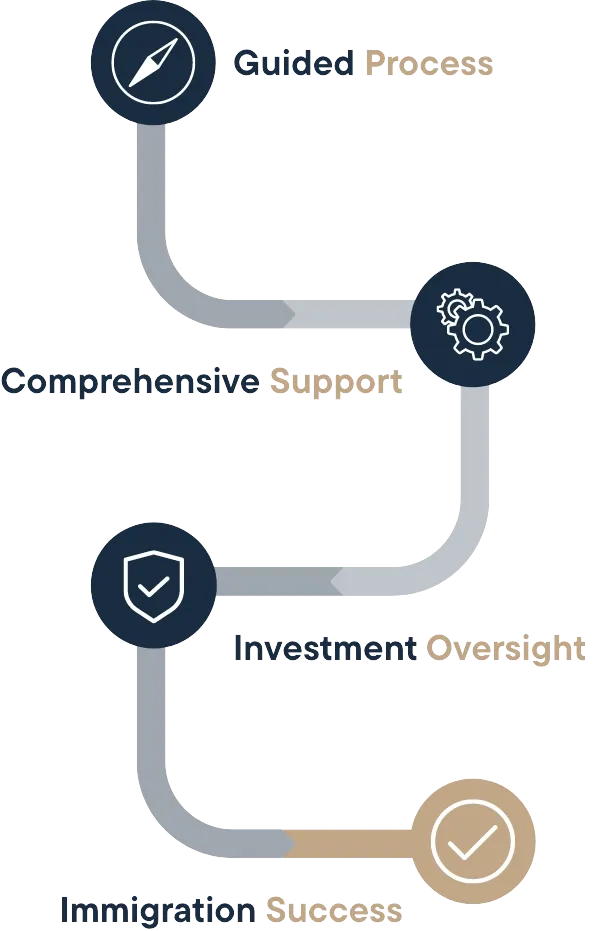
Nuestro equipo experimentado lo guiará a través de todo su proceso EB-5 con pasos claros y manejables:
PASO 1
Conéctese con nosotros
Comience su viaje hacia la Tarjeta Verde conectándose con nuestro equipo de expertos.
PASO 2
Revisar y enviar
Revise con confianza los documentos de oferta esenciales y envíe su petición I-526E con nuestra orientación dedicada.
PASO 3
Prepárese para la entrevista
Prepárese completamente para su entrevista en el Consulado con la asistencia profesional y personalizada de CanAm.
PASO 4
Presentar la petición I-829
Obtenga con éxito la residencia permanente en EE. UU. presentando su petición I-829 con nuestro apoyo continuo
Lo que ofrecemos: Calidad y oportunidad
CanAm ofrece proyectos de inversión de alta calidad que cumplen con todos los requisitos del USCIS para el Programa de Visas EB-5.
Conectamos a inversionistas extranjeros calificados con promotores de proyectos de renombre. Esto le permite obtener la residencia permanente en EE. UU. y, al mismo tiempo, contribuir a la economía estadounidense mediante la creación de empleo y el crecimiento económico.
El Programa de Visas EB-5:
Su inversión. Su futuro.
El Programa EB-5 ofrece a inversores extranjeros calificados la oportunidad de obtener la residencia permanente (una “tarjeta verde”) a cambio de invertir $800,000 en proyectos ubicados en Áreas de Empleo Específicas (TEAs) que creen al menos diez empleos permanentes de tiempo completo para trabajadores estadounidenses.
Presentación concurrente:
¡Quédese en Estados Unidos mientras espera!
Descubra los importantes beneficios de la presentación concurrente. Si ya se encuentra en EE. UU. con una visa de no inmigrante válida, podría ser elegible para:
¡Explora los beneficios hoy mismo! Podrías ser elegible para:
Documento de autorización de empleo
Trabajar en los EE. UU. para cualquier empleador sin patrocinio con un Documento de Autorización de Empleo (EAD).
Permiso de viaje
Viaje dentro y fuera de los EE. UU. libremente con un permiso de viaje.
TESTIMONIOS
Escuche de los clientes de CanAm
"El equipo de CanAm trabajó muy duro para que nuestra solicitud fuera muy completa. Recibimos informes sobre el estado de nuestra inversión con regularidad."
INVERSORProyecto de la Universidad de Temple
"El equipo de CanAm fue siempre receptivo y mantuvo las cosas actualizadas de forma proactiva siempre que se le solicitó".
INVERSOR, SR. MProyecto Miamicentral
"Gracias a todos vosotros en CanAm, estoy viviendo realmente mi sueño y no tengo más palabras para expresar mi gratitud. "
INVERSOR, SR. CProyecto Todo a Bordo Florida
"CanAm ha dado un ejemplo asombroso devolviendo la cantidad en esta desesperada y caótica situación de pandemia en la que todo el sector está sufriendo dramáticamente".
INVERSORA, SRA. CHProyecto Todo a Bordo Florida
"Durante una economía turbulenta y algunos cambios rápidos en la interpretación de la legislación EB5, CanAm demostró ser la mejor empresa EB-5. Me mantuvieron al día constantemente sobre el progreso de mi EB-5/tarjeta verde, y nunca me preocupé por la seguridad o el retorno de mi inversión."
Inversor, MR. BCentro Convencional PA
"Me gustaría dar las gracias a CanAm por vuestro excelente trabajo, vuestra capacidad fiable y digna de confianza y vuestro apoyo duradero a los socios. Ha sido una gran experiencia trabajar con vosotros".
Inversor, MR. YProyecto PCC
CanAm Enterprises:: 20 años en EB-5
CanAm celebró recientemente nuestro 20º Aniversario en EB-5. Mira nuestro vídeo conmemorativo de los muchos hitos que nos han llevado hasta aquí.