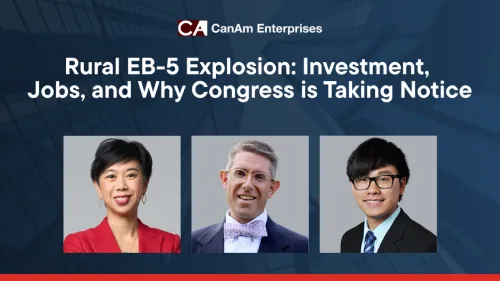
Key takeaways from CanAm’s webinar with WR Immigration’s Joey Barnett and Charlie Oppenheim
The March 2026 Visa Bulletin carries more than the usual monthly update. A Presidential Proclamation, a footnote that reshaped how many read the employment-based date movements, and continued good news for EB-5 investors in the reserved categories. For anyone navigating the EB-5 process right now, or evaluating whether to start, the March bulletin carries meaningful signals about both the opportunity in front of you and the urgency of acting on it.
To break it all down, CanAm Enterprises hosted a live webinar with two of the leading voices in EB-5 immigration: Charlie Oppenheim, Director of Visa Consulting at WR Immigration and former 23-year chief of immigrant visa control at the U.S. Department of State, and Joey Barnett, Partner at WR Immigration. Charlie is the person who set the final action dates for over two decades. His read of the Visa Bulletin, in Joey’s words, the one everyone in the industry listens to.
This post summarizes the key takeaways from that conversation. Each topic will be covered in greater depth in the follow-on posts in this series.
Why Employment-Based Priority Dates Advanced in March 2026 (And What It Means for EB-5)
Many employment-based priority dates moved forward significantly in the March bulletin. For investors or professionals tracking EB-2 and EB-3 categories, this looked like a real breakthrough. Charlie and Joey were clear: it is not.
The State Department advanced those dates intentionally to maximize visa number use during the period when a Presidential Proclamation is restricting the processing of nationals from approximately 75 countries. This is an artificial movement, not organic demand reduction. If and when the proclamation is lifted and those countries resume normal processing, demand will return, and the dates could retrogress.
Charlie’s advice: do not read too much into these movements, and do not make immigration decisions based on the assumption they will continue at the same pace.
Good News for EB-5: Reserved Categories Remain Current in 2026
All three EB-5 reserved categories remain current for March 2026:
- Rural (20% of reserved visas)
- High Unemployment Area, or HUA (10%)
- Infrastructure (2%)
Chart B also remains available, meaning investors already in the United States can continue to file concurrently: submitting their I-526E petition and their adjustment of status application at the same time. This benefit has never been available in prior EB-5 eras and is, as Joey put it, “a once in a lifetime opportunity” for eligible investors.
Both Joey and Charlie emphasized that this current status will not last indefinitely. Based on current data and the absence of any warning footnote in the March bulletin, they expect the categories to remain current through at least April or May 2026. After that, the outlook becomes harder to predict.
EB-5 FOIA Data 2025: What We Know About Petition Approvals and What’s Still Missing
One of the most consistent themes across the webinar was how much the industry is operating with incomplete information. The most current FOIA data available runs only through July 2025. The State Department stopped publishing monthly visa issuance data after May 2025. The National Visa Center waiting list report has not been updated since November 2023.
Joey Barnett has filed a new FOIA request for data through January 2026 and is prepared to litigate it if necessary. When that data becomes available, it will be shared publicly. Until then, the industry is making its best projections from an incomplete picture.
EB-5 Rural vs. High Unemployment Area: Why Rural Petitions Are Being Approved Faster
FOIA data through July 2025 shows a striking gap in how USCIS is processing the two main reserved categories. Rural cases represent 81% of all adjudications in the reserved pool, despite having only slightly more receipts than HUA. High unemployment area cases account for just 16% of adjudications despite comparable filing volume.
This means 45% of all rural receipts have already been adjudicated, compared to only 8% of HUA receipts. The practical implication: if this pace continues, rural investors can expect a final action date to arrive before HUA investors face one, even though HUA has fewer visa numbers available annually.
EB-5 Final Action Date 2026: When Will Rural and HUA Categories Retrogress?
Based on current data, both Joey and Charlie believe the reserved categories will remain current through the first half of fiscal year 2026, meaning no final action dates through at least April or May. But the math of visa supply versus demand makes a backlog inevitable.
With an estimated annual rural reserved visa limit of 4,262 (including carryover from FY 2025) and well over 7,500 estimated rural receipts already on file, demand clearly outpaces the available supply. The same is true for HUA, where demand is approaching or exceeding the 2,130 estimated annual limit.
Charlie added an important wrinkle: cases are not being processed strictly in filing date order. That means when final action dates are eventually imposed, they could land closer to 2024 or 2025 rather than the 2022–2023 range many might expect. This has a potential boomerang effect: initial dates that look favorable could retrogress once earlier-priority cases are approved and become ready for final action.
EB-5 Infrastructure Category: A Lower-Competition Path for Early Filers
FOIA data showed zero infrastructure adjudications, but this is a known data error in how USCIS ran the query. Infrastructure petitions do exist and are being processed. The low queue depth means investors filing in the infrastructure category today may be near the front of any line that develops, particularly for Chinese and Indian nationals who may capture otherwise unused rest-of-world numbers.
Key Takeaways: What Charlie Oppenheim Says About EB-5 Visa Processing in 2026
Charlie closed with four formal observations that summarize the current state of the program:
- No indication exists that final action dates are needed during at least the first half of FY 2026, despite the January 2025 Visa Bulletin having issued an earlier warning.
- USCIS does not appear to be processing rural or HUA petitions in strict filing date order. This matters significantly for where final action dates will land when they do appear.
- It remains unclear how quickly USCIS will adjudicate Form I-485 adjustments after I-526E approval, adding another variable to overall timeline estimates.
- The State Department and USCIS must dramatically increase immigrant visa scheduling. That pace will be the primary factor determining when final action dates are imposed in the second half of FY 2026.
Ready to Discuss Your EB-5 Options?
CanAm Enterprises has spent over 35 years helping investors navigate EB-5, including every market cycle, program lapse, and legislative change the program has seen. Our track record speaks for itself:
- $4B+ in EB-5 capital raised from 8,000+ investors
- 75+ projects funded across real estate, life sciences, clean energy, and digital infrastructure
- 100% USCIS project approval rate
- 4,580+ investor families repaid
- 5,800+ I-526 and I-526E petition approvals
The window for concurrent filing is still open. Contact our team to learn more about current EB-5 opportunities and get personalized guidance on your path to U.S. permanent residency.
Contact us at info@canamenterprises.com or +1 (212) 668-0690.
About the Webinar Speakers
Charlie Oppenheim, Director of Visa Consulting, WR Immigration
Charlie Oppenheim served for 23 years as Chief of Immigrant Visa Control at the U.S. Department of State, where he was personally responsible for setting the final action dates published in each monthly Visa Bulletin. His decisions facilitated the immigration of over 9 million people to the United States. He has testified before congressional immigration subcommittees and consulted with the White House on immigration policy. He now serves as Director of Visa Consulting at WR Immigration.
Joey Barnett, Partner, WR Immigration
Joey Barnett is a Partner at WR Immigration, one of the largest EB-5 immigration law firms in the world, with 15 attorneys holding over 10 years of EB-5 experience. WR Immigration files approximately 15% of all EB-5 cases annually. Joey advises investors and regional centers on the full EB-5 process, from source of funds through permanent green card.
Peter Calabrese, CEO, CanAm Investor Services
Peter Calabrese serves as CEO of CanAm Investor Services, the FINRA-registered broker-dealer affiliate of CanAm Enterprises. He has been a leading voice in EB-5 investment immigration and oversees CanAm’s investor-facing operations and business development.