Something significant happened inside USCIS in the third quarter of 2025. After more than a year of processing roughly 400 individual investor petitions per quarter, the agency approved over 1,000 cases in a single three-month period. For an EB-5 industry accustomed to cautious optimism, this spike in adjudications felt like a turning point.
But alongside this encouraging news comes a more complicated picture. The same surge in approvals that investors have been waiting for may also set the stage for final action dates (FADs) for certain countries, creating what analysts are calling an invisible backlog. Understanding both sides of this dynamic is essential for anyone navigating the EB-5 program today.
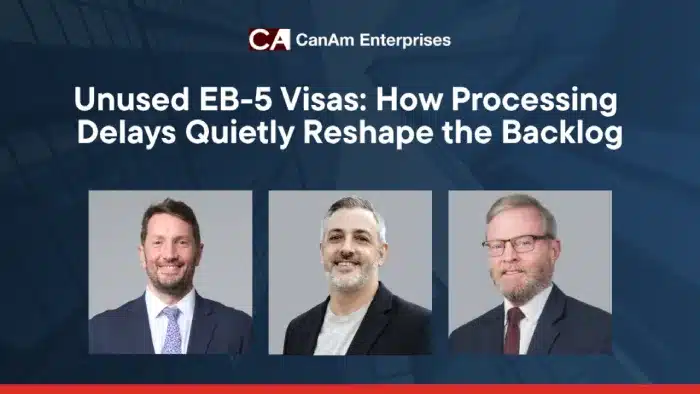
In a recent webinar, Chief Operating Officer Christine Chen and Lee Li, IIUSA’s Director of Policy Research and Data Analytics, break down the latest adjudication data, explain what a 90%+ approval rate really means for post-RIA investors, and walk through the conditions that could trigger a backlog in reserved visa categories.
The Q3 2025 Approval Spike: What the Data Shows
For most of the post-RIA period, USCIS adjudicated EB-5 investor petitions at a modest pace. The numbers tell the story plainly:
- 2023 (full year): 63 I-526 and I-526E approvals
- 2024 (full year): Over 1,000 approvals
- 2025 (first three quarters only): Already more than 1,800 approvals, with Q3 alone exceeding 1,000
“The biggest update is that the agency suddenly approved so many cases in Q3 2025,” Li explained. “Before this quarter, we usually saw around 400 case approvals every quarter. But this quarter alone, they approved over 1,000 cases, which is a big spike.”
Christine Chen reflected the cautious relief many in the industry felt: “For many of us who saw the numbers coming out of USCIS initially, there was a lot of worrying and hand-wringing about visas being wasted and slow adjudication times. We are finally seeing the pace of adjudications closer to where they need to be for this program to run smoothly.”
Visa Usage and the Risk of Wasted Reserved Visas
The approval surge matters for more than just investors waiting on decisions. Under the EB-5 program, reserved visa categories (rural, high-unemployment area, and infrastructure) carry over for only one year before being lost if not used. With a large pipeline of petitions filed but not yet approved, unused visas represented a real and costly risk.
“We know we have so many investors who have already filed their petitions, but we did not see a lot of visa numbers being used,” Li noted. “That means most of the visas could be lost from the reserve category if they are not used in the next year.”
Chen put the stakes in perspective: “For an industry that is always short on visas, wasting any is such a tragic loss for us.”
The Q3 2025 spike in approvals offered hope that more petitions could translate into visa usage in the second half of fiscal year 2025, reducing the likelihood of visa loss from reserved categories. But whether this pace of adjudication would continue remained an open question.
The 90%+ Approval Rate: A Post-RIA Achievement
Alongside the volume data, the quality of adjudications has also improved markedly. For I-526E petitions filed under the RIA, the approval rate now exceeds 90%.
This number is striking in context. As Li pointed out, the approval rate for direct EB-5 I-526 petitions (standalone investors not using a regional center) sits at only around 25%. The contrast illustrates just how much the RIA’s structural changes have strengthened the regional center model.
“For 2025, we have a big spike in approvals. So we have a larger data sample, and the approval rate is still over 90%, which I think is very high,” Li said. “And this is not just a post-RIA trend because if you look at direct EB-5 investors, the approval rate is not even over 25%.”
Why Project Approval First Matters
The RIA’s requirement that an I-956F project approval (or at minimum a filed I-956F receipt) precede investor I-526E filings has had a measurable downstream effect. Investors who enter projects with already-vetted I-956F filings benefit from an additional layer of USCIS review before their own petition is considered.
“The fact that projects have to be approved before individual investor petitions get approved means that there is a stage of certainty at that level,” Chen observed. “A lot of the patterns of behavior that we now know to avoid have meant that most petitioners have a much clearer path towards approval.”
Li agreed: “The project has to be approved or at least filed before the investors can file their 526Es. That definitely boosts the approval rate and the quality of the projects, and also provides a lot of certainty to investors, too.”
The Invisible Backlog: Could Final Action Dates Arrive Soon?
The same adjudication acceleration that is good news for approved investors creates a new concern: as approvals accumulate, demand for visas in reserved categories could outpace annual supply, triggering final action dates (FADs). This is the scenario analysts have been calling the “invisible backlog.”
Li walked through the mechanics: after an I-526E is approved, the case still transfers to another department for the I-485 adjustment of status adjudication before a visa can actually be issued. That transition introduces roughly a six-month lag between petition approval and visa usage.
“My guesstimate is about a six-month delay,” Li said. “So I do not think there will be any cutoff date in the first half of 2026. The December visa bulletin had no warning about an upcoming cutoff. January or even February should be current for the reserve category. However, when we enter the second half of fiscal year 2026, it is hard to say.”
The key variable is sustainability. If USCIS continues approving more than 1,000 cases per quarter, the conditions for a cutoff date become more likely. If Q3 2025 turns out to be an anomaly, the timeline shifts.
China and India: Countries Most at Risk for FADs
For investors from high-demand countries, particularly China and India, the potential for final action dates deserves particular attention. These two countries represent the largest share of post-RIA EB-5 filings and have historically experienced the most significant retrogression under general visa categories.
Chen noted that the industry has been in this position before. During the period after 2017, retrogression led to a significant drop in filings as wait times stretched substantially longer. Rural EB-5 projects with reserved visa allocations and priority processing offer the clearest path to avoiding that scenario.
What This Means for EB-5 Investors Today
The current moment in post-RIA EB-5 adjudications presents both opportunity and urgency. Approval rates are high, processing times are improving, and USCIS is demonstrating meaningful capacity. At the same time, the conditions for a future backlog may be forming.
For prospective investors, several considerations stand out:
- Rural projects continue to offer the strongest protection against future FADs through reserved visa allocations and priority processing.
- The 90%+ approval rate for I-526E petitions underscores the value of investing through established regional centers with strong I-956F track records.
- The next quarter’s USCIS data will be critical to watch. Sustained high approval numbers increase the likelihood of second-half FY2026 cutoffs; a return to 400 per quarter eases that pressure.
- Investors from China and India should evaluate the visa availability picture carefully and consult with experienced immigration counsel about timing.
Conclusion: A Promising Trend That Warrants Close Monitoring
The Q3 2025 adjudication spike represents the most encouraging sign yet that USCIS has the capacity to process post-RIA petitions at a meaningful pace. A 90%+ approval rate for I-526E petitions confirms that the structural reforms introduced by the RIA are working as intended.
At the same time, the possibility of final action dates arriving in the second half of FY2026 introduces a new variable that investors and their counsel must track carefully. Rural EB-5 projects remain the strongest hedge against that risk.
In Part 5 of this series, we examine the rural EB-5 explosion in detail, including the extraordinary growth in rural investment, job creation numbers, and why Congress is increasingly focused on what rural EB-5 has achieved.
Ready to Invest with Confidence in a Post-RIA World?
CanAm Enterprises has been helping EB-5 investors navigate every phase of the program since 1987. With a 100% USCIS project approval rate across 75+ projects and 15 I-956F approvals under the RIA, our track record speaks for itself.
- $3.9B+ raised in EB-5 capital
- $2.5B+ returned to EB-5 investors
- 16,900+ conditional green cards and 9,300+ permanent green cards
- Rural, urban TEA, and infrastructure projects across 30+ U.S. states
Contact our team to discuss how CanAm’s projects align with your immigration and investment goals.
Email: info@canamenterprises.com | Phone: +1 (212) 668-0690
About the Speakers
Christine Chen
Chief Operating Officer, CanAm Enterprises
Christine Chen serves as COO of CanAm Enterprises, one of the longest-operating regional centers in the EB-5 industry. She oversees operations and investor relations across a portfolio that has raised over $3.9 billion in EB-5 capital and facilitated more than 16,900 conditional green cards.
Aaron Grau
Executive Director, IIUSA
Aaron Grau is the Executive Director of Invest in the USA (IIUSA), the national trade association for the EB-5 Regional Center Program. IIUSA leads industry advocacy, education, and policy research to support continued program growth and integrity.
Lee Li
Director of Policy Research & Data Analytics, IIUSA
Lee Li is the Director of Policy Research & Data Analytics at IIUSA, where he leads the organization’s data collection and analysis efforts. His research provides the EB-5 industry with critical insights into filing trends, processing times, and program performance.