When Congress passed the EB-5 Reform and Integrity Act in 2022, it created three set-aside categories designed to prioritize certain types of investments: rural area projects, high-unemployment area (TEA) projects, and infrastructure projects. While rural and TEA projects have gained significant traction in the market, infrastructure set-asides remain one of the EB-5 program’s best-kept secrets.
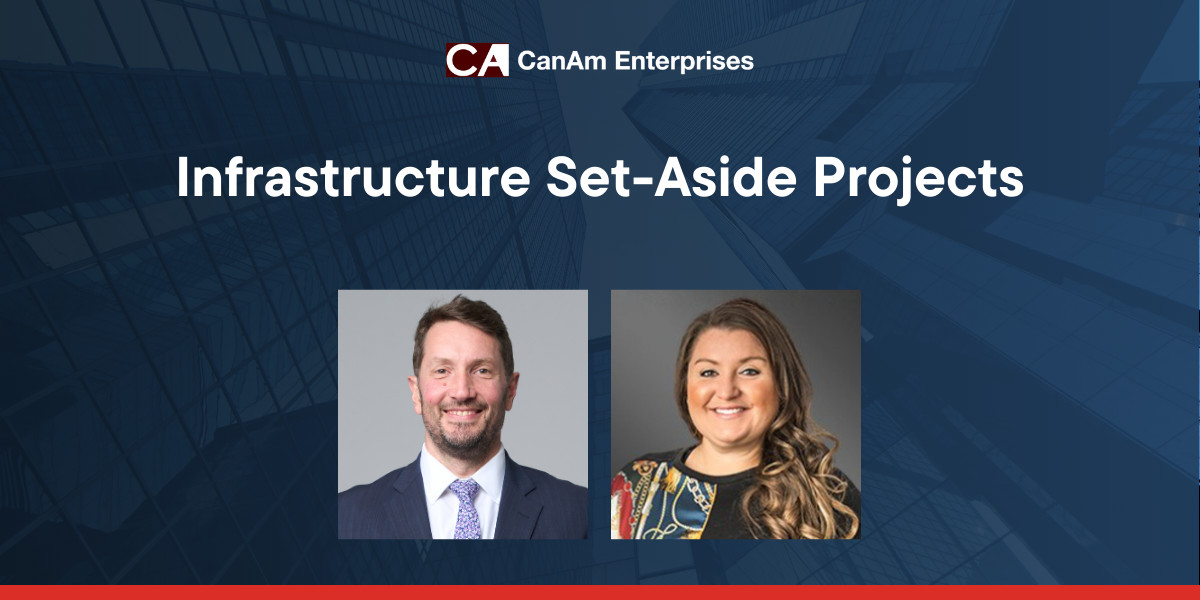
In a recent educational webinar, Peter Calabrese, CEO of CanAm Investor Services, and Jennifer Hermansky, Shareholder at Greenberg Traurig and National EB-5 Committee Chair for AILA, explored the unique characteristics, benefits, and considerations of infrastructure set-aside projects. This article summarizes their discussion and outlines what investors and advisors should understand about this lesser-used EB-5 category.
What Are Infrastructure Set-Aside Projects?
Infrastructure set-aside projects represent a specific category within the EB-5 program designed to encourage governmental entities to utilize EB-5 capital for public works initiatives. According to Hermansky, “This was an incentive put in the law to try to facilitate these types of public works projects” that benefit local communities.
Unlike most EB-5 projects, which are sponsored by private developers, infrastructure set-aside projects must be administered by a governmental entity and structured to meet a narrow statutory definition.
Two Critical Requirements
For a project to qualify as an infrastructure set-aside, it must meet two distinct criteria:
- Governmental Entity as Job-Creating Entity (JCE)
The project must be administered by a governmental entity—federal, state, or local agency or authority. This governmental entity must serve as the job-creating entity that contracts with the regional center or New Commercial Enterprise (NCE) to receive EB-5 capital investments.
As Calabrese explained, “It’s a public-private partnership where a private entity is the actual borrower, the actual JCE, so it wouldn’t qualify for the set-aside.” The governmental entity must be the actual borrower under a loan or the recipient of an equity investment.
This distinction is critical and often misunderstood in the market, particularly where projects may have a public benefit but are ultimately structured with a private borrower or JCE.
- Public Works Project
The Reform and Integrity Act specifies that infrastructure projects must involve maintaining, improving, or constructing public works. While the law does not provide an exhaustive definition, Hermansky explained that qualifying projects generally include initiatives that deliver a clear public benefit.
- Green spaces and parks
- Roads and highways
- Community redevelopment areas
- Spaces designed for public use and benefit
“It’s not just a highway or a bridge,” Hermansky noted. “It’s taking some space and then doing something to it to elevate it for better public use.”
Key Benefits of Infrastructure Set-Asides
Infrastructure projects offer two primary benefits for EB-5 investors:
Lower Investment Threshold
Like rural and high-unemployment area projects, infrastructure set-asides qualify for the reduced EB-5 investment amount of $800,000, rather than the $1,050,000 required for non–set-aside projects.
Dedicated Visa Allocations
The Reform and Integrity Act allocates 2% of annual EB-5 visas specifically to infrastructure projects. With approximately 10,000 EB-5 visas available each year, this translates to roughly 200 visas reserved annually for infrastructure investors.
Unused visas roll over from one fiscal year to the next, allowing availability in this category to accumulate over time.
The Market Reality: Limited Supply, Limited Demand
Perhaps the most compelling aspect of infrastructure set-asides is the current market dynamic. As Calabrese noted, “I’ve seen very few projects in the market that meet that criteria or at least have been marketed as such.”
Infrastructure projects remain scarce due to their narrow statutory definition and structural complexity. At the same time, demand has been minimal relative to other set-aside categories.
“There has not been a high demand at all for this type of project, and there’s just not that much of a supply of this type of project out there in the market for investors,” Hermansky confirmed.
Based on recent USCIS data discussed during the webinar, there have been no adjudications of infrastructure set-aside petitions to date. As a result, visa numbers in this category are widely expected to remain current for an extended period.
For investors concerned about retrogression, this imbalance between visa supply and demand may represent a meaningful strategic advantage.
Why Infrastructure Projects Are Difficult to Find
The strict definition of infrastructure set-asides creates significant barriers to entry that explain their scarcity in the market.
Public–Private Partnership Limitations
Many projects that could benefit communities and add to infrastructure in a general sense don’t qualify for the set-aside because they involve private entities as borrowers or job-creating entities.
“We’ve had projects that we’ve worked on in the past that have definitely fit that first type of definition—train lines, public works that definitely would seemingly be adding to the infrastructure,” Calabrese explained. “But when it comes down to it, it’s meeting that actual definition.”
Hermansky added that USCIS has not provided guidance on whether public-private partnerships could qualify, even if part of the project is infrastructure-related. “The way that the law is written, it seems like they wanted the project itself to be fully administered by some level of government agency.”
Administrative Complexity
Infrastructure set-asides require governmental entities to assume roles that may be unfamiliar, including:
- Acting as the direct borrower or equity recipient of EB-5 capital
- Serving as the job-creating entity
- Contracting with regional centers and NCEs
- Administering the project under EB-5 compliance requirements
These added layers of complexity have limited the number of governmental bodies willing or able to pursue this structure.
How Infrastructure Projects Compare to Other Set-Asides
Understanding the differences between infrastructure and other set-aside categories can help investors make informed decisions.
Investment Amount
All three set-aside categories (rural, high-unemployment, and infrastructure) qualify for the $800,000 investment threshold, compared to $1,050,000 for standard EB-5 investments.
Visa Allocations
Each set-aside category has dedicated visa reserves:
- Rural: 20% of annual visas (~2,000)
- High Unemployment Area: 10% of annual visas (~1,000)
- Infrastructure: 2% of annual visas (~200)
Project Availability
Rural and TEA projects have become increasingly popular, with thousands of I-526E petitions filed in these categories. Infrastructure projects remain rare due to their strict qualifying criteria.
Retrogression Outlook
Rural projects have seen the most demand and may face retrogression sooner. High-unemployment area projects have moderate demand. Infrastructure projects currently have minimal demand relative to visa availability, suggesting the best near-term outlook for visa currency.
Due Diligence for Infrastructure Projects
While infrastructure projects offer unique benefits, investors should conduct thorough due diligence just as they would for any EB-5 investment.
Verify Governmental Entity Status
Hermansky recommends that investors “look in the offering documents about how the project is structured.” Key questions include:
- Is the borrower entity a federal, state, or local government agency or authority?
- Is the governmental entity acting as the job-creating entity?
- How are jobs being created and attributed?
Assess the At-Risk Requirement
“Even though it’s an infrastructure project and it is a government entity that is going to ultimately be the JCE, it doesn’t mean it’s guaranteed,” Calabrese emphasized. “Your at-risk provision is still very much a part of an infrastructure EB-5 project.”
Investors should evaluate:
- Job creation sufficiency: Is there adequate job creation with a reasonable buffer?
- Capital protection: What collateral and security mechanisms protect investor capital?
- Capital stack position: Where do EB-5 investors sit in priority?
- Exit strategy: What is the timeline and plan for repayment?
Strong Underwriting Standards
Calabrese stressed the importance of “good strong fundamentals to make sure for capital preservation and safety of the return of funds for investors.”
Even with governmental involvement, infrastructure projects should demonstrate:
- Conservative underwriting standards
- Adequate collateral
- Clear repayment mechanisms
- Reasonable project timelines
- Proper risk mitigation strategies
The Public Benefit Alignment
Infrastructure projects align closely with the original intent of the EB-5 program: to stimulate the U.S. economy through foreign direct investment while creating jobs for U.S. workers.
“A lot of times when people think about EB-5, it’s going towards our communities—it’s foreign direct investment in the U.S.; it’s job-creating, it’s elevating spaces to a better, more productive use for an entire community,” Hermansky observed. “It’s exactly what is intended by the EB-5 law.”
This alignment with public benefit may provide additional comfort for investors seeking to make a positive impact while pursuing U.S. permanent residency.
Looking Ahead: A Hidden Opportunity
As the EB-5 landscape continues to evolve, infrastructure set-asides represent what Calabrese called “a hidden little gem in the overall visa set-aside category.”
With dedicated visa allocations, minimal current demand, and the potential for meaningful community impact, infrastructure projects offer a distinct pathway for EB-5 investors—when properly structured projects become available.
The challenge lies in finding projects that meet the strict definition. For investors and their advisors, understanding these requirements is the first step in identifying legitimate infrastructure opportunities if and when they enter the market.
“When done right, I think that there are definitely a lot of great potential outcomes for working through this set-aside,” Calabrese concluded.
Key Takeaways
- Infrastructure set-asides require governmental entities to serve as the JCE and borrower
- Projects must involve maintaining, improving, or constructing public works
- Investors benefit from an $800,000 investment threshold and 200 annual visa allocations
- Minimal market demand suggests lower retrogression risk compared to other categories
- Public-private partnerships face uncertainty and likely don’t qualify
- Strong due diligence remains essential despite governmental involvement
- Projects are rare due to strict qualifying criteria and administrative complexity
For investors exploring all EB-5 pathways to U.S. permanent residency, infrastructure set-asides deserve consideration—particularly for those concerned about retrogression and visa availability in more popular categories.
About the Speakers
Peter Calabrese is the Chief Executive Officer of CanAm Investor Services, LLC, the FINRA-registered broker-dealer affiliate of CanAm Enterprises, one of the most successful regional centers in the EB-5 program’s history. Prior to joining CanAm in 2015, Mr. Calabrese worked for 15 years in institutional sales and trading, focusing on equity derivatives and volatility products with firms including ICAP and WallachBeth Capital. He earned a Bachelor’s degree in Business Economics from Brown University and holds FINRA Series 7, 24, 63, and 66 licenses. Under his leadership, CanAm Enterprises has raised over $3 billion in private placement funds and created more than 100,000 U.S. jobs through its EB-5 projects.
Jennifer Hermansky is a Shareholder at Greenberg Traurig LLP in Philadelphia, where she focuses on employment-based immigration and leads the firm’s EB-5 practice. She has structured over $3 billion in EB-5 capital raises and has successfully guided thousands of families through the EB-5 process, filing I-526, I-526E, and I-829 petitions for both regional center and direct EB-5 investors. Currently serving as the National EB-5 Committee Chair for the American Immigration Lawyers Association (AILA), Ms. Hermansky is a recognized thought leader who frequently speaks at national and international conferences. She has been named to EB5 Investors Magazine’s “Top 25 Attorneys” multiple times since 2013 and earned her law degree cum laude from Drexel University’s Earle Mack School of Law.