Visa Limits Constrain the Use of EB-5
The potential for EB-5 to drive investment and job creation depends on visas. EB-5 has an annual quota of about 10,000 visas [1] which have historically been issued 38% to investors and 62% to spouses and children [2]. In other words, the EB-5 quota effectively supports about 3,800 annual EB-5 investments. Actual EB-5 demand has periodically surged above this threshold, resulting in economic benefits followed by visa applicant backlogs and then plummeting demand.
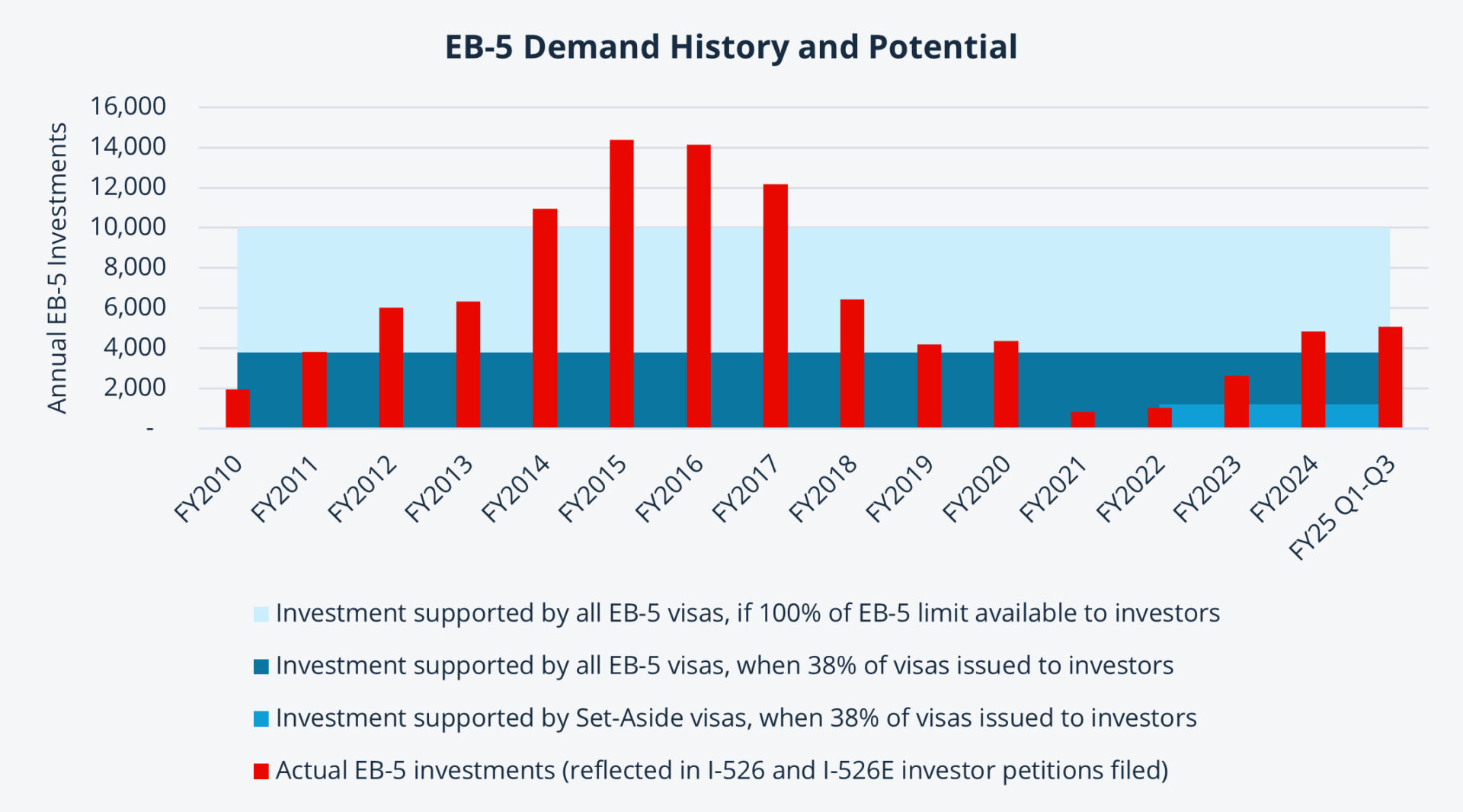
Post-RIA EB-5 Demand Exceeds EB-5 Quota Limits
The EB-5 Reform and Integrity Act set aside 32% of EB-5 visas to incentivize new investment in Rural, High Unemployment, and Infrastructure projects. The set-aside incentive has been very successful, to the point that investors have overwhelmed the set-aside visa allocation and set the stage for retrogression.
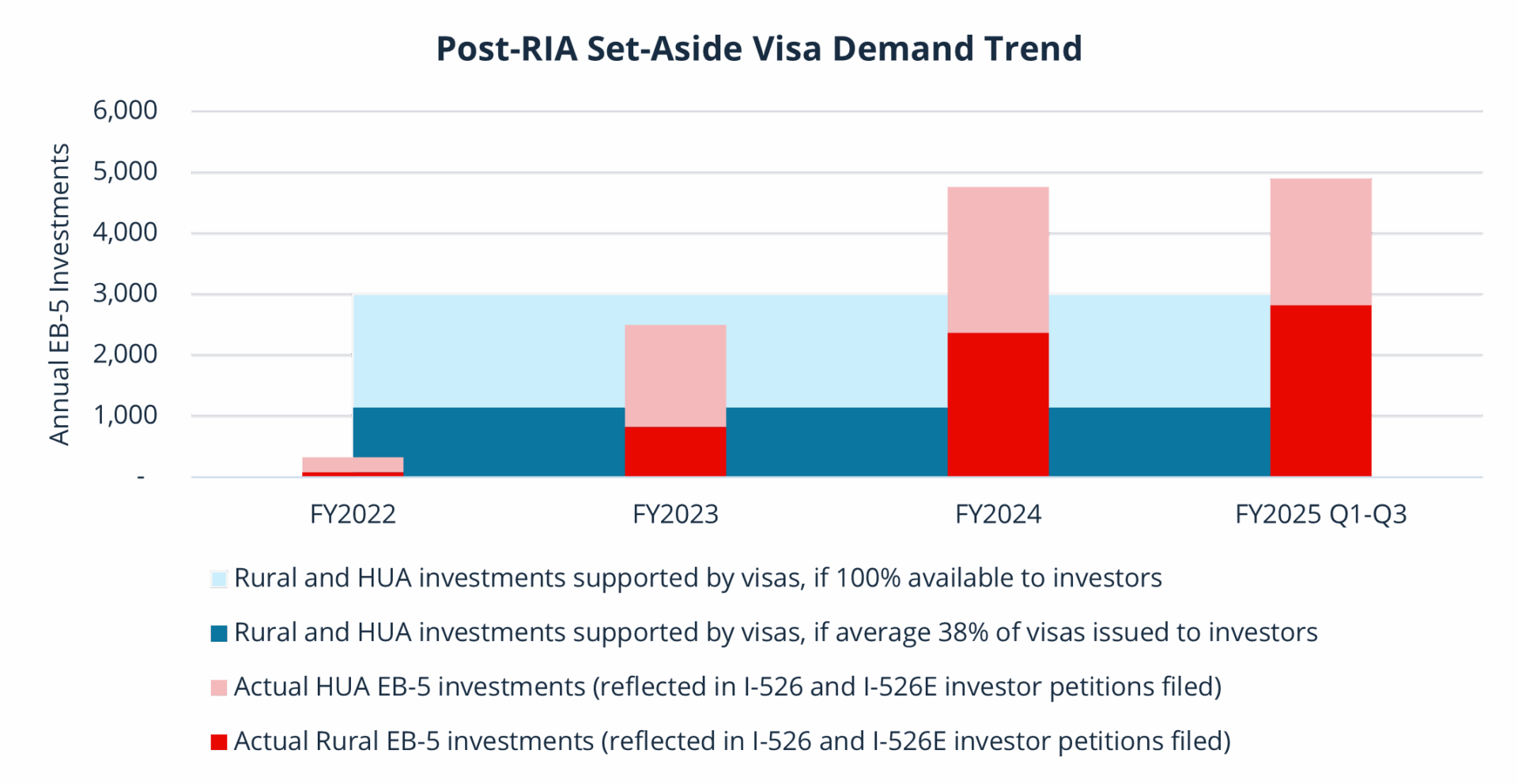
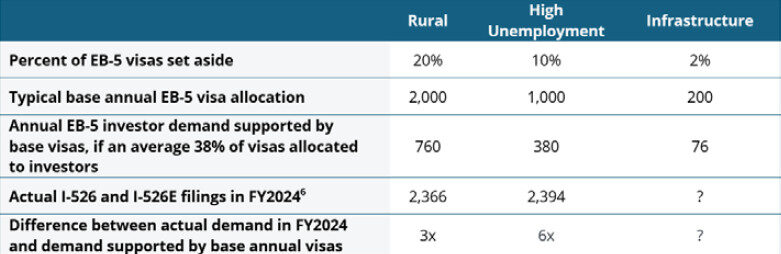
In FY2024 alone, nearly 5,000 EB-5 investments were made in Rural and High Unemployment projects—representing triple the number of Rural investments and six times the number of High Unemployment investments possible to support under a visa allocation that must also cover spouses and children.
If every year attracts three to six times more investors than can be accommodated under annual visa availability, then backlogs and wait times balloon quickly. The economic benefit resulting from Rural and High Unemployment investment in 2024 cannot continue, absent visa relief.
Post-RIA backlogs will gain visibility when the Visa Bulletin publishes cut-off dates for Rural and High Unemployment
Significant post-RIA backlogs have already accumulated and will shortly gain visibility in the Visa Bulletin.
From 2022 to June 2025, 6,089 Rural investors and 6,389 High Unemployment investors filed I-526(E) petitions [7]. What happens as over 12,000 set-aside investors with priority dates before 2025 get I-526E approval, and are joined by spouses and children to demand around 24,000 set-aside visas? The Visa Bulletin will have to control demand for the 3,000+ set-aside visas that are available annually.
The Visa Bulletin has delayed announcing cut-off dates for Rural and High Unemployment because the pipeline backlog has been hidden in processing. Low I-526E processing volume by USCIS prevented many investors from becoming qualified visa applicants who can be considered in the Visa Bulletin [8]. Low visa processing volume by Department of State stalled even qualified visa applicants from absorbing available visas. [9]. But in 2026, the conditions for Visa Bulletin retrogression could exist.
For example, USCIS had approved 1,519 I-526(E) by January 2025, with 1,126 (74%) being for Rural investors [10]. From January to June 2025, USCIS approved another 1,255 I-526E, and had increased the rate of approvals to over 300 per month [11]. If Rural has continued to account for a majority of volume, then over 2,000 Rural I-526(E) have likely been approved. And 2,000 approved investors, when joined by spouses and children, could be over 4,000 visa applicants able to maximize the FY2026 quota of about 4,100 Rural visas [12]. The actual month of Visa Bulletin movement remains unknown, as it depends on processing productivity. But the inevitable retrogression announcement gets closer by the day, as I-526E approvals continue daily to add to the pool of qualified visa applicants.
Cut-off dates in the Visa Bulletin make backlogs more visible and close the door for concurrent I-485 filing, which will have a chilling effect on the EB-5 market.
Nuances Qualify but Do Not Avoid the Message About Severe Post-RIA Backlogs
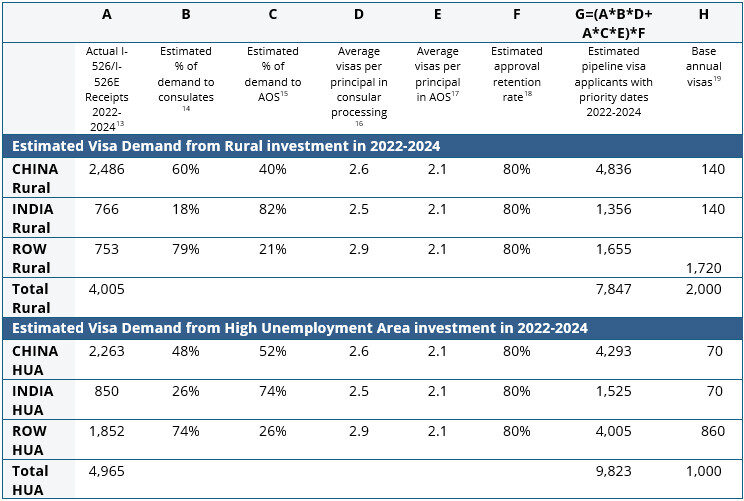
The above analysis is simplified—looking at overall averages and the big picture and omitting nuances. Significant nuances worth considering include denial rates that can reduce visa demand, country-specific and path-specific differences in family size, the trend from consular processing to status adjustment, the effect of country caps on visa allocation, and the option for set-aside investors to select Unreserved visas. However, accounting for additional nuance does not avoid alarming conclusions about Rural and High Unemployment visa backlogs and wait times, as illustrated below.
Absent reform, the economic benefits of EB-5 cannot be sustained. The numbers point to a clear conclusion: systemic change is required. This sets the stage for the next question: what policy solutions—and advocacy—are needed to address the challenge?
Table 2 provides a calculation that includes family size detail by country and path, a denial assumption, and country caps. The more nuanced calculation concludes visa applicants far in excess of visa availability. Of particular concern, demand from “Rest of the World” investors has been sufficiently high to potentially generate applicants for the maximum level of set-aside visas available to ROW. Maximizing ROW visas means minimizing visas left to cap-limited countries. If China and India are indeed each limited to the 7% country cap on an ongoing basis, the resulting enormous gap between applicants and visa supply could result in apocalyptic visa wait times for China and India. And even ROW faces set-aside retrogression in High Unemployment, with over 4,000 Rest of World applicants already in the pipeline as of 2024 for under 1,000 HUA visas available to give in a typical year.
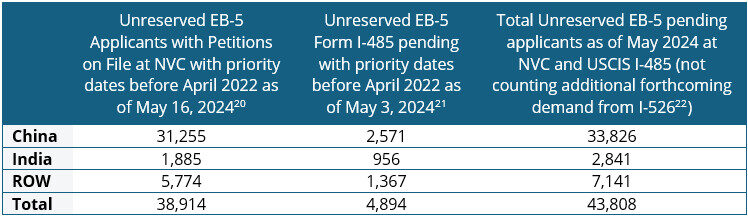
Rural and High Unemployment investors also have access to Unreserved EB-5 visas, providing a potential alternative to waiting in line for the small set-aside visa allocations. The country cap limit applies to EB-5 as a whole, not simply within reserved categories individually. However, the Unreserved lane is also crowded. Table 3 summarizes available data on the legacy Unreserved backlog, which apparently still has years-worth of applicants pending from China and India.
Why Derivatives Matter
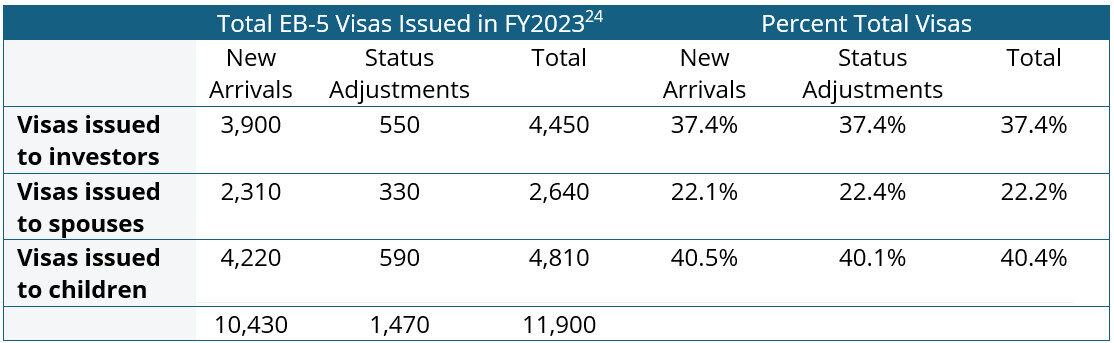
From 2017 to 2023, 62% of EB-5 visas were not issued to EB-5 investors, but rather to spouses and children. Only 38% of EB-5 visas during this period corresponded to an EB-5 investment. Investors accounted for 1 in 3 EB-5 visas issued through consular processing, and 1 in 2 EB-5 visas issued through adjustment of status. If derivatives typically absorb 62% of EB-5 visas, then not counting derivatives could effectively increase visas available to EB-5 investors by 162%. This dynamic—where spouses and children absorb the majority of EB-5 visas—creates a critical bottleneck. The policy implications of this reality are explored in the following section.
Download EB-5 After the RIA White Paper
Investors aren’t the only ones benefiting from the passing of the EB-5 Reform and Integrity Act (RIA) in March 2022. As the most comprehensive legislative reform in the Program’s history, rural states throughout the United States have seen transformative effects from EB-5 financed projects.
CanAm’s white paper brings together leading voices from across the EB-5 stakeholder community to reflect on the RIA’s powerful effects and measure the Program’s impact to date like never before.
Watch the Webcast: Navigating the Future of EB-5
In a recent CanAm webinar, Chief Operating Officer Christine Chen sat down with Aaron Grau, Executive Director of IIUSA, and Lee Li, IIUSA’s Director of Policy Research and Data Analytics. Their wide-ranging conversation covered everything from the grandfathering timeline to new filing trends, updated adjudication data, rural investment growth, and what the pathway to a permanent reauthorization could look like.
About the Author
 Suzanne Lazicki
Founder, Lucid Professional Writing
Suzanne Lazicki is the principal of Lucid Professional Writing, a boutique service specializing in business plans for immigration purposes. She has assisted developers, entrepreneurs, and investors for over a decade, writing hundreds of business plans for use in EB-5, E-2, and L-1A visa applications. Suzanne is the author of blog.lucidtext.com, a leading source of analysis for EB-5 developments and data since 2010. She is frequently invited to speak and write about EB-5 visa availability and wait time questions. She was a contributing editor for AILA’s Immigration Options for Investors & Entrepreneurs, 4th Ed., and authored the collection’s article on EB-5 business plans. Ms. Lazicki holds an MBA from the Goddard School of Business at Weber State University and received her B.A. summa cum laude in English from Seattle Pacific University.
Footnotes
[1] Specifically, the 8 U.S.C. 1153(b)(5) allocates to EB-5 7.1% of employment-based visas, which have an annual base of 140,000 visas.
[2] 38% is the average percentage of principal applicants in EB-5 visas issued from FY2017 to FY2023, according to the Yearbook of Immigration Statistics. Annual averages during this period ranged between 35% and 44%. The last reported year (FY2023) showed 37% of EB-5 visas issued to investors, 22% to spouses, and 40% to children. https://ohss.dhs.gov/topics/immigration/yearbook
[3] “Actual EB-5 demand (I-526 investor petitions filed)” records data for I-526 and I-526E investor petition filings by period reported by USCIS at https://www.uscis.gov/tools/reports-and-studies/immigration-and-citizenship-data
[4] Quoted from p. 3 of the CIS 2017 Annual Report Executive Summary, published by DHS in English, Chinese and Spanish in June 2017. https://www.dhs.gov/publication/ombudsman-annual-reports
[5] I-526 and I-526E receipt data by TEA category provided by USCIS in response to AIIA FOIA Request https://goaiia.org/aiia-foia-series-updated-i-526e-inventory-statistics-for-january-2025/
[6] Ibid.
[7] Ibid.
[8] From April 2022 to March 2025, USCIS processed a total of only 1,704 post-RIA I-526 and I-526E (17% of the petitions filed) according to quarterly reports at https://www.uscis.gov/tools/reports-and-studies/immigration-and-citizenship-data.
[9] Department of State issued 0 set-aside visas in FY2022, 0 in FY2023, and 332 Rural and 91 High Unemployment visas in FY2024 according to Annual Reports of the Visa Office. https://travel.state.gov/content/travel/en/legal/visa-law0/visa-statistics/annual-reports.html.
[10] Category-specific data from USCIS in response to AIIA FOIA Request https://goaiia.org/aiia-foia-series-updated-i-526e-inventory-statistics-for-january-2025/; overall processing data for FY2025 Q2 published by USCIS at All USCIS Application and Petition Form Types (Fiscal Year 2025, Quarter 2).
[11] Most Rural investors since 2022 are still in the queue as of 2026, given that only 332 Rural visas were issued in FY2024, and FY2025 appears on pace to issue less than 1,000 Rural visas.
[12] I-526 and I-526E receipt data by TEA category provided by USCIS in response to AIIA FOIA Request https://goaiia.org/aiia-foia-series-updated-i-526e-inventory-statistics-for-january-2025/.
[13] The estimated proportion of post-RIA investors who will use consular processing versus status adjustment is derived by comparing the known number of total investors by period (from I-526 and I-526E receipts) against the known number of EB-5 applicants with I-485 pending by period (published by USCIS at https://www.uscis.gov/tools/reports-and-studies/immigration-and-citizenship-data).
[14] Ibid.
[15] The average visas per principal applicant in consular processing is the average inverse of “percentage of EB-5 principal applicants at State” reported for FY2017 through FYTD 2024 by country by Department of State in IIUSA conference presentations https://iiusa.org/wp-content/uploads/2024/05/3_EB-5-IIUSA-Conference-May-2024.pdf and https://iiusa.org/wp-content/uploads/2020/11/Virutal-Industry-Forum-Visa-Update.pdf
[16] The average visas per principal applicant in adjustment of status is the average for status adjustment visas issued FY2017 to FY2023 according to the DHS Yearbook of Immigration Statistics (https://ohss.dhs.gov/topics/immigration/yearbook). The Yearbook does not specify family sizes by country.
[17] The estimated future approval or retention rate is a guess; past approval rates have varied.
[18] The base annual visas reflect the potential minimum allocation to China and India (7% each of the total). The base total does not include carryover visas, which will have the effect of doubling visas issued in one year.
[19] Department of State data presented at the May 2024 IIUSA conference https://iiusa.org/wp-content/uploads/2024/06/Insights-from-DOS-Recap-of-2024-IIUSA-EB-5-Forum-1.pdf.
[20] Data from USCIS “Pending Applications for Employment-Based Preference Categories as of May 3, 2024 (XLSX, 106.13 KB)”. https://www.uscis.gov/sites/default/files/document/reports/eb_inventory_may_2024_081324.xlsx.
[21] The total is the sum of applicants registered at the National Visa Center or with pending I-485 as of May 2025. The sum includes spouses and children. There were also 4,496 pre-RIA I-526 still pending as of May 2024, which could add at least another 5,000 future pre-RIA Unreserved visa applicants (after accounting for denials, derivatives, and degree of overlap with the pending I-485 list).
[22] Data averages for EB-5 visas issued from FY2017 to FY2023, according to annual data published in the Yearbook of Immigration Statistics. https://ohss.dhs.gov/topics/immigration/yearbook.
[23] Data from the FY2023 Yearbook of Immigration Statistics, Lawful Permanent Residence Table 7 https://ohss.dhs.gov/topics/immigration/yearbook-immigration-statistics/yearbook-2023.