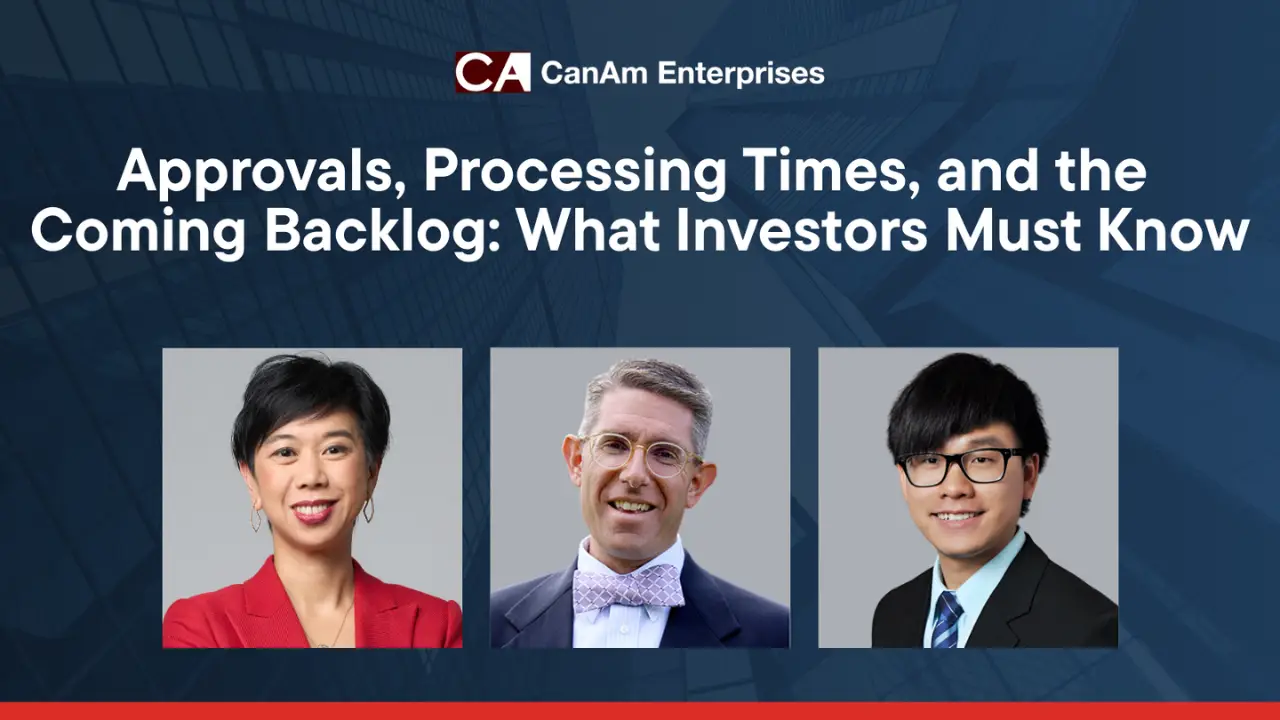
This article is the second in our five-part series breaking down CanAm’s recent webinar, Navigating EB-5 Visa Backlogs in 2025.
In Part 1, we looked at the surge in EB-5 demand, why backlogs are inevitable, and what’s at stake for families entering the program today.
Now in Part 2, we turn to the data. Suzanne Lazicki, EB-5 analyst and author of LucidText, walked investors through the mechanics of visa allocation, using clear analogies to explain a complex system.
The Funnel Effect: Where Backlogs Begin
When investors file an EB-5 petition (Form I-526E), they don’t move straight to receiving a visa. Instead, each case passes through multiple layers of review and constraint:
- I-526 Processing – Limited by USCIS resources and adjudication capacity.
- Visa Application Stage – Limited by scheduling and consular/adjustment backlogs.
- Annual Visa Quotas – Capped at about 10,000 visas worldwide per year.
As Lazicki explained:
“You want to think how many people are down there waiting for I-526 processing? How many people with earlier priority dates are waiting for visas? That’s how long it will take you to get to the bottom of the funnel.”
This layered funnel means delays stack up long before investors see them in the Visa Bulletin.
Visible vs. Invisible Backlogs
Official wait times only reflect the “visible backlog”—investors who have cleared I-526 and are waiting at the visa stage. But the “invisible backlog” is just as important: thousands of investors stuck in the I-526 queue who will eventually add to visa demand.
That’s why the backlog picture is always bigger than it looks.
The Numbers: 60,000+ in Line, 10,000 Visas a Year
By early 2025, data showed roughly 60,000 people already in the EB-5 pipeline (including investors and family members) against only 10,000 visas available annually.
The math makes one thing certain: not everyone will get a visa quickly.
“Somebody is going to be waiting. The question is: who, and for how long?” – Suzanne Lazicki
The “Ships” Analogy: Categories and Country Caps
Lazicki used another analogy—ships leaving a harbor—to illustrate how EB-5 visas are distributed. Each ship represents a visa category:
- Unreserved visas – roughly 6,800 annually
- Rural set-asides – about 2,000
- High-unemployment set-asides – about 1,200
Each ship has only so many seats, and not every country has equal access. Under the 7% per-country cap, Indian and Chinese investors can only count on a limited number of spots unless there are unused visas left over from the rest of the world.
This is why nationality matters so much: while Rest of World investors may avoid retrogression, Indian and Chinese applicants face inevitable wait times.
Key Takeaways from Part 2
- EB-5 visas flow through a layered funnel—delays stack up at multiple stages.
- The visible backlog understates the real line; thousands more wait invisibly at the I-526 stage.
- More than 60,000 people are in line for about 10,000 visas a year.
- Country of birth drives outcomes: China and India face multi-year retrogression, while Rest of World may still avoid it.
Download the Full White Paper
For a deeper dive into visa availability, backlog projections, and strategic investor considerations, CanAm commissioned EB-5 analyst Suzanne Lazicki to author a comprehensive white paper:
Download the White Paper: Visa Availability and Allocation – Q&A for 2025
This resource expands on the data and themes discussed in the webinar and provides critical context for families evaluating the EB-5 program today.