Paying taxes and filing the necessary tax returns is a necessity. Yet, for many people, maneuvering the U.S. tax system can be a daunting and stressful task – even for experienced tax filers. Individuals can follow some fairly simple steps to make preparing personal income taxes a much smoother process. The best advice is to simply get organized and start the process early rather than waiting until the last minute. Here are 10 suggested tips that can help individuals better prepare for the looming tax filing deadlines.
1) When is my tax return due?
The deadline to file individual tax returns, and importantly, make any payments for taxes owed for calendar year 2019 is April 15, 2020. Returns must be filed electronically before midnight on that date. If mailing returns and payments, returns must be officially postmarked (date stamped) at a U.S. Post Office no later than April 15th.
2) What is my tax bracket?
There is no single standard tax rate. The U.S. tax authority, the Internal Revenue Service (IRS), uses seven different tax brackets or levels based on income that are assessed at different tax rates. Tax brackets are based on an individual’s or married couple’s adjusted gross income (AGI), which is the equivalent of income minus any eligible deductions. Tax rates range from a low of 10% to a high of 37% for the top bracket of earners.
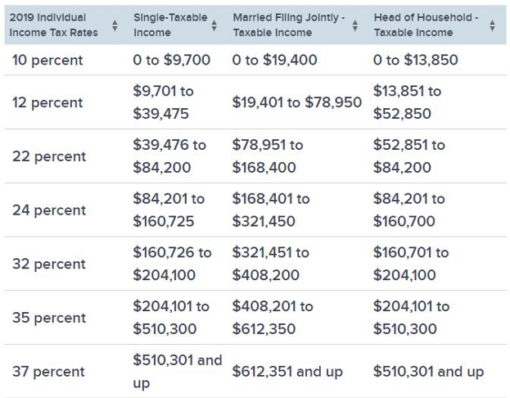
2019 Tax Brackets
3) What’s new for 2019?
The Tax Cuts & Jobs Act created some important new rules for taxpayers. Most of those new rules went into effect in tax year 2018. However, some changes to be aware of for 2019 are:
The “Obamacare penalty” that charged a penalty fee for individuals who did not secure personal health insurance coverage was eliminated starting in tax year 2019 and going forward.
The foreign earned income exclusion rose slightly to the amount of $105,900.
Retirement contributions also increased slightly for 2019. 401(k) and 403(b) contributions are up to $19,000 for 2019, with a $6,000 catch up contribution allowed for those 50 and over. SEP IRA and Solo 401(k) contribution limits increased to $56,000 for 2019.
4) What are eligible tax deductions?
One of the biggest changes that affects individual taxpayers is a sizable increase in the standard deduction. In a move that was aimed at simplifying the process of filing annual tax returns for many Americans, the U.S. government nearly doubled the amount of the standard deduction, which for 2019 is set at $12,200 for single filers and $24,400 for married couples.
Personal expense deductions are used to offset or reduce taxable personal income on an individual tax return. So, for those taxpayers who report personal deductions that exceed the minimum threshold, it can be worthwhile to create an itemized list of eligible deductions that can help to save money by reducing the amount of taxable income. Some examples of eligible deductions include:
Contributions to retirement investment and savings accounts
Medical expenses
Charitable contributions
Property taxes
Investment losses
5) Do I need help preparing my taxes?
One of the goals of the Tax Cuts & Jobs Act was to simplify the tax filing process. However, it is debatable on whether that goal was achieved as wading through the myriad of changes, even two years later, is no easy task. In addition, the IRS continues to make slight annual adjustments to income thresholds, eligible deductions and contribution amounts to retirement savings account. So for many taxpayers, it is still advisable to seek guidance from a trusted accountant or financial advisor.
6) What documents do I need to provide to my tax preparer?
Generally, the start of a new year comes with a flurry of tax forms that are either mailed or available to download. Individuals need to make sure they are gathering all of the official tax documents on both the income and expense side to support any claims for eligible tax deductions. Some examples to watch for include:
W-2s: These forms provided by an employer show wages earned and any federal, state and local taxes that have already been paid.
1099s: These forms show a variety of income earned from various sources.
1099-MISC: These forms show miscellaneous wage income earned, and are commonly used to show payments made to independent contract workers
1099-INT and 1099-DIV: These report your interest income and dividend income from bank and investment accounts.
1099-S: This form reports any income you may have received through U.S. social security payments.
K-1s: The K-1 form is used if you have income from a partnership, small business or trust.
Mortgage interest statements: These forms are typically provided by the mortgage company.
Documentation of other state and local taxes paid, such as property taxes or sales tax on a large purchase as with a car or boat.
Payment receipts, credit card statements or check stubs that verify payments made for eligible deductions, such as educational expenses or annual statements for charitable giving.
7) Review Before Signing
Before signing a tax return, the taxpayer should always review it carefully for errors or omissions before signing and filing it. Once they sign the return, taxpayers are accepting responsibility for the information on it.
8) Never Sign a Blank Return
Taxpayers should not use a tax preparer who asks them to sign a blank tax form.
9) Should I e-file?
The quickest way for taxpayers to get their refund is to electronically file their federal tax return and choose the direct deposit
10) How long should I keep tax records?
The IRS recommends that individuals keep records for 3 years from the date you filed your original return, or 2 years from the date you paid the tax, whichever is later. In addition, it is advised that you keep records for 7 years if you file a claim for a loss from worthless securities or bad debt deduction.

Join Our Newsletter for Immigration Insights and Tax Tips
Sign up to receive emails for the latest news on CanAm and the EB-5 Visa Program.
Featured Insights
Explore what’s happening now with CanAm and the EB-5 Visa.
The U.S. Department of State’s January 2026 Visa Bulletin delivers a clear message for EB-5: set-aside categories remain “Current,” and unreserved cut-off dates continued to...
A Year of Leadership, Milestones, and Measurable Impact in EB-5 In a year defined by heightened scrutiny, evolving visa dynamics, and growing global demand for...
direct deposit, credit, income, tax return, standard deduction, donation, interest, tax deduction, tax credit, tax bracket, fee, tax refund, earned income tax credit, individual retirement account, internal revenue service, student loan, expense, form 1040, child tax credit, health savings account, mortgage, taxable income, identity theft, retirement, social security number, employment, gross income, capital gains tax, dividend, savings account, payroll, property, head of household, marriage, net income, itemized deduction, home mortgage interest deduction, required minimum distribution, tax filing, business tax, tax preparation, tax preparer, taxes filed, professional tax preparer, tax season, preparer, tax rate, premium tax credit, revenue, tax withholding, taxpayer identification number, property tax, back taxes, charitable organization, 401, checklist, adjusted gross income, personal finance, preparer tax identification number, filing status, free file, license, refinancing, personal income, cost of living, fraud, roth ira, taxpayer, unemployment benefits, liability, s corporation, bookkeeping, household, table of contents, tax advisor, directory, income tax credit, tax filing status, federal tax, federal income tax, irs direct file, tax extension, direct file, wolters kluwer tax, deductions, tax preparation software, tax filing deadline, preparation, traditional ira, federal tax return, tax tips, irs free file, asset, debt, capital loss, fiscal year, payroll tax, personal exemption, tax cuts and jobs act, flat tax, tax cut, progressive tax, state income tax, corporate tax, inflation, tax revenue, wage, government revenue, kansas, iowa, salary, tax policy center, tax policy, bracket, sales tax, capital gain, tax foundation, surtax, excise, oklahoma, personal income tax, taxpayers, individual tax, rate, individual income taxes, individual income tax, corporate income tax, rates, bracket creep, certified public accountant, paycheck, audit, credit score, filing taxes, expert, form 1099, national society of accountants, enrolled agent, lifetime learning credit, research, alimony, partnership, earned income tax, income tax return, ptin, zip code
Frequently Asked Questions
How do I organize my tax documents effectively?
Organizing tax documents effectively involves categorizing them by type, such as income statements, deductions, and receipts, while maintaining a checklist of required documents. Utilize digital tools or physical folders to ensure easy access and streamline your filing process.
What are the most common tax deductions I can claim?
The most common tax deductions you can claim include mortgage interest, property taxes, state income taxes, charitable contributions, and medical expenses. These deductions can help lower your taxable income, resulting in potential tax savings.
How do I claim tax credits for education expenses?
Claiming tax credits for education expenses involves completing IRS Form 8863 and providing documentation of qualified expenses. Ensure you meet eligibility requirements and carefully follow the instructions to maximize your credits.
Can I deduct home office expenses on my tax return?
You can deduct home office expenses on your tax return if you use part of your home exclusively for business purposes. Be sure to meet IRS requirements for eligibility and properly document your expenses to claim the deduction.
What are the deadlines for filing personal income tax?
The deadlines for filing personal income tax are critical to note. Typically, individual tax returns are due on April 15 of each year, but this may vary if it falls on a weekend or holiday.
What are the most common tax preparation mistakes to avoid?
Common tax preparation mistakes to avoid include failing to report all income, not claiming eligible deductions and credits, and missing deadlines. Additionally, errors in personal information, such as Social Security numbers, can lead to complications with the IRS.
Can I deduct student loan interest on my taxes?
You can deduct student loan interest on your taxes if you meet specific income requirements, allowing you to reduce your taxable income by up to $2,500. This deduction can help ease your financial burden.
How can I organize my tax documents efficiently?
Efficient organization of tax documents involves creating categories for different types of income and deductions, using digital tools for storage and tracking, and maintaining a checklist of required documents to ensure everything is ready by tax season.
What are the tax implications of self-employment income?
The tax implications of self-employment income include the requirement to pay both income tax and self-employment tax, which covers Social Security and Medicare. Self-employed individuals must also keep accurate records of their earnings and expenses for proper reporting.
What is the deadline for filing my tax return?
The deadline for filing your tax return is April 15th of each year. If this date falls on a weekend or holiday, the deadline may be extended to the next business day.
What documents do I need for tax filing?
The documents needed for tax filing include your W-2 forms, 1099 forms, proof of deductions (like mortgage interest and charitable donations), income statements, and personal identification information such as your Social Security number.
How to track my deductible expenses?
Tracking your deductible expenses involves maintaining detailed records of all relevant receipts and invoices. Use tools like spreadsheets or accounting software to categorize and monitor these expenses, ensuring they align with IRS guidelines for tax reporting.
What education expenses qualify for tax credits?
The education expenses that qualify for tax credits include tuition and fees, course materials, and other necessary supplies required for enrollment or attendance at an eligible institution.
How can I maximize my tax deductions?
Maximizing your tax deductions involves thorough documentation of all eligible expenses, such as mortgage interest, medical costs, and charitable contributions, while also leveraging any available credits to reduce your taxable income effectively.
What are penalties for late tax filing?
The penalties for late tax filing are: Individuals may face a failure-to-file penalty, which is 5% of the unpaid tax per month, plus interest on any unpaid balance, potentially adding up to substantial costs over time.
Can I amend my tax return after filing?
You can amend your tax return after filing. To do so, complete Form 1040-X within three years from the original filing date to correct any errors or claim additional deductions.
How do I report freelance income accurately?
Reporting freelance income accurately involves tracking all earnings received, documenting expenses related to your work, and filing Schedule C (Form 1040) to report net profits. Ensure you keep thorough records for IRS compliance.
What tax forms are needed for self-employment?
The tax forms needed for self-employment include Schedule C to report income and expenses, Schedule SE to calculate self-employment tax, and Form 1040 for the individual tax return.
How does my filing status affect deductions?
Your filing status significantly affects the deductions you can claim on your tax return. Different statuses (e.g., single, married filing jointly) come with varying standard deduction amounts, which can influence your overall tax liability.
What is the process for claiming the home office deduction?
The process for claiming the home office deduction involves determining if your workspace qualifies, calculating the deduction amount based on the percentage of your home used for business, and filing the appropriate forms (Schedule C or Form 8829) with your tax return.
How can I reduce my tax liability legally?
Reducing your tax liability legally involves utilizing available tax deductions, credits, and contributions to retirement accounts while ensuring proper documentation. Consult a tax professional to explore strategies tailored to your financial situation and compliance with IRS regulations.
What records should I keep for tax purposes?
Keeping proper records for tax purposes is essential. You should retain documents such as W-2s, 1099s, receipts for deductible expenses, and any relevant bank statements for at least three years after filing your tax return.
How often should I update my tax documents?
The frequency of updating tax documents is crucial. It's important to review and update these documents at least annually, especially after significant life changes or financial transactions, to ensure accurate reporting and compliance with IRS regulations.
What are the tax benefits of retirement contributions?
The tax benefits of retirement contributions include the ability to defer taxes on contributions and investment gains until withdrawal, potentially lowering your taxable income during your working years and providing tax advantages when you retire.
How do I claim moving expenses on my tax return?
Claiming moving expenses on your tax return involves completing IRS Form 3903, which details your eligible moving costs. Ensure that all expenses meet IRS requirements and attach the form when filing your tax return.
What is the standard deduction amount this year?
The standard deduction amount this year varies based on filing status. For 2023, it is $13,850 for single filers and $27,700 for married couples filing jointly.
Are there deadlines for different tax forms?
Deadlines for different tax forms vary depending on the type of form. For individual tax returns, the deadline is typically April 15th, while other forms may have specific due dates throughout the tax year.
How do I know if I need to file taxes?
Determining whether you need to file taxes depends on factors like your income level, filing status, and age. Generally, if your income exceeds the IRS threshold for your specific situation, you are required to file a tax return.
What options do I have for tax payment plans?
The options for tax payment plans include short-term payment plans for those who can pay within 120 days, installment agreements for extended payments over six to 72 months, and offers in compromise for settling tax debts for less than the full amount owed.
How to handle an audit effectively?
Handling an audit effectively involves staying organized, communicating clearly with auditors, and providing accurate documentation. Prepare by reviewing relevant records and seeking professional assistance if needed to ensure compliance and a smooth process.
taxation preparation tips, personal income tax, tax preparation tips, tax filing tips, 2023 tax filing tips, tips for preparing your tax return, last minute tax filing tips, how to prepare my tax return, how to prepare to file your taxes, what are the 7 types of taxes, preparing for taxes, how to prepare tax return
Understanding the Importance of Tax Deadlines
Tax deadlines are critical for maintaining compliance with the IRS and avoiding penalties. The deadline for filing individual tax returns is typically April 15, and missing this date can lead to significant financial repercussions, including late fees and interest on unpaid taxes.
For the 2019 tax year, it is essential to postmark returns by April 15, 2020. This date is crucial for taxpayers to remember, as it not only marks the end of the filing period but also influences the timing of potential refunds or payments due. Keeping a calendar with important tax dates can help ensure timely filing.
Maximizing Deductions and Credits
Understanding how to maximize deductions and credits can significantly reduce your taxable income. Taxpayers should be aware of common deductions, such as mortgage interest, state taxes, and charitable contributions, which can lower the amount owed to the IRS.
In addition to standard deductions, taxpayers may qualify for various tax credits, such as the Earned Income Tax Credit or education-related credits. These credits can directly reduce the tax owed and may result in a refund, making it vital to research eligibility and ensure all potential savings are claimed.
Common Tax Filing Mistakes to Avoid
Many taxpayers make common mistakes that can lead to complications with their tax returns. Errors such as incorrect Social Security numbers, failing to report all income, or neglecting to claim eligible deductions can result in audits or delayed refunds.
To avoid these pitfalls, individuals should take the time to review their returns carefully before submission. Utilizing tax preparation software or consulting with a tax professional can also help mitigate errors and ensure that all necessary information is accurately reported.
The Role of Tax Preparation Tools
Tax preparation tools can simplify the filing process and help taxpayers stay organized. These tools often include features for tracking expenses, calculating deductions, and ensuring compliance with tax laws, making them invaluable for both individual and business tax filers.
Many tax software programs also offer guidance on tax law changes and provide resources for maximizing deductions. By leveraging these tools, taxpayers can enhance their understanding of the filing process and improve their chances of a successful outcome.