A Targeted Employment Area (TEA) is a geographic area in the United States that qualifies for a reduced EB-5 investment threshold due to its economic conditions. There are two types of TEAs:
Under the EB-5 Reform and Integrity Act of 2022, USCIS is responsible for determining TEA designations based on these criteria.
Investing in a Targeted Employment Area offers several significant advantages:
These incentives are designed to channel foreign investment into communities most in need of economic development and job creation.
Under the EB-5 Reform and Integrity Act of 2022, USCIS is responsible for determining whether a project is located in a TEA. The determination is based on official government data, including census tract unemployment rates from the American Community Survey (ACS) and Local Area Unemployment Statistics (LAUS).
To qualify as a high-unemployment TEA, the project must be located in a census tract (or a combination of adjacent census tracts) where the weighted average unemployment rate is at least 150% of the national average. For rural TEA designation, the project must be located outside a metropolitan statistical area and outside any city or town with a population of 20,000 or more.
Industry resources such as the IIUSA TEA Mapping Tool can help stakeholders identify whether a specific location qualifies as a TEA. However, the final determination is made by USCIS as part of the petition adjudication process.
The EB-5 Visa Program offers numerous benefits for qualified foreign investors and their families:
Yes. When an EB-5 investor files an I-526E petition, eligible family members are included in the application. The following family members can obtain conditional permanent residency along with the principal investor:
All eligible family members receive the same immigration benefits as the investor, including the right to live, work, and study anywhere in the United States. It is important to note that children must remain unmarried and under the age of 21 at the time of visa issuance to qualify. The Child Status Protection Act (CSPA) may provide certain age-out protections in cases of processing delays.
No. There are no country-specific exclusions from the EB-5 Program. Citizens of any country are eligible to apply, provided they meet the program’s investment and source-of-funds requirements. However, investors from certain countries may experience longer wait times for visa availability due to per-country visa allocation limits. For example, investors from countries with high EB-5 demand, such as China and India, may face visa retrogression in the unreserved visa category, which can extend the timeline for obtaining a visa number.
Additionally, all EB-5 applicants must pass background checks, security screenings, and a consular interview (or adjustment of status process). Applicants who are inadmissible under U.S. immigration law for reasons such as criminal history or security concerns may be denied regardless of nationality.
The EB-5 Regional Center Program is an investment pathway within the EB-5 Visa Program that allows foreign investors to pool their capital into large-scale projects sponsored by USCIS-designated Regional Centers. The program was originally created in 1992 and was most recently reauthorized and reformed through the EB-5 Reform and Integrity Act of 2022.
Under the Regional Center Program, investors make a passive investment through a New Commercial Enterprise (NCE) affiliated with an approved Regional Center. The key advantage is that investors can count both direct and indirect/induced jobs toward the 10-job requirement, as calculated by USCIS-approved economic models. This makes it generally easier to satisfy the job creation requirement compared to a direct EB-5 investment.
The Regional Center Program also allows investors to remain passive, meaning they are not required to participate in the day-to-day management of the business or project.
Regional Centers act as liaisons between foreign investors and EB-5-eligible projects in the United States. Regional Centers will source projects, conduct due diligence to ensure viability of those projects, and then offer projects to potential investors.
Regional Centers pool funds from multiple investors and deploy the proceeds either as debt or equity into an EB-5 project.
Debt-based structures are by far the most common EB-5 investment vehicles. Here, the Regional Center pools capital from EB-5 investors who invest in a special purpose entity, or NCE, which then loans the proceeds to an EB-5 project for a period of 5 to 7 years. The EB-5 project must create at least 10 qualifying jobs per EB-5 investor. The EB-5 project may use the EB-5 investors’ funds for construction and/or operations to create the qualifying EB-5 jobs. Upon the maturity and repayment of the loan to the NCE, investors who have sustained their investments for at least 2 years of conditional lawful permanent residence may be repaid their investment capital.
In the case of an equity-based structure, the EB-5 investor is expected to take an equity risk position in the EB-5 project.
Prudent Regional Centers aim to provide low-risk, investor-focused EB-5 investment opportunities that have sound financial projections and aim to exceed the minimum job requirement of 10 jobs per investor to maximize the likelihood of achieving immigration and repayment benefits for all investors.
EB-5 Regional Center Investment Structure (need to update the dollar amount $800,000 and 5-7 year loan term)
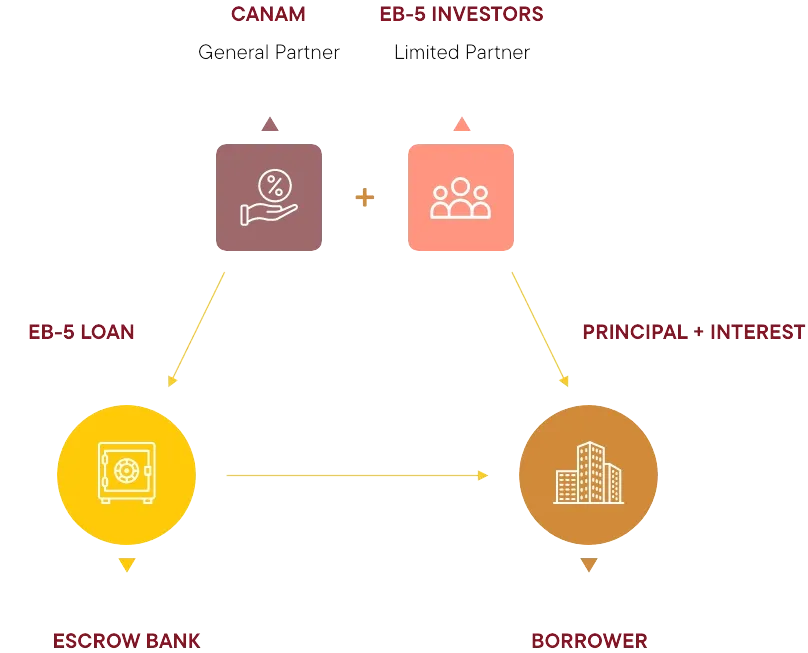
Regional Centers manage the entire process from inception to completion and mitigate potential risks:
The USCIS requires that EB-5 investments preserve or create at least 10 full-time jobs for U.S. workers per EB-5 investor. At the I-526E Petition stage, an EB-5 investor must demonstrate prospectively that the requisite number of jobs are more than likely to be created within 2½ years of the approval of the I-526E Petition. Later, at the I-829 Petition stage, the EB-5 investor must demonstrate that the requisite number of jobs have already been created or will be created within a reasonable period of time (that is, within 1 year of the expiration of the conditional green card).
In case an EB-5 investor elects to make a direct EB-5 investment in a business, it must be proven that the EB-5 capital investment will create a minimum of 10 direct jobs (i.e., W-2 jobs) for U.S. workers who are employed directly by the business.
On the other hand, when investing with a Regional Center, EB-5 investors can count indirect/induced and direct jobs to meet the job creation requirement. EB-5 projects offered by reputable Regional Centers generally tend to be large-scale projects. It is often easier and safer for EB-5 investors to satisfy the job creation requirements with a large-scale project, as jobs are created across multiple industries, including direct construction jobs related to the project itself (if construction is 2+ years), indirect jobs created by the realization of the project, and jobs that were induced in the area by the creation of the EB-5 project. The job creation is calculated by the application of USCIS-approved economic models that take into consideration each set of project expenses to determine the resulting economic impacts.
The two most common deal structures for EB-5 offerings are debt and equity.
The EB-5 Program requires that an investor’s capital be “at risk” for the purpose of generating a return on the investment. This means the investor must place the required capital in a qualifying EB-5 project with no guaranteed return of capital and no guaranteed profit. The investment must be subject to the normal commercial risks associated with the project.
USCIS will not approve an EB-5 petition if the investment is structured to virtually eliminate any risk of loss. Arrangements such as guaranteed buybacks, redemption agreements, or promissory notes that ensure repayment regardless of business performance may cause USCIS to determine that the capital is not genuinely at risk.
The “at risk” requirement remains in effect throughout the investor’s period of conditional permanent residency, which is typically two years. During this time, the capital must remain invested in the qualifying project.
In case the funds come from another entity, the responsibility to prove a legal source of funds extends to the loaner or the donor who bestowed the funds to the investor.
Inheritance is an exception to this requirement. The USCIS generally does not require to prove how the person who left the inheritance acquired the funds.
The USCIS also requires investors to fully document the lawful path of funds. In other words, investors are required to prove that they have possession of the funds and that they transferred the funds to the NCE in the United States through lawful channels. EB-5 investors are advised to document the path of funds in a responsible and detailed manner.
EB-5 projects often provide funding to real estate developments.
Yes, EB-5 investment funds can come from a loan or gift, provided that the investor can fully document the lawful source and path of funds.
For loans, the borrowed funds must be the investor’s own personal obligation to repay. The loan must be secured by the investor’s own assets (not by the assets of the EB-5 project or NCE). Acceptable loan sources include mortgages, home equity loans, personal loans from financial institutions, and loans from family or friends. The investor must demonstrate the lawful source of the lender’s funds as well.
For gifts, the investor must provide documentation showing the donor’s lawful source of funds and evidence that the gift was genuinely made without any expectation of repayment. Gift letters, bank records, and transfer documentation are typically required.
In all cases, the complete chain of custody of the funds must be documented to USCIS’s satisfaction.
Retained earnings from a business owned by the investor may qualify as a lawful source of funds for the EB-5 investment, provided the investor can document that the earnings were lawfully generated and properly reported for tax purposes. The investor must demonstrate the path of funds from the business to the investment.
Promissory notes, however, require careful consideration. A promissory note issued by the investor to the NCE generally does not satisfy the “at risk” requirement because the capital has not yet been placed at risk. However, promissory notes or loans obtained from third parties (such as banks or individuals), where the investor has a personal obligation to repay the loan regardless of the EB-5 project’s outcome, may be acceptable as a source of capital. The key distinction is that the investor must bear the risk of repayment, not the EB-5 project or NCE.
EB-5 investors should begin their investment process as soon as possible due to the following reasons:
It is essential to know the fundamentals of the EB-5 Program to adequately assess whether an investment opportunity will satisfy program requirements.
EB-5 investors must determine whether the Regional Center is authorized by USCIS and active at the time of making the investment. The track record of the Regional Center one is interested in must be reviewed and compared against other centers. The years of experience and the number of successful projects sponsored are good measures to analyze the performance of the Regional Center. A successful project would most likely be defined by its ability to achieve full immigration status and repayment of funds to investors.
The short answer is definitely YES!
Prospective EB-5 investors may face the decision whether or not they need assistance from an immigration lawyer. As you can tell by now, the EB-5 Program is complex and requires a significant amount of document submission and administration. Any misstep or error caused by providing incorrect information or documents may lead to several months of delays, requests for additional documentation or even a complete application denial. It is strongly recommended that investors work with experienced immigration attorneys that specialize in the EB-5 Program.
Experienced EB-5 immigration attorneys assist investors with pre-filing work, transitions from conditional residency to permanent residency, and offer expert guidance in case there are any roadblocks or issues along the EB-5 application process. EB-5 immigration attorneys are also often able to direct to reputable Regional Center operators.
The guidance of an experienced and knowledgeable EB-5 immigration attorney and Regional Center is recommended in order to maximize the likelihood of receiving permanent residency in the United States.
No. An EB-5 investment does not guarantee the issuance of a green card. The EB-5 Program involves both immigration and investment risks that investors should carefully consider.
USCIS may deny an I-526E petition if the investor fails to demonstrate a lawful source and path of funds, the project does not meet program requirements, or the required job creation is not adequately projected. Even after I-526E approval, the investor must maintain the investment and the project must create the requisite number of jobs for the I-829 petition (removal of conditions) to be approved.
Additionally, visa availability depends on annual visa allocations and country-based quotas, which may result in wait times for investors from high-demand countries. Investors are strongly advised to work with experienced immigration attorneys and reputable Regional Centers to maximize the likelihood of a successful outcome.
EB-5 investments carry both immigration and financial risks that investors should evaluate carefully:
Investors should conduct thorough due diligence on the Regional Center, project developer, deal structure, and job creation projections before committing to an investment.
Evaluating an EB-5 project requires a thorough due diligence process. Key factors to assess include:
Investors are strongly encouraged to work with experienced EB-5 immigration attorneys and financial advisors when evaluating projects.
If an EB-5 project fails to create the required 10 full-time jobs per investor, it may jeopardize the investor’s ability to obtain unconditional permanent residency. At the I-829 petition stage, the investor must demonstrate that the jobs have been created or will be created within a reasonable period of time.
If the project fails entirely, the investor faces both immigration and financial consequences:
Under the EB-5 Reform and Integrity Act of 2022, certain protections exist for investors, including the ability to retain their priority date and transfer their investment to a new qualifying project if the original project or Regional Center is terminated. Investors should work closely with their immigration attorneys to understand their options in such scenarios.
The EB-5 Reform and Integrity Act of 2022 (RIA) introduced several important protections for investors in the event of Regional Center termination or project failure:
Despite these protections, investors should understand that the EB-5 investment remains “at risk” and there is no guarantee of capital return. Conducting thorough due diligence before investing remains the most effective protection.
The EB-5 Program requires investors to sustain their investment throughout the period of conditional permanent residency, which typically lasts two years. Failure to sustain the investment or meet job creation requirements can have serious consequences:
Investors must ensure that their capital remains invested in the qualifying project for the required sustainment period and that they file their I-829 petition within the designated filing window.
During the two-year conditional permanent residency period, EB-5 investors have several important responsibilities:
The EB-5 Reform and Integrity Act of 2022 (RIA) introduced several measures designed to protect EB-5 investors:
These measures represent a significant enhancement to investor protections compared to the prior EB-5 regulatory framework.
The EB-5 application process involves several key steps:
The pathway to U.S. permanent residency through the EB-5 Program follows these stages:
The total timeline for the EB-5 process varies depending on several factors, including USCIS processing times, visa availability, and the investor’s country of birth. A general timeline is as follows:
In total, the process from initial investment to unconditional permanent residency typically takes 5 to 7+ years, though timelines can vary significantly based on individual circumstances.
Conditional permanent residency lasts for two years from the date the conditional green card is issued. During this period, the investor must maintain the EB-5 investment in the qualifying project and ensure the required jobs are being created.
Within the 90-day window before the two-year conditional period expires, the investor must file Form I-829 (Petition by Investor to Remove Conditions on Permanent Resident Status) to convert conditional residency to unconditional permanent residency. Upon approval of the I-829 petition, the investor and eligible family members become unconditional permanent residents of the United States.
Yes. If you are already in the United States on a valid nonimmigrant visa (such as an H-1B, L-1, F-1, B-1/B-2, or other status), you may file an I-526E petition with USCIS. Additionally, under the concurrent filing provisions introduced by the EB-5 Reform and Integrity Act of 2022, eligible investors may file Form I-485 (Application to Register Permanent Residence or Adjust Status) at the same time as, or after, their I-526E petition, provided a visa number is immediately available.
Concurrent filing can provide significant benefits, including the ability to obtain an Employment Authorization Document (EAD) and Advance Parole while waiting for the petition to be adjudicated. This allows the investor to work and travel while their case is pending.
Investors should consult with an experienced EB-5 immigration attorney to determine the best filing strategy based on their current immigration status.
The sustainment period requires EB-5 investors to maintain their capital investment in the qualifying EB-5 project for a minimum of two years from the date they obtain conditional permanent resident status. During this period, the invested capital must remain “at risk” and committed to the project.
The sustainment period is critical because at the I-829 petition stage, the investor must demonstrate that:
If the investor withdraws capital before the sustainment period ends, or if the project fails to meet job creation requirements, USCIS may deny the I-829 petition. In cases where the EB-5 project loan matures and funds are returned before the sustainment period ends, the capital may need to be redeployed into another qualifying activity to maintain compliance.
Consular processing is the process by which an EB-5 investor who is outside the United States obtains an immigrant visa through a U.S. embassy or consulate in their home country. After the I-526E petition is approved and a visa number becomes available, the case is transferred to the National Visa Center (NVC) and then to the appropriate U.S. consulate for an interview.
The consular processing timeline typically takes 6 to 12+ months from I-526E approval to visa issuance, depending on the consulate’s workload and visa availability.
During the consular interview, the investor and family members must present required documents, pass background and medical checks, and demonstrate eligibility for the EB-5 visa.
If an investor does not complete consular processing within the required timeframe, the visa may expire and the investor would need to request reissuance or, in some cases, re-initiate the process. It is important to respond promptly to NVC and consulate communications to avoid delays or complications
Consular processing and adjustment of status (AOS) are the two pathways for obtaining permanent residency after I-526E approval:
Each pathway has its own advantages. AOS allows the investor to remain in the U.S. during processing and may provide work authorization (EAD) and travel permission (Advance Parole). Consular processing may be faster in certain circumstances and does not require the investor to maintain a separate U.S. immigration status.
Regarding visitor visas: Filing an EB-5 petition or applying for a green card demonstrates immigrant intent, which can complicate applications for nonimmigrant visas such as B-1/B-2 visitor visas. However, dual intent is recognized for certain visa categories. Investors should consult with their immigration attorney before applying for a visitor visa while an EB-5 case is pending.
USCIS may deny an I-526E or I-829 petition for a number of reasons, including:
Working with experienced EB-5 immigration attorneys and reputable Regional Centers can help minimize the risk of petition denial.
If USCIS denies an EB-5 petition, the investor has several potential options:
The appropriate course of action depends on the specific grounds for denial. Investors should consult with their immigration attorney immediately upon receiving a denial to evaluate the best strategy.
Yes. EB-5 investors may challenge petition denials in U.S. federal district court under certain circumstances. Common legal avenues include:
Federal court litigation can be a lengthy and expensive process, and success is not guaranteed. Courts generally give deference to USCIS’s interpretation of immigration regulations, but they can and do reverse agency decisions when errors of law are identified.
Investors considering federal court action should work with an attorney experienced in both EB-5 immigration law and federal litigation.
The USCIS allocates 10,000 visas to the EB-5 Program each fiscal year (October 1 to September 30). EB-5 visas are very popular and the demand for EB-5 visas has increased consistently since 2009.
The EB-5 Reform and Integrity Act created new EB-5 immigrant visa set-asides for qualified immigrant investors. Each fiscal year, a certain percentage of EB-5 immigrant visas are available to qualified immigrants who invest in specific areas:
| Area of Investment | EB-5 Immigrant Visas Set-Aside Each Fiscal Year |
|---|---|
| Rural Area | 20% |
| High Unemployment Area | 10% |
| Infrastructure Project | 2% |
Any set-aside EB-5 visas that go unused are held in the same set-aside category for one additional fiscal year. After the second fiscal year, any remaining unused immigrant visas from EB-5 set-aside categories are released to the pool of unreserved EB-5 immigrant visa during the third fiscal year.
Yes. The EB-5 Program is subject to per-country visa limits, which cap the number of immigrant visas that can be issued to nationals of any single country at approximately 7% of the total annual allocation. When demand from a particular country exceeds this cap, a visa backlog (also known as retrogression) occurs.
Historically, China has experienced the most significant EB-5 visa backlogs, with wait times that have extended to several years. India and Vietnam have also experienced retrogression in recent years due to increasing demand.
The EB-5 Reform and Integrity Act of 2022 introduced set-aside visa categories (rural, high-unemployment, and infrastructure) that provide separate visa queues. These set-aside categories currently have no backlogs for most countries, offering investors from high-demand countries an opportunity to potentially avoid retrogression by investing in qualifying set-aside projects.
If EB-5 visas are no longer immediately available for your country of chargeability due to retrogression, you will need to wait until a visa number becomes available before you can proceed with consular processing or adjustment of status. Your I-526E petition can still be filed and adjudicated, but you cannot receive a green card until a visa number is current for your country.
During the wait, the investor maintains their priority date, which determines their place in the visa queue. When a visa number becomes available based on the monthly Visa Bulletin published by the U.S. Department of State, the investor can then proceed.
To potentially avoid or reduce the impact of retrogression, investors may consider investing in projects that qualify for the set-aside visa categories (rural, high-unemployment, or infrastructure), which have separate visa allocations and may have shorter or no backlogs.
Visa retrogression can significantly impact the eligibility of an investor’s children. Under the EB-5 Program, unmarried children under the age of 21 are eligible to receive derivative green cards along with the principal investor. However, if processing delays or visa backlogs cause a child to turn 21 before a visa number becomes available, the child may “age out” and lose eligibility.
The Child Status Protection Act (CSPA) provides some relief by allowing the child’s age to be calculated by subtracting the time the I-526E petition was pending from the child’s biological age at the time a visa number becomes available. This adjusted age is known as the “CSPA age.”
For investors with children approaching age 21, it is critical to file the I-526E petition as early as possible and to consider investment options that may provide faster visa availability, such as projects in set-aside categories (particularly rural TEAs, which also benefit from priority processing).
A visa priority date is the date on which the investor’s I-526E petition is properly filed with USCIS. This date determines the investor’s place in line for receiving an immigrant visa number when demand exceeds supply (i.e., when there is retrogression).
EB-5 investors can track visa availability through the monthly Visa Bulletin published by the U.S. Department of State. The Visa Bulletin shows “Final Action Dates” and “Dates for Filing” for each employment-based visa category, broken down by country of chargeability. When the investor’s priority date is earlier than the date shown in the Visa Bulletin for their category and country, a visa number is considered available.
The Visa Bulletin is updated monthly and can be accessed on the U.S. Department of State website. Investors should monitor it regularly and work with their immigration attorney to understand how their priority date relates to current visa availability.
Form I-956F (Application for Approval of an EB-5 Investment in a Commercial Enterprise) is a USCIS filing made by the entity associated with a Regional Center to seek approval of a specific EB-5 investment offering. The I-956F is essentially the project-level approval that demonstrates the investment opportunity complies with EB-5 Program requirements.
The I-956F filing includes detailed information about the EB-5 project, the New Commercial Enterprise (NCE), the job-creating entity, the business plan, economic impact analysis, and the offering documents. USCIS reviews this filing to determine whether the project meets the requirements of the EB-5 Program before individual investor petitions are adjudicated.
The I-956F was introduced as part of the EB-5 Reform and Integrity Act of 2022 and replaces certain functions previously handled through the I-924 exemplar process
The I-956F must be filed before or concurrently with the first I-526E petition associated with the project. In practice, Regional Centers and their legal counsel typically file the I-956F as early as possible in the project lifecycle to obtain USCIS pre-approval of the investment offering.
Having an approved I-956F can provide investors with greater confidence that the project has been reviewed and approved by USCIS, and it may streamline the adjudication of individual I-526E petitions filed in connection with the project.
Investors should confirm that the EB-5 project they are considering has a filed or approved I-956F before making an investment commitment.
The I-956F filing requires comprehensive documentation related to the EB-5 project, including:
The specific requirements may vary depending on the nature of the project and current USCIS policies.
When reviewing an I-956F filing, USCIS evaluates several key aspects of the EB-5 project:
A thorough and well-documented I-956F filing can facilitate smoother adjudication of individual investor I-526E petitions.
Form I-829 (Petition by Investor to Remove Conditions on Permanent Resident Status) is the USCIS petition that an EB-5 investor files to convert their conditional permanent residency to unconditional permanent residency. The conditional green card is initially valid for two years, and the I-829 petition must be filed to remove those conditions.
The I-829 petition requires the investor to demonstrate that:
Upon approval of the I-829 petition, the investor and eligible family members become unconditional lawful permanent residents of the United States.
The I-829 petition must be filed within the 90-day window immediately preceding the expiration of the investor’s two-year conditional permanent residency period. For example, if the conditional green card was issued on January 1, 2024, the filing window would open on approximately October 3, 2025 (90 days before the January 1, 2026 expiration).
Filing the I-829 on time is critically important because:
Investors should work closely with their immigration attorney to ensure the petition is filed accurately and within the required timeframe.
The I-829 petition requires the investor to submit evidence demonstrating that the EB-5 investment was properly made and sustained, and that the required jobs were created. Key evidence includes:
Regarding interviews, USCIS may schedule an in-person interview as part of the I-829 adjudication process, although interviews are not always required. If an interview is scheduled, the investor’s immigration attorney can typically attend. USCIS may use the interview to ask questions about the investment, source of funds, and residency.
Yes. Although source-of-funds issues are primarily addressed during the I-526E petition stage, USCIS retains the ability to revisit these issues during I-829 adjudication. This can occur if:
However, under the EB-5 Reform and Integrity Act of 2022, there are certain limitations on USCIS’s ability to re-adjudicate issues that were previously approved at the I-526E stage, unless there is evidence of fraud, material misrepresentation, or a material change in circumstances.
Investors should maintain complete records of their source-of-funds documentation throughout the entire EB-5 process to be prepared for any questions at the I-829 stage.
After the I-829 petition is filed, the following occurs:
The possible outcomes are:
Form I-526 (Immigrant Petition by Alien Investor) was the petition filed by EB-5 investors under the legacy EB-5 Program (prior to the EB-5 Reform and Integrity Act of 2022). The I-526 petition was used by investors to demonstrate that they had made or were in the process of making a qualifying EB-5 investment that would create the required number of jobs.
Since the enactment of the EB-5 Reform and Integrity Act (RIA) on March 15, 2022, the I-526 form has been largely replaced by Form I-526E for new filings associated with Regional Center projects. However, I-526 petitions that were filed prior to the RIA may still be pending adjudication under the legacy rules.
Form I-526E (Immigrant Petition by Regional Center Investor) is the current petition form used by EB-5 investors who invest through a Regional Center under the EB-5 Reform and Integrity Act of 2022. The I-526E petition is filed with USCIS to demonstrate that:
The I-526E petition includes extensive documentation regarding the investor’s source and path of funds, the EB-5 project’s business plan and economic impact analysis, and the Regional Center’s authorization. Upon approval, the investor can proceed with consular processing or adjustment of status to obtain conditional permanent residency.
The EB-5 Program requires that the full amount of the required capital investment be made or be in the process of being made at the time the I-526E petition is filed. USCIS requires evidence that the investor has committed the full investment amount and that the funds are irrevocably committed to the NCE.
In practice, some EB-5 projects may allow investors to make an initial capital contribution and then transfer the remaining balance according to a defined schedule outlined in the offering documents. However, the investor must demonstrate to USCIS that the full amount has been committed and is in the process of being invested. Simply making a partial deposit with a vague commitment to invest more later is unlikely to satisfy USCIS requirements.
Investors should work with their immigration attorney and the Regional Center to ensure the investment structure and timing comply with USCIS requirements.
Concurrent filing refers to the ability of an EB-5 investor who is physically present in the United States to file Form I-485 (Application to Register Permanent Residence or Adjust Status) at the same time as, or while, their I-526E petition is pending, provided a visa number is immediately available for their category and country.
This provision, strengthened under the EB-5 Reform and Integrity Act of 2022, offers significant advantages:
Concurrent filing is particularly beneficial for investors already in the U.S. on a nonimmigrant visa, as it provides a bridge to permanent residency status. Eligibility depends on visa availability at the time of filing.
Filing an I-526E petition alone does not grant the investor any right to live or work in the United States. The I-526E is an immigrant petition, and the investor must maintain a valid nonimmigrant status (such as H-1B, L-1, F-1, B-1/B-2, etc.) or be otherwise authorized to remain in the U.S. while the petition is pending.
However, if the investor is eligible for concurrent filing (i.e., they file Form I-485 along with or after the I-526E, while a visa number is available), they may apply for an Employment Authorization Document (EAD) and Advance Parole, which would allow them to live, work, and travel while the application is pending.
Investors who are outside the United States will need to wait for I-526E approval and visa availability before entering the U.S. through consular processing. Investors should consult with their immigration attorney to determine the best strategy based on their current location and immigration status.
Travel during the EB-5 process depends on the investor’s current immigration status and the stage of the process:
Investors should consult their immigration attorney before any extended international travel to avoid jeopardizing their immigration status.
The safest time to travel is after the investor has received their conditional green card. At that point, the investor is a lawful permanent resident and can travel internationally, though they should be mindful of the following:
Before receiving a conditional green card, travel is generally safe as long as the investor maintains their valid nonimmigrant status or has obtained Advance Parole if an I-485 is pending. Investors should avoid traveling immediately before or after critical filing deadlines and always consult their immigration attorney before planning extended trips.
If you are in the United States on a nonimmigrant visa and have filed an I-485 (adjustment of status) application concurrently with or after your I-526E petition, you should obtain Advance Parole (AP) before traveling internationally. Departing the U.S. without Advance Parole while an I-485 is pending may be considered an abandonment of the application, except for investors in H-1B or L-1 status, which allow travel without AP.
Advance Parole is applied for using Form I-131 (Application for Travel Document), which can be filed concurrently with the I-485. Once approved, it allows the investor to depart and re-enter the United States without abandoning the pending adjustment of status application.
Additionally, the investor may apply for an Employment Authorization Document (EAD) using Form I-765, which allows the investor to work while the I-485 is pending.
Note: Investors who have not filed an I-485 and are waiting for I-526E adjudication must maintain their existing nonimmigrant visa status to remain in the U.S. legally.
The impact of traveling before receiving approval depends on your specific situation:
In all cases, investors should consult their immigration attorney before traveling to ensure they do not inadvertently jeopardize their immigration status or pending applications.
In addition to the minimum capital investment ($800,000 or $1,050,000), EB-5 investors should budget for the following fees:
The total out-of-pocket costs beyond the investment amount can range from approximately $75,000 to $150,000 or more depending on individual circumstances.
Generally, government filing fees paid to USCIS are not refundable if the petition is denied. This applies to the I-526E filing fee, I-485 filing fee, biometrics fees, and other USCIS fees.
Regarding the EB-5 investment capital and administrative fees:
Investors should thoroughly review all offering documents, fee agreements, and refund policies before committing to an EB-5 investment.
Yes. The most significant recent change to the EB-5 Program was the enactment of the EB-5 Reform and Integrity Act, signed into law on March 15, 2022, as part of the Consolidated Appropriations Act. Key changes include:
Investors should stay informed about any additional regulatory changes or USCIS policy updates that may affect the program.
The EB-5 Regional Center Program is a congressionally authorized program that allows foreign investors to make passive investments in large-scale, job-creating projects through USCIS-designated Regional Centers. It is the most popular pathway for EB-5 investment, as it offers advantages including the ability to count indirect and induced jobs toward the 10-job requirement.
The Regional Center Program was reauthorized through the EB-5 Reform and Integrity Act of 2022, which extended the program through September 30, 2027. The RIA also introduced significant reforms to enhance program integrity, investor protections, and oversight.
As of the current date, the Regional Center Program is authorized and operational. However, because the program requires periodic congressional reauthorization, investors should monitor legislative developments as the authorization expiration date approaches.
The EB-5 Program has historically been subject to periodic legislative and regulatory changes. While specific proposals are subject to change, areas that may see future developments include:
Investors are encouraged to stay informed by monitoring USCIS announcements, consulting with their immigration attorneys, and following industry organizations such as IIUSA for the latest updates on legislative and regulatory developments.
Capital redeployment refers to the reinvestment of EB-5 funds into a new qualifying activity when the original EB-5 project’s loan or investment matures before the investor’s sustainment period has ended. The sustainment period requires the investor to maintain their capital “at risk” in the EB-5 project for the full duration of their conditional permanent residency (two years).
Redeployment may be required in the following scenarios:
In such cases, the NCE must redeploy the capital into a new qualifying commercial activity to ensure the investor’s funds remain “at risk” and the sustainment requirement is met. The redeployed capital must be placed in an activity that maintains a meaningful nexus to the EB-5 project’s geographic area and business scope.
Redeployment introduces additional risks that EB-5 investors should be aware of:
Best practices for ensuring compliance include:


