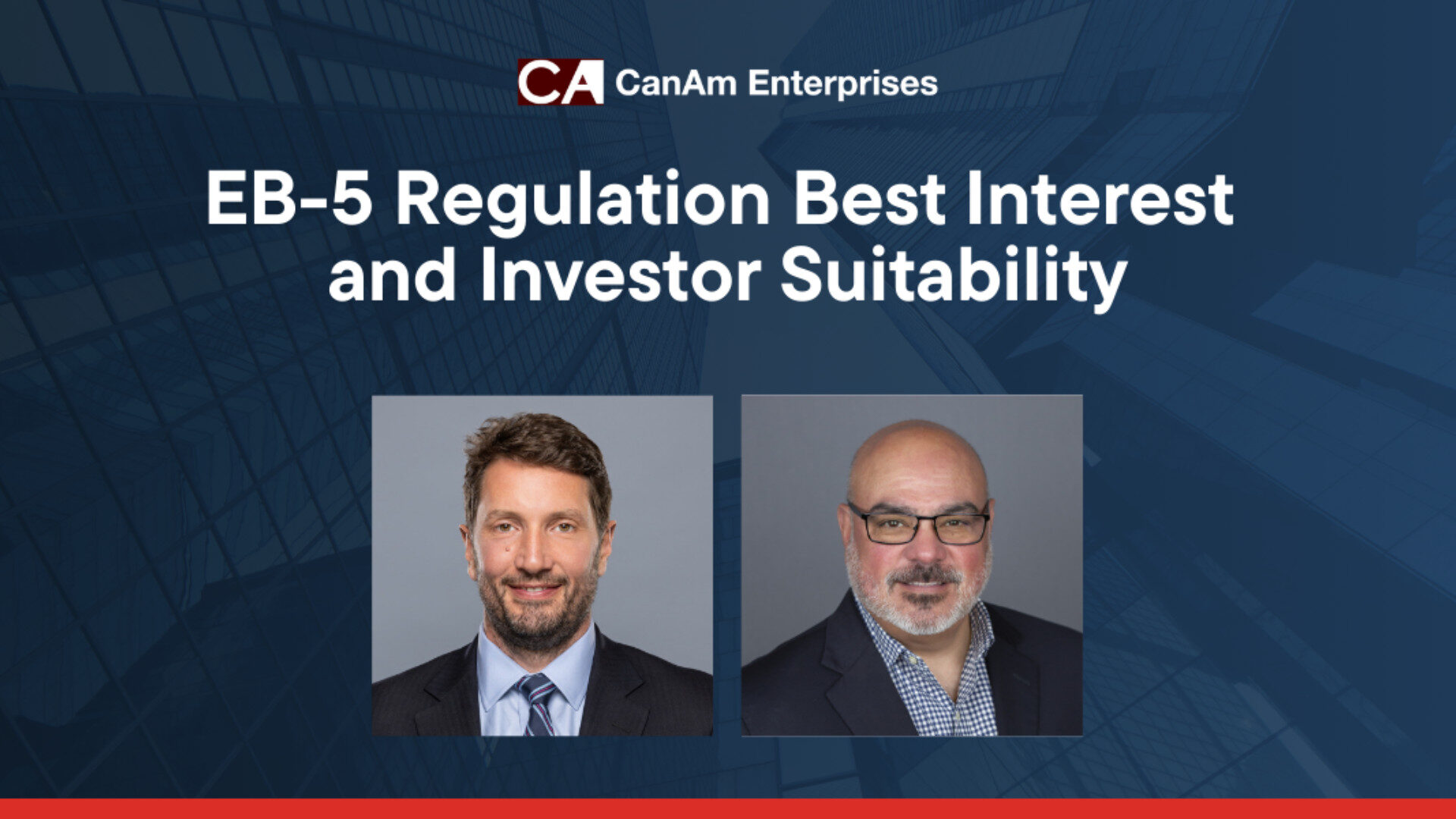
Part 3 of CanAm’s Series on EB-5 Adjudication Trends with Jen Hermansky and Pete Calabrese
“Can I use a loan to fund my EB-5 investment?”
It’s one of the most frequent—and most misunderstood—questions that investors ask. In this part of CanAm’s series on EB-5 adjudication trends, Greenberg Traurig’s Jen Hermansky and CanAm Investor Services CEO Pete Calabrese dive into how loan-based funding is being treated today by USCIS, what’s changed under the Reform and Integrity Act (RIA), and how to structure these investments correctly.
“Loans have always been a common source of EB-5 capital,” said Hermansky. “But the way USCIS reviews them has evolved—and the documentation requirements have never been higher.”
A Proven Funding Path—With More Oversight
For decades, loans have helped investors participate in the EB-5 Program without liquidating major assets. The classic example: borrowing against personal real estate and using the proceeds for the $800,000 investment.
“That’s still one of the most common approaches we see,” Hermansky explained. “It’s practical, it’s permitted, and it’s been tested through years of adjudications.”
But she cautioned that today’s EB-5 environment is more demanding. “You can still use loan proceeds, but every part of the transaction—the lender, the collateral, the repayment terms—must stand up to scrutiny.”
What the Courts Have Already Settled
Much of the confusion about loan-funded EB-5 investments stems from old litigation. Roughly a decade ago, USCIS took the position that only secured loans—those backed by the investor’s own personal assets—qualified as eligible sources of funds.
That interpretation was overturned in federal court. The court clarified that when an investor receives loan proceeds and contributes them as cash to a new commercial enterprise, that contribution counts as a valid EB-5 investment. The collateral didn’t have to be the investor’s own property.
“That ruling opened the door for unsecured loans and loans guaranteed by others,” Hermansky said. “The focus shifted from the collateral to the legitimacy of the funds themselves.”
How the Reform and Integrity Act Changed the Landscape
When Congress passed the EB-5 Reform and Integrity Act of 2022, it didn’t restrict the use of loans—but it did codify stricter expectations.
- Loans must be made in good faith. The transaction must be commercially reasonable and not designed to sidestep EB-5 requirements.
- Bank loans are simpler to document. When the loan originates from a licensed financial institution, investors are not required to trace the bank’s source of funds—only their own ability to receive and invest the proceeds.
- Non-bank loans demand full transparency. If the lender is a family member, business entity, or other non-bank, USCIS requires documentation of the lender’s lawful source of funds and, if collateral is pledged, evidence showing how that collateral was originally purchased.
“That’s where many investors underestimate the work involved,” Hermansky noted. “You may end up documenting well over $800,000 to prove both sides of the loan are legitimate.”
Affiliated or Third-Party Loans: A Gray Zone
In recent months, USCIS has been taking a closer look at loans offered by regional-center affiliates or other related entities. While such arrangements can be structured correctly, they raise red flags if they appear risk-free or artificially timed to avoid genuine capital at risk.
“USCIS is asking hard questions,” Hermansky said. “Was the loan made in good faith? Is there a realistic repayment obligation? Does the investor truly have $800,000 at risk?”
Calabrese agreed that while these structures can be legal, they must be designed carefully.
“If the repayment schedule aligns perfectly with when the EB-5 project matures, USCIS may question whether those were ever truly the investor’s own funds,” he said. “That’s not a fight anyone wants to have.”
Short-Term vs. Long-Term Loans: Why Timing Matters
USCIS appears most comfortable when loans are short-term bridge arrangements—for example, a few months to allow the investor to liquidate another asset. In those cases, the investor quickly repays the loan, and the capital at risk remains clearly theirs.
By contrast, multi-year or open-ended loans create unease for adjudicators. “If there’s no expectation that the investor will repay for several years—or if the lender is affiliated with the regional center—that starts to look less like a bona fide loan and more like a workaround,” Hermansky explained.
The Compliance Checklist: How to Do It Right
Whether your loan is secured, unsecured, from a bank, or from a family business, the same core principles apply.
- Document Everything
Include the full loan agreement, repayment schedule, proof of transfer, and evidence that the lender legally possessed the funds used for the loan. - Verify the Collateral
If assets were pledged, provide purchase records and valuations to show the collateral was legitimately obtained. - Confirm the Loan’s Purpose and Terms
The loan agreement must not prohibit transferring funds abroad or limit their use to non-EB-5 purposes. Any such restriction could make the proceeds ineligible. - Demonstrate Good-Faith Repayment
Show that repayment is required—and realistic—whether through existing income, pending sales, or other verified resources. - Coordinate With Your Immigration Counsel Early
Small variations in loan structure can have major adjudication implications. Early legal review prevents costly re-filings.
Balancing Flexibility With Risk
Loans remain a valuable tool for EB-5 investors, but they also require careful planning. As Calabrese emphasized:
“It’s not about avoiding risk—it’s about managing it. When investors understand how USCIS views these structures, they can make informed, compliant choices.”
With processing times stretching beyond a year in many cases, the stakes are higher for getting it right the first time. A denial issued after the September 2026 grandfathering deadline could mean losing the Program’s protections entirely.
The Bottom Line
EB-5 still allows significant flexibility in how investors fund their $800,000 contribution—but every pathway must stand up to the same test:
- Is the money lawfully sourced?
- Is the investor’s capital truly at risk?
- And is the structure transparent and commercially genuine?
If the answer is “yes” to all three, the case can still succeed.
“With the right preparation, loans can absolutely be used for EB-5,” Hermansky concluded. “But good structure and documentation are non-negotiable.”
What’s Next in the Series
In the next and final part of this series, CanAm and Greenberg Traurig examine another creative—but increasingly popular—funding option: self-directed IRAs.
Part 4: Alternative Paths to EB-5 Funding — Using Self-Directed IRAs and Preparing for Success