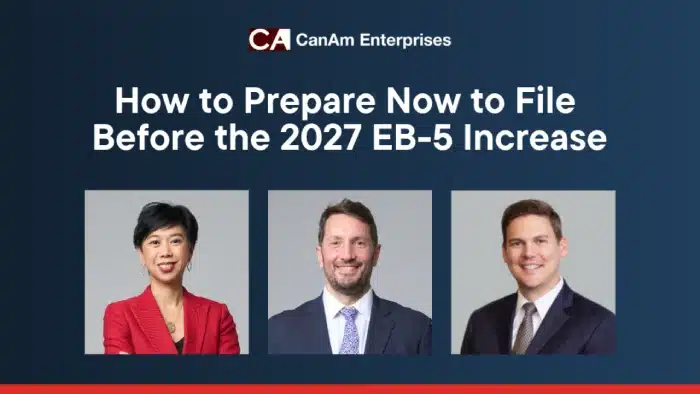
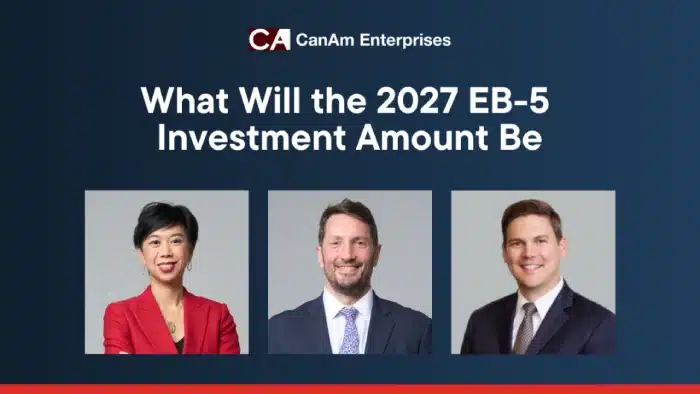
CanAm recently sat down with Jacob Ratzan, an immigration attorney specializing in business and investment cases. With nearly two decades of experience, Jacob brings a wealth of knowledge and dedication to assisting companies and individual investors in their U.S. immigration processes through commercial enterprises. Their conversation illuminated critical aspects of the EB-5 visa program, its recent updates, and its benefits.
You can watch their full conversation here.
In this blog post, we discuss some of the essential points covered in their discussion.
Understanding the EB-5 Visa
The EB-5 visa program is a gateway for foreign investors to obtain a green card by investing in new commercial enterprises in the United States. The program aims to strengthen the U.S. economy through job creation and capital investment by foreign nationals. To qualify, investors must meet one of the following financial thresholds:
– $800,000 for investments in Targeted Employment Areas (TEAs), which include rural or high-unemployment regions.
– $1.05 million for investments outside of TEAs.
The primary goal of the EB-5 program is to create at least 10 full-time jobs for U.S. workers for each EB-5 investor. This job creation requirement is a pillar of the program, ensuring that the investment contributes significantly to the U.S. economy.
Key Requirements of the EB-5 Program
To successfully apply for the EB-5 visa, investors must meet three main requirements:
- Qualifying Investment: The investment must be made in a new commercial enterprise, which can be any for-profit activity formed for the ongoing conduct of lawful business.
- Job Creation: The investment must create or preserve at least 10 full-time jobs for qualified U.S. workers within two years of the investor’s admission to the United States as a conditional permanent resident.
- Lawful Source of Funds: Investors must provide evidence that their investment capital comes from lawful sources. This requirement is crucial to ensure that funds were obtained through legal means and are available for use in the investment.
Recent Changes and Concurrent Filing
Significant updates to the EB-5 program were introduced in March 2022. One of the most notable changes is the option for concurrent filing. This update allows investors already in the U.S. on a valid visa to file an adjustment of status application concurrently with the I-526 petition. Concurrent filing offers several advantages, primarily allowing investors to remain in the U.S. and obtain work and travel permits while their application is pending.
Prior to this change, investors had to wait for the approval of their I-526 petition before beginning the adjustment of status process, a period that could extend several years. With the new concurrent filing option, both applications can be submitted simultaneously, significantly accelerating the path to permanent residency.
Benefits and Considerations of Concurrent Filing
Concurrent filing provides numerous benefits, making the EB-5 visa program even more attractive to potential investors:
– Remain in the U.S.: Investors can stay in the U.S. throughout the application process, avoiding the need to leave the country.
– Work and Travel Permits: Within approximately six months, investors can obtain work and travel permits, allowing them to live and work freely in the U.S.
– Social Security Number: Access to a Social Security number allows investors to open bank accounts, build credit, and integrate more fully into American life.
– Health Insurance: Investors become eligible for health insurance under the Affordable Care Act (Obamacare), providing essential coverage.
– Educational Benefits: Investors’ children can access educational benefits and scholarships, enhancing their opportunities for academic success.
Rural Projects and Priority Processing
A highlight of recent regulations is priority processing for investments in rural projects. These projects benefit from a lower minimum investment requirement and expedited processing times. The emphasis on rural projects aligns with the program’s goal of promoting economic growth in less developed areas of the country.
Priority processing has revitalized the EB-5 program by addressing previous backlogs and making it more attractive to investors. Faster approval times for rural projects encourage investment in these regions, promoting job creation and economic development.
Conclusion
The EB-5 visa program presents a valuable opportunity for foreign investors to achieve permanent residency in the U.S. through significant economic contributions. Recent changes, such as concurrent filing and priority processing for rural projects, have enhanced the program’s appeal and efficiency.
For those considering the EB-5 visa, consulting with experienced professionals and selecting reputable regional centers is crucial to ensuring a smooth and successful application process.

Want to learn more? Contact us below.
Error: Contact form not found.